

SEO
What Is SEO? Understanding the Power of a Complete SEO Audit
Learn what SEO is and how an SEO audit helps you identify issues, track keywords, and improve rankings.
Search engine optimisation, or SEO, is the practice of improving your website to rank higher in search engine results. At its core, an SEO audit is the foundation of any successful optimisation strategy. It reveals what is working, what is broken, and where opportunities exist. Whether you are launching a new site or trying to improve Google rankings on an established one, understanding SEO through a thorough website audit gives you the roadmap you need. This guide covers what SEO involves, why audits matter, and how to use tools like an SEO score checker to take control of your visibility online.
What Is SEO and Why Does an SEO Audit Matter?
SEO encompasses everything that helps search engines understand, index, and rank your website. This includes technical elements like site speed and mobile responsiveness, on page factors like content quality and meta tags, and off page signals like backlinks.
An SEO audit is a comprehensive review of all these elements. It identifies issues that may be holding your site back and highlights areas where you can gain an edge over competitors. Without a proper audit, you are essentially guessing at what needs fixing.
Think of it like a health check for your website. Just as a doctor runs tests before recommending treatment, an SEO audit diagnoses problems before you invest time and resources into the wrong areas.
A strong audit covers:
- Technical SEO issues such as crawl errors and indexing problems
- On page elements including title tags, headings, and internal linking
- Page speed and performance metrics
- Content quality and keyword relevance
- Backlink profile analysis
For a deeper dive into the audit process, read our Website SEO Audit: Complete Guide.
Key Components That Improve Google Rankings
Understanding what actually moves the needle helps you prioritise your efforts. Here are the main areas that impact your visibility.
Technical Health and Crawlability
Search engines need to access and understand your pages. Broken links, redirect chains, and missing sitemaps create barriers. A proper website audit uncovers these issues so you can fix them systematically.
Index status matters too. If Google cannot find your pages, they will not rank. Using tools that offer GSC URL inspection helps you check whether specific pages are indexed and identify problems like canonical mismatches.
Core Web Vitals and Page Experience
Google uses Core Web Vitals as ranking signals. These metrics measure loading performance, interactivity, and visual stability. A core web vitals audit reveals whether your pages meet the thresholds Google expects.
Poor scores here directly impact rankings. Pages that load slowly or shift around while users try to interact frustrate visitors and send negative signals to search engines. You can learn more about this in our Core Web Vitals Audit: A Practical Guide to Faster, Stronger SEO.
Content Relevance and Quality
Search engines reward content that satisfies user intent. This means your pages need to answer the questions people are actually asking. Using an SEO score checker helps you evaluate whether your content meets best practice guidelines for structure, readability, and keyword usage.
Thin content, duplicate pages, and missing meta descriptions all hurt your chances. Regular audits catch these problems before they compound.
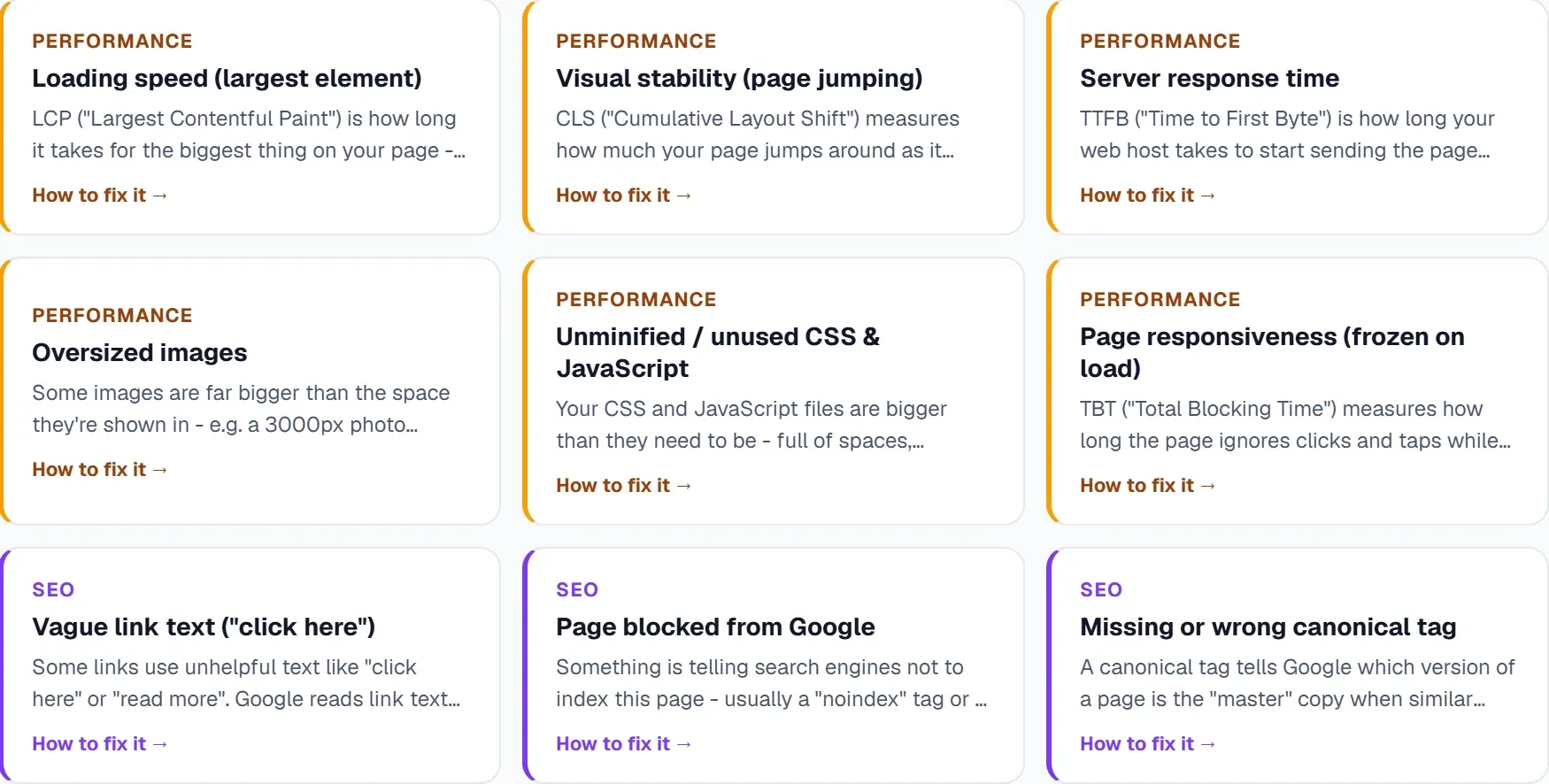 Each audit finding links to a plain-English guide on how to fix it, from loading speed to oversized images and blocked pages.
How to Check Keyword Position and Track Progress
Ranking improvements do not happen overnight. You need consistent SEO keyword monitoring to understand whether your efforts are working.
Tracking where your pages appear for target keywords gives you measurable data. Without this, you cannot know if changes made a difference or if competitors are gaining ground.
When you check keyword position regularly, patterns emerge. You might notice certain pages dropping after algorithm updates or rising after content refreshes. This information guides your next steps.
Effective keyword tracking should include:
- Position changes over time for priority terms
- Impressions and click data from search console
- Device and country breakdowns for localised strategies
- Grouping options to organise keywords by topic or campaign
Our guide on How To Track Google Rankings: A Practical Guide for SEO Monitoring covers this in detail.
Real World Example: From Audit to Results
This example shows why audits work. They remove guesswork and create a clear action plan based on real data.
How UtilitySEO Supports Your SEO Audit Process
UtilitySEO provides a complete toolkit for running and acting on audits. The platform combines scanning, tracking, and actionable recommendations in one place.
The Single URL scan delivers a deep PageSpeed and SEO audit with dual pass averaging for accuracy. For larger sites, the Full site scan crawls up to 10,000 pages (depending on plan) via sitemap and internal links, running server side to capture everything search engines see.
Results appear in the SEO results dashboard, which displays your score, categorised issues, suggested fixes, and lightbulb tips for improvement. Previous scans are saved in scan history, so you can track progress over time.
For keyword tracking, UtilitySEO connects directly to Google Search Console. The Keyword tracking feature shows GSC powered rankings, impressions, and clicks with grouping options. You can check keyword position for any term and use device and country breakdown views to understand performance in specific markets.
The Pages tab offers GSC page performance data with inline URL inspection, index status, mobile usability scores, and canonical mismatch detection. This makes running a core web vitals audit and checking technical health straightforward.
For content improvements, AI Content Quality Scoring evaluates pages against SEO best practices. The Meta Generator creates AI powered title tags and meta descriptions with SERP preview and alternatives.
You can also use the Site audit tool for technical SEO issue categorisation and the Sitemap scanner and visualiser to spot structural problems.
If you want to see how this fits into a broader strategy, explore the Workflow page or compare options on Pricing.
Take the Next Step With Your SEO
Understanding SEO starts with knowing where you stand. An SEO audit gives you that clarity. It reveals technical barriers, content gaps, and keyword opportunities you might otherwise miss.
Combine regular website audits with consistent SEO keyword monitoring, and you create a feedback loop that drives continuous improvement. The goal is not just to improve Google rankings once but to build sustainable visibility over time.
If you are ready to start, UtilitySEO offers a Start Your SEO Journey Today with a Free SEO Audit to help you get moving. Run your first scan, identify your biggest issues, and begin fixing what matters most.
Further reading
- SEO score checker
Frequently asked questions
Search engine optimization (SEO) improves your website's visibility in search results, a process an effective SEO audit is fundamental to guiding.
- Helps search engines understand, index, and rank your content.
- Involves technical, on-page, and off-page factors.
- Aims to increase organic traffic and online visibility.
An SEO audit is crucial as the foundational diagnostic tool for optimization, revealing specific issues and opportunities on your website.
- Identifies what's working and what's broken on your site.
- Provides a clear roadmap for targeted improvements.
- Prevents wasted effort on incorrect fixes.
- Diagnoses problems before investing valuable resources.
A comprehensive SEO audit examines a wide range of elements, including technical, on-page, and off-page factors for a holistic site review.
- Technical issues like crawl errors and site speed.
- On-page elements such as title tags and content quality.
- Backlink profile analysis for external signals.
- Page performance metrics and keyword relevance.
An SEO audit directly improves Google rankings by identifying and addressing specific technical and content issues that hinder search engine visibility.
- Uncovers crawlability problems preventing proper indexing.
- Highlights content gaps and keyword opportunities.
- Reveals issues with Core Web Vitals affecting user experience.
- Provides actionable insights to outrank competitors.
Core Web Vitals are Google's key ranking signals measuring user experience, and understanding them is crucial for a successful SEO audit.
- Measure loading performance, interactivity, and visual stability.
- Impact how users perceive your site's speed.
- Poor scores can negatively affect search rankings.
- An audit reveals if pages meet Google's thresholds.
Know what to fix next.
Scan your site for a clearer place to start.
About 30 seconds. No card needed.