
AI Visibility Is the Least Tested Area in SEO. That Is the Opportunity.
AI visibility testing is largely untested in SEO, presenting a critical opportunity for businesses to gain an advantage through rigorous experimentation.
AI visibility testing is significantly underrepresented in current SEO research, presenting a critical opportunity for those willing to conduct rigorous, controlled experiments. This gap means many confident pronouncements about optimising for AI answers lack empirical backing. Understanding this deficit is crucial for developing effective strategies.
The current lack of robust testing for AI visibility and answer engine optimisation evidence leaves the industry largely operating on speculation. As AI becomes more integrated into search, the businesses that move beyond untested assumptions and embrace genuine experimentation will gain a distinct advantage. This is not merely a theoretical concern; it directly impacts how brands are cited and perceived by advanced AI systems.
What Is the Current State of AI SEO Research?
The SEO industry often prioritises topics based on current trends rather than robust evidence. A recent meta study of SEO research highlights this discrepancy. The study, which analysed 1,000 SEO experiments, revealed a significant imbalance in the areas subjected to controlled testing Ovisy SEO Meta Study. For instance, content depth was tested in 36 separate experiments, title tags in 20, and internal linking in 18. These are foundational SEO elements with a substantial body of evidence supporting best practices.
In stark contrast, AI visibility testing appeared in only 10 experiments, and answer formatting in a mere 7. Geo testing, a critical component for local and international businesses, was almost entirely absent from controlled studies. This indicates a profound ai seo research gap. While AI search and answer engines are a dominant topic of discussion, the actual empirical evidence guiding optimisation efforts for them is remarkably thin. This means that many "best practices" for answer engine optimisation evidence, including those confidently stated in various checklists, remain largely untested in a controlled environment.
Why Is Geo Testing So Important for AI Visibility?
Geo testing involves isolating geographical variables to understand their impact on search and AI visibility. For businesses operating across different regions or targeting specific local markets, understanding how AI answers vary by location is paramount. An AI answer engine might provide different recommendations, citations, or summaries depending on the user's inferred location or the location specified in the prompt. Without geo testing, businesses cannot accurately assess if their content is achieving visibility in the intended markets.
The absence of controlled geo testing in AI visibility studies is a critical oversight. A real test requires a control group, a single variable being manipulated, and a willingness to publish negative results. For example, a business might test how a specific piece of content is cited by an AI in London compared to Manchester, ensuring all other variables (like prompt wording or time of day) are kept constant. Without such rigour, any confident checklist suggesting "optimise for local AI answers" remains an untested hypothesis. This makes it difficult to provide specific, actionable strategies for improving AI visibility in a geographically targeted manner.
How Can We Conduct Meaningful AI Visibility Testing?
Meaningful AI visibility testing requires a structured approach that mirrors scientific experimentation. The core principle is isolation: change only one variable at a time and observe the outcome against a control.
Here is a step by step procedure:
- Define Your Hypothesis: Start with a clear, testable statement. For example: "Adding structured data for local business information will increase citation frequency in AI answers for geo specific queries."
- Establish a Baseline (Control Group): Select a set of pages or content pieces that will not be altered. These pages represent your current state of AI visibility. Record their current mention rate across various AI models for a defined set of prompts.
- Identify a Single Variable: Choose one specific element to change. This could be:
* Adding specific schema markup (e.g., LocalBusiness, FAQPage).
* Rephrasing content to be more concise and directly answerable.
* Ensuring content is accessible to AI crawlers via robots.txt and llms.txt files.
* Optimising for specific answer formats (e.g., bullet points, numbered lists).
- Implement the Change (Test Group): Apply the chosen variable to a comparable set of pages or content pieces.
- Monitor and Measure: Track the AI visibility of both the control and test groups over a defined period. This involves:
* Prompt Selection: Use a consistent set of prompts that are representative of how users might query AI for information related to your content. Include geo specific prompts if that is your testing variable.
* Multiple AI Models: Test across major LLMs like ChatGPT, Gemini, Perplexity, and Claude. AI models can exhibit different behaviours and citation patterns.
* Recording Visibility: Document whether your brand or content is recommended, mentioned, or cited, and note the sentiment if applicable.
* Citation Churn Alerts: Set up notifications for when mention rates drop, indicating a change in AI perception.
- Analyse Results and Publish Findings: Compare the performance of the test group against the control group. A statistically significant difference in citation frequency or sentiment would indicate the impact of your variable. Crucially, be prepared to publish negative results; understanding what does not work is as valuable as knowing what does.
For example, consider a business wanting to improve its AI visibility for "best coffee shops in Edinburgh."
* Hypothesis: Adding LocalBusiness schema markup to our Edinburgh coffee shop page will increase its citation frequency in AI answers for location specific queries.
* Control: Our current Edinburgh coffee shop page, without LocalBusiness schema.
* Variable: Adding comprehensive LocalBusiness schema to the test page.
* Prompts: "What are the best coffee shops in Edinburgh?", "Recommend a coffee shop in Edinburgh," "Coffee shop near me Edinburgh."
* Measurement: Track citations on ChatGPT, Gemini, Perplexity, and Claude for both pages over four weeks.
This controlled approach moves beyond anecdotal evidence and provides concrete data on what influences AI visibility.
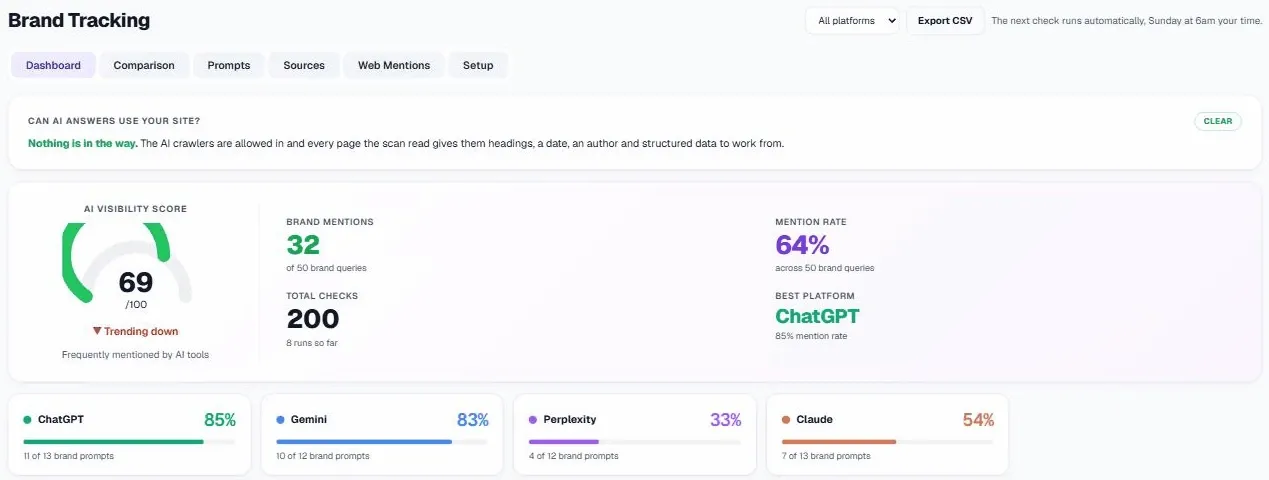
UtilitySEO's Brand Tracking feature can assist in this process by monitoring mention rates across ChatGPT, Gemini, Perplexity, and Claude. It provides a baseline AI readiness check and an AI visibility score, allowing businesses to track changes after implementing specific variables. This tool focuses on measuring the outcome of your AI visibility testing.
How Do We Know if Our AI Visibility Efforts Are Working?
Determining whether AI visibility efforts are effective requires more than just anecdotal observation. It demands consistent tracking and analysis of specific metrics. The primary goal is to see an increase in your brand's or content's mention and citation rate within AI generated answers.
Here are key indicators to monitor:
* Increased Mention Rate: The most direct indicator is a higher frequency of your brand, product, or content being explicitly mentioned or recommended by AI models. This needs to be tracked across multiple AI platforms (ChatGPT, Gemini, Perplexity, Claude) as their citation behaviour can differ. UtilitySEO's Brand Tracking feature provides per prompt trends and overall mention rates across these LLMs, offering a clear view of this metric.
* Positive Sentiment: Beyond mere mentions, the sentiment associated with those mentions is crucial. Is the AI presenting your brand favourably? Sentiment analysis on brand mentions helps gauge the quality of AI visibility, not just the quantity. A positive sentiment suggests the AI is correctly understanding and valuing your brand.
* Direct AI Referral Traffic: While AI answers often do not provide direct clickable links, some answer engines, like Perplexity, do. Tracking AI referral traffic specifically from these sources can provide direct evidence of your content being used and driving users to your site. This requires careful configuration in analytics platforms.
* Improved Citation Quality: Look for instances where the AI provides more detailed or accurate information about your offerings, or where it directly cites your website as a source. This indicates that the AI has a deeper understanding of your content.
* Reduced Citation Churn: Consistent AI visibility means your mention rate should be stable or growing, not fluctuating wildly. Alerts for citation churn can highlight when your brand's presence in AI answers drops unexpectedly, prompting investigation.
* Correlation with Traditional SEO Metrics: While AI visibility is distinct, it can sometimes correlate with traditional SEO performance. For instance, if content optimised for AI answers also becomes more concise and authoritative, it might indirectly improve organic search rankings. However, this is an observation, not a direct measure of AI visibility itself.
It is important to remember that AI visibility is not a static target. AI models are constantly evolving, and their training data and algorithms change. Therefore, continuous ai visibility testing and monitoring are essential. The goal is to establish a feedback loop where you test a specific change, measure its impact on AI mentions and sentiment, and then refine your strategy based on the evidence. Without this systematic approach, efforts to gain answer engine optimisation evidence remain speculative.
The current landscape of SEO research reveals a significant void in the area of AI visibility testing. While AI answer engines are a major industry topic, the empirical evidence supporting optimisation strategies is limited, particularly for geo testing and specific answer formats. This gap presents a unique opportunity for businesses to conduct rigorous, controlled experiments, moving beyond assumptions to data driven insights. By implementing structured tests with control groups, single variables, and transparent reporting, organisations can genuinely understand and improve their AI visibility.
Free AEO Scan: checks how ready a site is to be cited by AI answer engines.
Frequently asked questions
how do i start ai visibility testing for my website
Starting ai visibility testing involves creating controlled experiments that isolate variables affecting AI answer rankings.
- Define a single hypothesis per test
- Use identical content across regions
- Measure AI citations and rankings
- Document both positive and negative results
why is geo testing essential for ai visibility testing
Geo testing is essential for ai visibility testing because AI answers can differ based on user location.
- Isolate geographic variable only
- Compare AI responses across regions
- Keep content and prompts constant
- Analyze citation differences per location
what metrics should i track during ai visibility testing
Key metrics for ai visibility testing include citation frequency, answer ranking position, and relevance score.
- Number of AI citations per page
- Position in AI-generated answer list
- Relevance rating from AI feedback
- Conversion rates from AI traffic
can i use existing SEO tools for ai visibility testing
You can adapt existing SEO tools for ai visibility testing by focusing on AI-specific output data.
- Export AI answer snippets
- Track changes over time
- Integrate geo-targeting filters
- Compare against baseline SEO metrics
is ai visibility testing worth the investment for small businesses
AI visibility testing is worth the investment for small businesses because it uncovers untapped traffic sources.
- Identify niche AI answer opportunities
- Optimize content for AI citations
- Reduce reliance on traditional rankings
- Gain competitive edge in local markets
Keep reading
See how your site actually scores
Free 30-second scan, real Google scores and a ranked fix list. No signup needed.
No credit card · Cancel anytime