

SEO
SEO Keyword Monitoring: Complete Guide
A complete guide to SEO keyword monitoring covering tools, techniques, and best practices for tracking rankings effectively.
Understanding where your website ranks for important search terms is fundamental to any successful SEO strategy. SEO keyword monitoring gives you the visibility needed to track progress, identify opportunities, and respond to changes in search engine results. Without consistent monitoring, you are essentially working blind, unable to measure the impact of your optimisation efforts or spot declining positions before they affect traffic. This guide covers everything you need to know about tracking keywords effectively, from choosing the right rank tracking software to interpreting the data and taking action on your findings.
What Is SEO Keyword Monitoring and Why Does It Matter?
SEO keyword monitoring is the practice of regularly tracking where your web pages appear in search engine results for specific search terms. It involves recording positions over time, analysing trends, and using that data to inform your SEO strategy.
When done properly, keyword monitoring helps you:
- Measure SEO performance against concrete benchmarks
- Identify ranking drops before they significantly impact traffic
- Spot new ranking opportunities for related terms
- Track competitor movements in your target keywords
- Validate the effectiveness of content updates and technical fixes
Many website owners find themselves asking why is my website not ranking for terms they have targeted. Often, the answer lies in inconsistent monitoring. Without tracking data, it is impossible to know whether rankings have dropped, never improved, or are simply fluctuating due to algorithm updates. A reliable keyword rank tracker removes this uncertainty by providing historical data you can analyse.
For a deeper look at troubleshooting ranking issues, see Why Is My Website Not Ranking? A Practical SEO Troubleshooting Guide.
Choosing the Right Rank Tracking Software
Not all rank tracking software is created equal. The best tools provide accurate, frequent data while making it easy to interpret results and take action.
Key Features to Look For
Accuracy and freshness should be your top priorities. Rankings can shift daily, so tools that only update weekly may miss important movements. Look for platforms that pull data directly from reliable sources like Google Search Console.
Device and location segmentation matters because rankings differ between mobile and desktop, and across geographic regions. A keyword might rank fifth on mobile in the UK but fifteenth on desktop in the US.
Grouping and organisation becomes essential as you scale. Managing hundreds of keywords without categorisation leads to analysis paralysis. The ability to create keyword groups and move terms between them keeps your tracking organised.
Historical data allows you to identify patterns and correlate ranking changes with specific actions or algorithm updates. Without history, every data point exists in isolation.
Common Mistakes When Selecting Tools
Many businesses choose rank tracking software based solely on price or brand recognition. This often leads to frustration when the tool lacks critical features or provides unreliable data.
Another frequent mistake is tracking too few keywords. Monitoring only your top five terms misses the long tail opportunities that often drive significant traffic. Equally problematic is tracking thousands of keywords without a clear strategy, creating noise that obscures meaningful signals.
For more guidance on effective tracking approaches, read How To Track Google Rankings: A Practical Guide for SEO Monitoring.
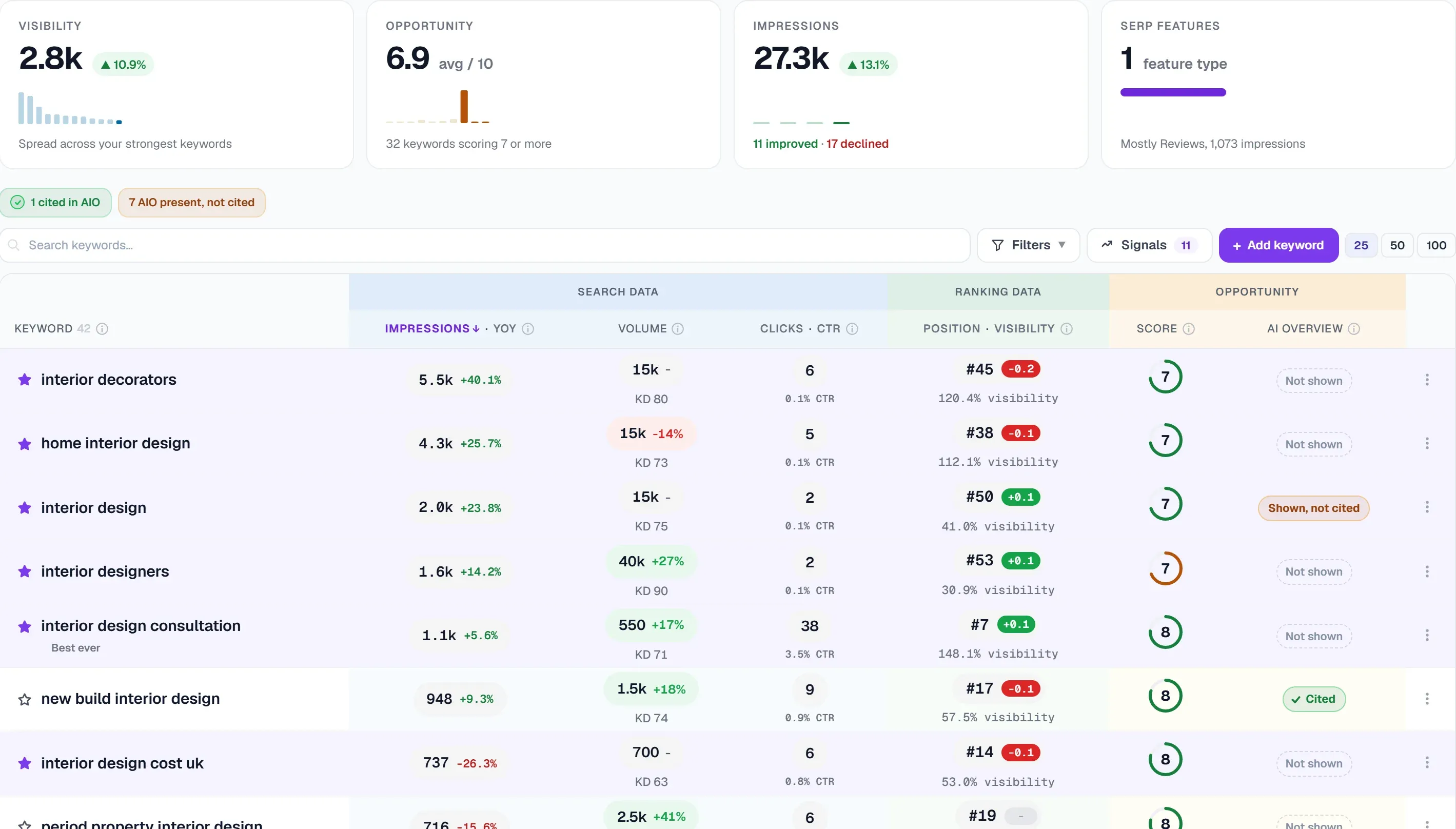 The keyword tracking panel shows visibility, an opportunity score and impressions above the full list of tracked keywords.
Integrating Technical SEO Audit Data With Keyword Tracking
Keyword positions do not exist in a vacuum. They are influenced heavily by technical factors that a technical SEO audit can uncover. Combining ranking data with technical insights creates a complete picture of your SEO health.
Why Technical Issues Affect Rankings
Google cannot rank pages it cannot properly crawl, index, or render. Common technical problems include:
- Slow page speed causing poor user experience signals
- Indexation issues preventing pages from appearing in results
- Mobile usability problems hurting rankings on mobile searches
- Canonical misconfigurations splitting ranking signals between URLs
- Sitemap errors preventing efficient crawling
When you notice a keyword dropping, your first instinct might be to add more content or build links. However, running a technical SEO audit often reveals the true cause is a crawl error, a broken redirect, or a mobile rendering issue.
Building a Holistic Monitoring Approach
The most effective SEO practitioners monitor both rankings and technical health simultaneously. When rankings drop, they can quickly check whether a technical issue emerged at the same time. When technical fixes are implemented, they can measure the ranking impact over subsequent weeks.
This integrated approach prevents wasted effort. There is no point optimising content for a page that Google cannot properly index. Equally, fixing technical issues matters little if your content does not target the right keywords.
Learn more about identifying technical problems in Website SEO Audit: How to Identify and Fix Technical SEO Problems.
How UtilitySEO Supports Comprehensive Keyword Monitoring
UtilitySEO brings together SEO keyword monitoring and technical auditing in a single platform, eliminating the need to switch between multiple tools.
GSC Powered Keyword Tracking
The keyword tracking feature pulls data directly from Google Search Console, providing rankings, impressions, and clicks for your tracked terms. You can organise keywords into groups, renaming and reorganising them as your strategy evolves. The device and country breakdown shows exactly how each keyword performs across different segments, removing guesswork about regional or mobile performance.
Pages Tab and Index Status
The Pages tab displays GSC page performance alongside URL inspection data, index status, mobile usability checks, and canonical mismatch detection. This means when a keyword drops, you can immediately check whether the ranking page has developed technical issues affecting its visibility.
Site Audit for Technical Health
The site audit feature runs a full technical SEO audit with issue categorisation, identifying problems that might be suppressing your rankings. Issues are prioritised so you can focus on fixes with the highest impact first.
Trends and Historical Analysis
The Trends tab shows search performance over time, from three days to two years. This historical view helps you correlate ranking changes with algorithm updates, content modifications, or technical fixes, turning raw data into actionable insights.
Progress Tracking
The issue tracking system lets you pin problems from scan results and mark them as fixed. The progress dashboard shows milestones, fix rates by priority, and daily scan streaks, helping teams stay accountable and measure improvement over time.
For teams managing multiple websites, UtilitySEO supports separate projects with their own data, making enterprise level monitoring accessible. Explore the Workflow to see how these features connect.
Real World Examples of Effective Keyword Monitoring
Example One: Catching a Ranking Drop Early
A B2B software company noticed their primary keyword dropped from position four to position twelve over two weeks. Their keyword rank tracker alerted them immediately. Investigation revealed a recent site migration had introduced canonical tags pointing to the wrong URL. Fixing this issue restored rankings within ten days. Without monitoring, they might not have noticed the problem until organic traffic had significantly declined.
Example Two: Validating Content Updates
An ecommerce site updated product category pages with better descriptions and structured data. Their rank tracking software showed positions for category related keywords improving from an average of eighteen to an average of nine over six weeks. This data justified further investment in content improvements and provided benchmarks for future updates.
Example Three: Identifying Algorithm Volatility
A news publisher saw rankings fluctuate wildly over a two week period. Historical tracking data showed the same pattern affecting competitors, indicating a Google algorithm update rather than a site specific issue. Instead of making reactive changes, they waited for volatility to settle. Rankings stabilised without intervention, avoiding unnecessary optimisation that might have caused more harm.
Taking Action on Keyword Monitoring Data
Collecting data is only valuable if you act on it. Here is how to turn monitoring insights into improvements.
Set up alerts for significant position changes. Drops of five or more positions for important keywords warrant immediate investigation. Similarly, unexpected gains should be analysed to understand what worked.
Review weekly or fortnightly rather than daily. Daily fluctuations are normal and create noise. Weekly reviews provide enough frequency to catch trends without triggering overreaction to temporary movements.
Correlate with other data sources. When rankings change, check your technical SEO audit results, content modifications, and link profile changes. Understanding why rankings moved is more valuable than simply knowing they moved.
Prioritise based on impact. A position drop from second to third for a high volume keyword matters more than dropping from fifteenth to twentieth for a low volume term. Focus your efforts where the traffic impact is greatest.
Document everything. Keep records of ranking changes, potential causes, and actions taken. This institutional knowledge helps you respond faster to future issues and build an understanding of how your site responds to different types of changes.
For ongoing SEO maintenance strategies, SEO Health Check, Complete Guide 2 offers additional practical guidance.
Conclusion
Effective SEO keyword monitoring transforms guesswork into strategy. By consistently tracking positions, understanding the technical factors that influence rankings, and taking data driven action, you can steadily improve your search visibility over time.
The key is choosing rank tracking software that provides accurate, segmented data and integrating that data with technical health monitoring. This combination lets you diagnose problems quickly, validate improvements confidently, and allocate resources wisely.
UtilitySEO offers the tools needed for this integrated approach, from GSC powered keyword tracking with device and country breakdowns to comprehensive site audits and historical trend analysis. Start monitoring your keywords properly today and take control of your search performance. Check out the Pricing to find a plan that fits your needs.
Frequently asked questions
SEO keyword monitoring is the practice of regularly tracking where your web pages appear in search engine results, which is fundamental for understanding SEO performance.
- Measures how well your SEO efforts are working.
- Helps identify sudden ranking drops quickly.
- Reveals new opportunities for ranking higher.
- Provides data to validate content and technical updates.
To choose the best software for SEO keyword monitoring, prioritize tools that offer high accuracy, frequent data updates, and detailed segmentation options.
- Look for daily updates, not just weekly.
- Ensure it tracks mobile and desktop rankings.
- Check for location-specific ranking data.
- Verify data sources for reliability.
Consistent SEO keyword monitoring is essential because it provides critical visibility into your website's performance, preventing you from working blind on your SEO efforts.
- Measures the impact of your optimization work.
- Helps spot declining positions before traffic drops.
- Identifies new ranking opportunities effectively.
- Allows tracking competitor movements in search results.
The main benefits of SEO keyword monitoring include measuring performance against benchmarks, identifying ranking drops, and spotting new opportunities to improve visibility.
- Clearly tracks your website's progress over time.
- Helps you react quickly to algorithm changes.
- Uncovers terms where you could rank higher.
- Validates the success of content or technical changes.
Know what to fix next.
Scan your site for a clearer place to start.
About 30 seconds. No card needed.