

SEO
Improve Google Rankings: Complete Guide
A realistic roadmap to improve Google rankings based on your budget, timeline, and industry type.
Getting your website to rank higher on Google is not just about following a checklist. It requires understanding your specific starting point, setting realistic expectations, and knowing exactly where to focus your limited time and resources. This guide takes a different approach. Rather than repeating generic advice, we will show you what ranking improvements you can realistically expect based on your budget, timeline, and industry type. Whether you are a small business owner with an hour per week or an agency managing multiple clients, you will learn which tactics deliver genuine returns and which waste your time. By the end, you will have a practical roadmap to improve Google rankings in a sustainable, measurable way.
Understanding What Actually Moves Rankings Today
Before diving into tactics, you need to understand that Google treats different websites differently. A health website faces far stricter scrutiny than a hobby blog because of YMYL (Your Money or Your Life) classification. E-commerce sites compete on different factors than local service businesses. This matters because the same tactic might deliver results in two weeks for one site and six months for another.
The key ranking factors remain consistent: relevance, authority, and user experience. However, the weight given to each varies by industry. Local businesses benefit enormously from Google Business Profile optimisation and reviews. E-commerce sites need strong product schema and fast page speeds. Content publishers require topical authority and freshness.
When you use rank tracking software effectively, you start seeing these patterns emerge. Position changes after specific actions reveal what Google values for your specific niche. This observational data becomes your personalised ranking playbook.
The Diminishing Returns Reality
Most guides skip an uncomfortable truth: there is a ceiling to how much you can gain from any single tactic. Optimising title tags might lift you from position 15 to position 8, but endlessly tweaking them will not get you to position 1. Knowing when to move on saves enormous amounts of wasted effort.
The typical progression looks like this:
- Technical fixes deliver the fastest initial gains
- On page optimisation compounds those gains
- Content depth and quality push into top positions
- Authority building (backlinks, brand signals) maintains those positions
Understanding this sequence helps you prioritise correctly at each stage.
Realistic Timelines by Competition Level
Here is what most guides avoid: concrete timeline expectations. These ranges assume consistent effort and no major technical issues holding you back.
Low competition keywords (fewer than 1,000 monthly searches, minimal established competitors):
- Initial movement: 2 to 4 weeks
- First page rankings: 1 to 3 months
- Stable top 5 positions: 3 to 6 months
Medium competition keywords (1,000 to 10,000 monthly searches, established competitors):
- Initial movement: 4 to 8 weeks
- First page rankings: 3 to 6 months
- Stable top 5 positions: 6 to 12 months
High competition keywords (10,000+ monthly searches, authoritative competitors):
- Initial movement: 2 to 4 months
- First page rankings: 6 to 18 months
- Stable top 5 positions: 12 to 24 months
These timelines assume you are starting with a reasonably healthy website. If your site has technical SEO issues to fix, add time for resolving those first.
Budget Segmented Strategies
What you can achieve depends heavily on available resources. Here is an honest breakdown:
Zero budget (time only, roughly 2 to 5 hours per week):
- Conduct a free SEO audit to identify priority fixes
- Optimise existing content for better keyword targeting
- Improve internal linking structure
- Fix technical issues using Google Search Console data
- Expected results: Incremental gains on low competition terms over 3 to 6 months
Small budget (under £100 per month):
- Everything above, plus:
- Basic rank tracking software to monitor progress
- AI tools for content improvement suggestions
- More efficient workflow through proper tooling
- Expected results: Faster identification of opportunities, better prioritisation
Moderate budget (£100 to £500 per month):
- Everything above, plus:
- Comprehensive site audit tools (WordPress SEO audit or Shopify SEO audit capabilities)
- Content creation support
- Limited link building outreach
- Expected results: Competitive for medium competition keywords within 6 months
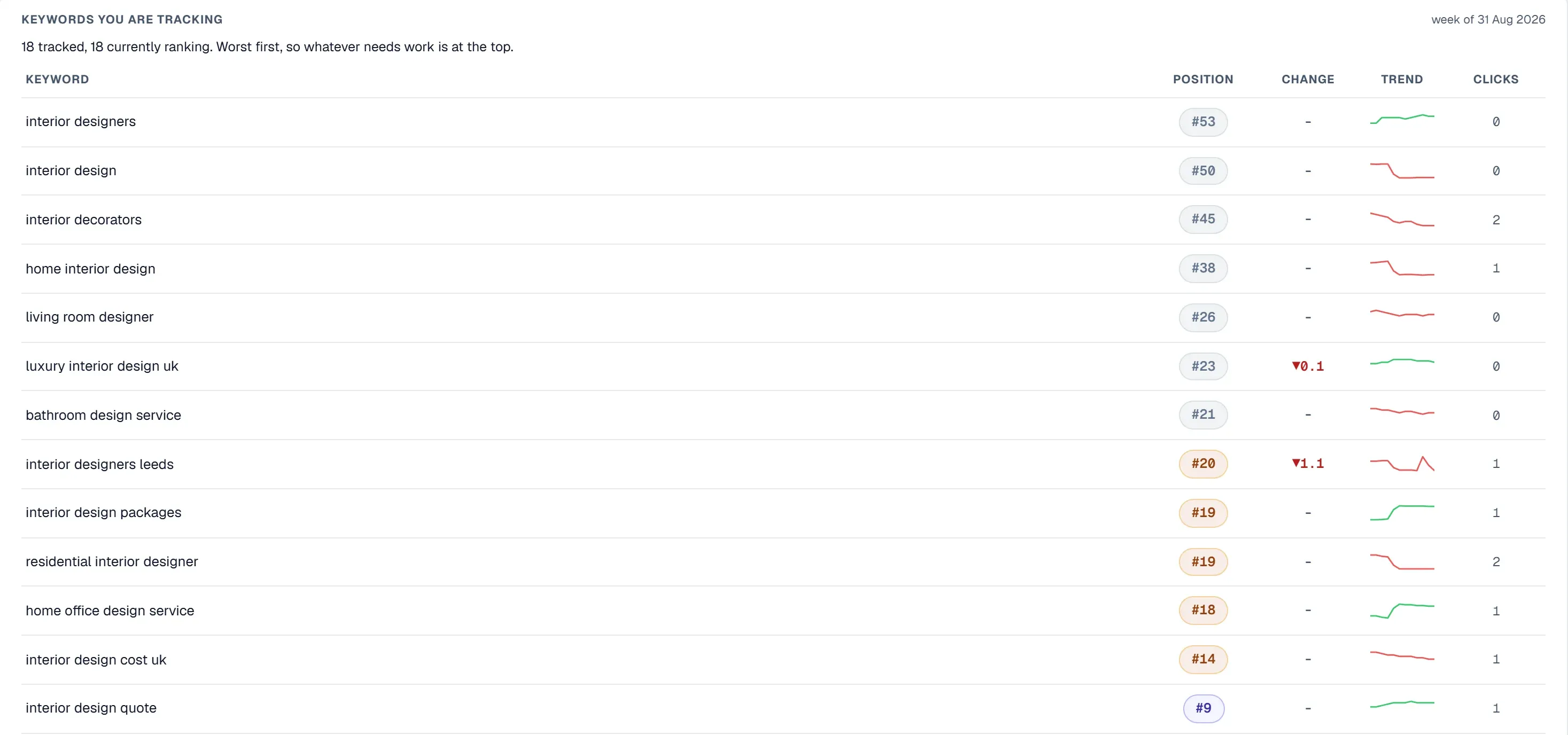 Tracked keywords with their position, change, a trend sparkline and clicks, worst first.
How to Improve Google Rankings with a Structured Workflow
Successful ranking improvement follows a predictable pattern. The mistake most people make is jumping straight to content creation without fixing foundational issues first.
Phase 1: Technical Foundation (Weeks 1 to 2)
Start with a complete technical audit. This catches issues that silently sabotage your efforts. Common problems include:
- Sitemap errors preventing proper crawling
- Robots.txt issues blocking important pages
- Mobile usability failures
- Core Web Vitals underperformance
- Canonical mismatches causing duplicate content
Many site owners skip straight to content improvements without realising their pages are not being indexed correctly. Using a Google Search Console alternative alongside GSC itself often reveals issues the standard interface obscures.
Phase 2: On Page Optimisation (Weeks 2 to 4)
With technical issues resolved, focus shifts to individual pages. Priority order:
- Pages already ranking positions 5 to 20 (quick wins)
- High value commercial pages
- Top traffic pages
- Everything else
For each page, check title tag relevance, meta description click appeal, heading structure, and keyword usage. Tools with AI meta generators can suggest improvements efficiently.
Phase 3: Content Depth and Quality (Ongoing)
Google increasingly rewards comprehensive, accurate content. This phase involves:
- Identifying thin pages needing expansion
- Adding supporting content that builds topical authority
- Refreshing outdated information
- Improving readability and structure
Content quality scoring helps prioritise which pages need attention most urgently. Rather than subjectively judging your content, automated scoring against SEO best practices provides actionable feedback.
Phase 4: Authority Building (Ongoing)
Backlinks remain important, but the approach matters. Modern link building focuses on:
- Creating linkable assets (research, tools, comprehensive guides)
- Digital PR and expert commentary
- Industry relationships and guest contributions
- Broken link building strategies
This phase runs continuously alongside content improvements.
What Not to Waste Time On
Protecting your time matters as much as knowing what to do. Here are common time wasters that deliver minimal ranking improvement:
Over optimising keyword density: Natural writing outperforms keyword stuffing. If your content reads awkwardly, you have gone too far.
Chasing every algorithm update: Minor fluctuations are normal. Only respond to confirmed major updates with substantial ranking changes lasting more than two weeks.
Obsessing over domain authority metrics: These are third party estimates, not Google metrics. Focus on actual ranking performance instead.
Building low quality links: One relevant, authoritative link outweighs dozens of directory submissions or forum spam.
Ignoring user experience signals: If visitors bounce immediately, no amount of technical optimisation will help. Content must satisfy search intent.
Protecting Existing Rankings
As you gain rankings, protecting them becomes important. Algorithm updates can cause volatility. Here is how to maintain stability:
- Diversify traffic sources so you are not entirely Google dependent
- Build genuine brand awareness (brand searches correlate with ranking stability)
- Maintain content freshness with regular updates
- Monitor for negative SEO attacks (sudden spammy backlink influxes)
- Keep technical health consistent
Regular monitoring through rank tracking software alerts you to problems before they become crises.
Using UtilitySEO to Streamline Your Ranking Improvement
Managing all these moving parts becomes complex quickly. UtilitySEO consolidates the essential functions into a single dashboard, eliminating the need to juggle multiple tools.
For the technical foundation phase, full site scans crawl up to 10,000 pages (depending on plan) via sitemap and internal links, identifying issues across categories. The SEO results dashboard shows scores, issues, fixes, and category filters, so you can systematically work through problems. Scan history saves previous scans, letting you track improvement over time.
During on page optimisation, the Meta Generator creates AI powered title tags and meta descriptions with SERP preview, helping you craft click worthy snippets efficiently. The Alt text generator handles image optimisation with suggest buttons on affected pages.
For ongoing monitoring, keyword tracking pulls GSC powered rankings, impressions, and clicks with grouping capabilities. Device and country breakdown shows how performance varies across different segments. The Pages tab includes GSC URL inspection, index status, mobile usability, and canonical mismatch detection, all accessible inline without switching between tools.
The AI Insights feature provides automated recommendations specific to your site, while AI Content Quality Scoring evaluates pages against SEO best practices. This gives you objective feedback rather than guesswork about content quality.
The Progress dashboard tracks milestones, streaks, and fix rate by priority, helping teams stay accountable. You can pin issues from scan results and mark them as fixed, creating a structured workflow for continuous improvement.
For agencies and teams, multi project support keeps data separate per project, while workspace dashboard handles team management with role based access.
Industry Specific Considerations
Your industry significantly impacts which tactics to prioritise.
E-commerce (Shopify, WooCommerce):
- Why product schema markup matters
- Category page optimisation often outperforms individual product pages
- Site speed directly impacts conversions and rankings
- Shopify SEO audit tools help identify platform specific issues
- Faceted navigation can create duplicate content problems
WordPress content sites:
- Plugin conflicts frequently cause technical issues
- Image optimisation typically offers major speed gains
- WordPress SEO audit reveals plugin related problems
- Internal linking structure deserves careful attention
Local service businesses:
- Google Business Profile optimisation delivers fastest initial results
- Reviews and NAP consistency matter enormously
- Local pack rankings require different tactics than organic rankings
- Service area pages need careful handling to avoid thin content
YMYL industries (health, finance, legal):
- E-E-A-T signals receive heightened scrutiny
- Author credentials and expertise demonstration matter
- Accuracy and citations become ranking factors
- Timeline expectations should double compared to other industries
Measuring What Matters
Tracking the right metrics prevents wasted effort on vanity numbers.
Primary metrics:
- Organic traffic (sessions, not just users)
- Ranking positions for target keywords
- Conversions from organic search
- Click through rates from search results
Secondary metrics:
- Impressions (visibility)
- Pages indexed
- Crawl stats
- Core Web Vitals scores
Vanity metrics to downweight:
- Domain authority/rating (useful for comparison only)
- Total backlink count (quality matters more)
- Keyword difficulty scores (these vary wildly between tools)
The Trends tab in UtilitySEO shows search performance over time, from 3 days to 2 years. GA4 analytics integration displays organic traffic, sessions, conversions, and top pages, connecting ranking improvements to actual business outcomes.
Traffic forecast based on keyword data helps set realistic expectations for what improved rankings might actually deliver in visits.
Building a Competitive Moat
The final consideration is sustainability. Reaching first page positions is meaningless if competitors easily copy your approach and overtake you.
Sustainable ranking advantages come from:
Proprietary data and research: Original statistics get linked to and cited.
Brand recognition: Sites people trust receive better engagement metrics.
Speed of execution: Responding to trends faster than competitors.
Accumulated authority: Years of consistent quality content creates a backlink profile difficult to replicate quickly.
Technical excellence: Consistently fast, accessible, well structured sites outperform neglected competitors.
Brand tracking features monitor how your brand appears across AI platforms like ChatGPT, Gemini, and Perplexity. As AI search becomes more prominent, understanding your AI visibility alongside traditional search visibility becomes increasingly important.
Getting Started Today
Improving Google rankings requires consistent effort over time, but the path forward should now be clearer. Start with a technical audit to identify any foundation issues. Move to on page optimisation of your most promising pages. Develop content depth systematically. Build authority gradually.
Track everything so you know what works specifically for your site. Use proper rank tracking to measure progress rather than guessing.
If you want a unified platform that handles technical audits, keyword tracking, content scoring, and progress tracking in one place, explore what UtilitySEO offers. View pricing to find a plan matching your needs, or start with a free audit to see your current standing.
Frequently asked questions
To realistically improve Google rankings, you need a tailored approach that considers your budget, timeline, and industry, moving beyond generic advice to focus on impactful strategies.
- Understand your specific starting point and competition.
- Prioritize tactics that offer genuine returns for your niche.
- Use observational data to create a personalized ranking playbook.
- Avoid endlessly tweaking single, less effective tactics.
The most important factors that influence Google rankings consistently revolve around relevance, authority, and user experience, though their weight varies by industry.
- Google treats different websites differently based on their type.
- YMYL classification impacts scrutiny for health or financial sites.
- Local businesses thrive on Google Business Profile and reviews.
- E-commerce sites need strong product schema and fast page speeds.
The best sequence of SEO tactics to improve Google rankings sustainably typically starts with foundational technical fixes before moving to content and authority building.
- Technical fixes often provide the fastest initial gains.
- On-page optimization helps to compound those early improvements.
- Deep, high-quality content pushes your site into top positions.
- Authority building, like backlinks, helps maintain high rankings.
Some SEO tactics eventually stop improving Google rankings due to the reality of diminishing returns, meaning there's a ceiling to gains from any single optimization.
- Optimizing title tags might only move you so far.
- Endless tweaking of one element wastes valuable effort.
- Focus should shift to other areas once initial gains are made.
- Prioritize new tactics that offer fresh opportunities for growth.
Know what to fix next.
Scan your site for a clearer place to start.
About 30 seconds. No card needed.