

SEO
Keyword Rank Tracker: Complete Guide
A complete guide to keyword rank tracking covering benefits, tool selection, and practical workflows for SEO monitoring.
Understanding where your website ranks for specific search terms is fundamental to any successful SEO strategy. A keyword rank tracker allows you to monitor your positions in search engine results pages over time, giving you clear visibility into what is working and what needs improvement. Without accurate tracking, you are essentially guessing whether your optimisation efforts are paying off. This guide explores how rank tracking works, why it matters for your business, and how to choose the right tools to monitor your search performance effectively. Whether you run a small blog or manage multiple client websites, consistent rank monitoring should be part of your workflow.
What Is a Keyword Rank Tracker and Why Does It Matter?
A keyword rank tracker is a tool that monitors where your web pages appear in search results for specific queries. Instead of manually searching Google every day, these tools automate the process and store historical data so you can spot trends over time.
The Core Function of Rank Tracking
At its simplest, rank tracking tells you the position of your URL for a given keyword. But modern tools go much further. They track rankings across different devices, locations, and search engines. They show you how positions change week over week and alert you when significant shifts occur.
This data becomes especially valuable when you combine it with other SEO insights. For example, knowing that a keyword dropped from position 5 to position 15 is useful. Knowing that this happened after a competitor published stronger content is actionable.
Why Rankings Still Matter
Some marketers argue that rankings are a vanity metric. They prefer to focus solely on traffic and conversions. While those outcomes are important, rankings provide leading indicators. A drop in position often precedes a drop in traffic. Catching that early gives you time to respond.
Rankings also help you understand the competitive landscape. If you see competitors consistently outranking you for valuable terms, you can analyse their approach and adjust your strategy.
Key Benefits of Using an SEO Monitoring Tool for Rank Tracking
An effective seo monitoring tool does more than check positions. It provides context that helps you make better decisions about your content and technical SEO.
Track Progress Over Time
One snapshot of your rankings tells you very little. What you need is trend data. Are your positions improving month over month? Did a recent algorithm update affect your visibility? An seo monitoring tool with historical data answers these questions.
When you can see your ranking trajectory over weeks or months, you can correlate changes with specific actions. Perhaps you updated a blog post and saw a position increase two weeks later. That feedback loop helps you refine your approach.
Identify Opportunities and Threats
Rank tracking reveals keywords where you are close to breaking onto page one. These are often your biggest opportunities. A keyword sitting at position 12 might need just a small content improvement to reach the top ten and start driving meaningful traffic.
Similarly, tracking alerts you to threats. If a previously stable keyword suddenly drops, you can investigate before traffic disappears entirely. This early warning system is invaluable for maintaining search visibility.
Measure the Impact of SEO Changes
Every time you make changes to your site, whether technical fixes, content updates, or link building efforts, you need a way to measure impact. Rank tracking provides that measurement. It closes the loop between action and outcome.
For those running a website SEO audit or implementing technical fixes, tracking positions helps validate that your changes are having the intended effect.
Choosing the Right Tools: From Google Search Console Alternative Options to Specialised Trackers
The market offers many approaches to rank tracking, from free tools to enterprise platforms. Understanding your options helps you choose the right fit.
Google Search Console Basics
Google Search Console provides ranking data directly from Google. It shows average positions, impressions, and clicks for queries where your site appeared. This data is valuable because it comes straight from the source.
However, Search Console has limitations. Data is delayed by a few days. Average positions can mask significant fluctuations. And you cannot track competitors or keywords you do not yet rank for.
Why Consider a Google Search Console Alternative
A google search console alternative often provides features that GSC lacks. Daily or real time position updates give you fresher data. Competitor tracking lets you benchmark against rivals. Custom keyword lists allow you to monitor terms that matter most to your business, even if you do not rank for them yet.
Many SEO professionals use GSC alongside other tools, getting the best of both approaches. The combination of GSC's authoritative data with a dedicated tracker's flexibility creates a comprehensive view.
What to Look for in Tracking Software
When evaluating options, consider these factors:
Data freshness determines how quickly you see position changes. Daily updates are standard, but some situations require more frequent monitoring.
Device and location tracking matters if your audience spans multiple regions or uses different devices. Mobile and desktop rankings often differ significantly.
Integration capabilities affect how easily you can combine rank data with analytics, audit findings, and other SEO metrics.
Historical depth determines how far back you can look when analysing trends.
Real World Applications: From Shopify SEO Audit to Enterprise Campaigns
Rank tracking applies across all types of websites and business models. The specific approach varies based on your situation.
Ecommerce and Shopify Sites
For ecommerce businesses, tracking product and category page rankings directly impacts revenue. A shopify seo audit often reveals that important product pages are not ranking as well as they should. Continuous monitoring helps you prioritise which pages need attention.
Shopify sites face unique challenges. Duplicate content from collection filtering, thin product descriptions, and limited technical SEO controls all affect rankings. Tracking positions helps you identify which issues are actually hurting visibility versus which are theoretical concerns.
If you are running an online store, consider reading more about Shopify SEO audit approaches to understand common challenges and solutions.
Agency and Multi Site Management
Agencies managing multiple client sites need scalable tracking solutions. Per project organisation, team access controls, and client reporting capabilities become essential at this scale.
Tracking also supports client communication. When you can show a client that their target keywords have improved from page three to page one over six months, the value of your work becomes tangible.
Local and Regional Businesses
Local businesses need to track rankings for location specific queries. A plumber in Manchester cares about rankings for "plumber Manchester" rather than generic national terms. Tools that support location based tracking provide this granularity.
How UtilitySEO Supports Keyword Rank Tracking
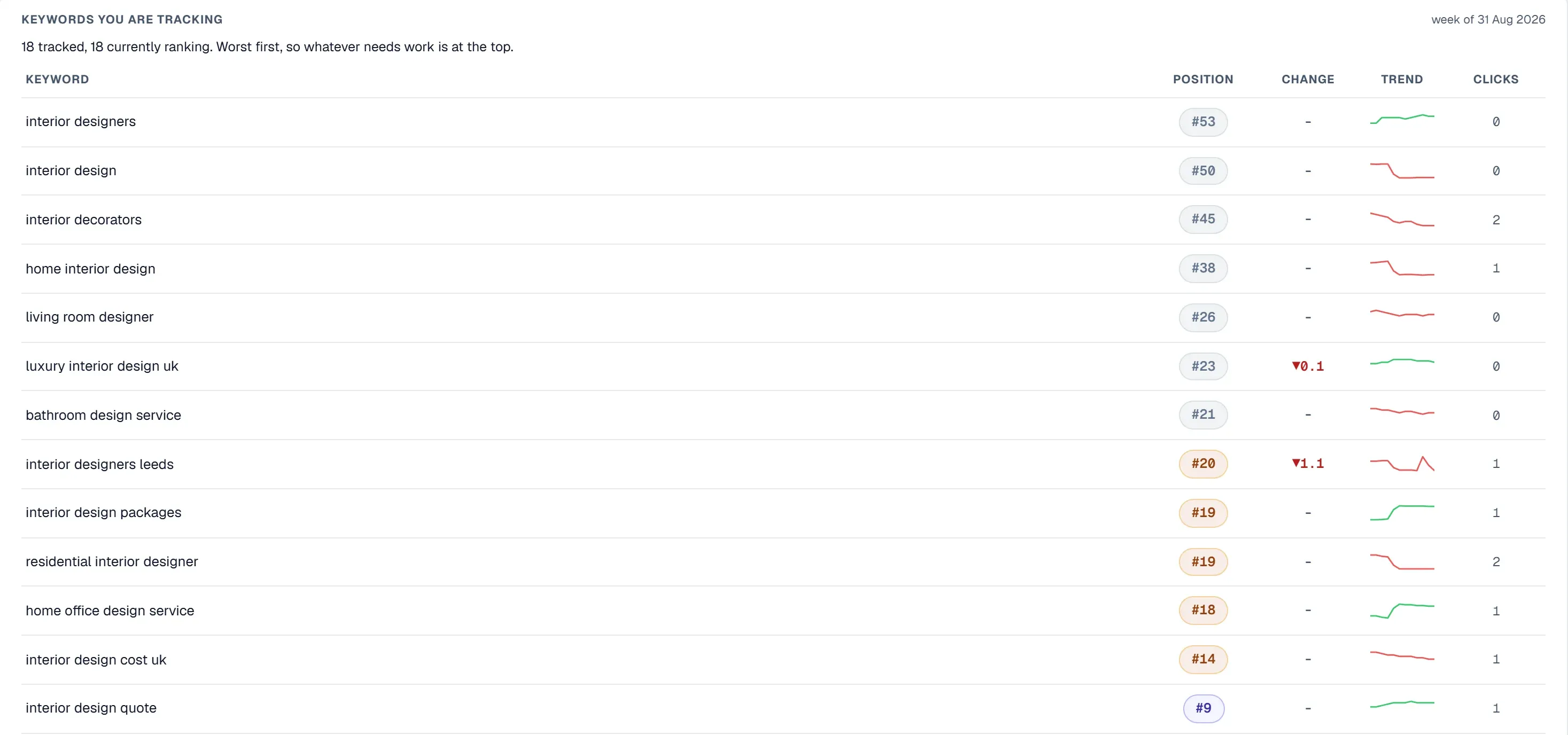
UtilitySEO includes GSC powered keyword tracking that pulls rankings, impressions, and clicks directly from your Search Console data. This gives you the reliability of Google's own data with additional organisation and analysis features.
Keyword Grouping and Organisation
Within UtilitySEO, you can create keyword groups to organise tracking around topics, campaigns, or product lines. Inline renaming and the ability to move keywords between groups keeps your data structured as your SEO strategy evolves.
This organisation matters when you track dozens or hundreds of terms. Without grouping, it becomes difficult to see patterns or prioritise efforts.
Device and Country Breakdown
The platform provides per keyword splits by device and country. This helps you understand whether mobile and desktop performance differs, and whether you are succeeding in your target geographic markets.
If you notice desktop rankings are strong but mobile lags, that insight points you toward mobile specific optimisation opportunities.
Pages Tab with Index Status
The Pages tab shows GSC page performance alongside URL inspection data, index status, mobile usability, and canonical mismatch detection. This combination helps you understand not just how pages rank, but whether technical issues might be holding them back.
For deeper analysis of your search performance trends, the Trends tab shows data from 3 days to 2 years, helping you spot seasonal patterns and long term trajectory.
Connecting Tracking to Action
What separates useful tracking from mere data collection is the connection to action. UtilitySEO's issue tracking lets you pin issues from scan results and mark them as fixed. The Progress dashboard shows milestones, streaks, and fix rate by priority.
When rank tracking reveals a problem, you can trace it back to technical issues identified in audits and track your resolution progress. This workflow, detailed on the Workflow page, turns data into results.
For a detailed guide on monitoring your Google rankings effectively, see How to Track Google Rankings: A Practical Guide for SEO Monitoring.
Pairing Rank Tracking with the Best SEO Audit Software
Rank tracking becomes most powerful when combined with technical SEO auditing. Knowing that a keyword dropped is useful. Understanding why it dropped through audit findings lets you fix the underlying problem.
The Audit and Track Workflow
The best seo audit software identifies technical issues that might be affecting rankings. Broken links, slow page speed, missing meta data, and crawl errors all impact how search engines evaluate your pages.
When you combine audit findings with rank data, patterns emerge. Perhaps pages with slow load times consistently rank lower. Or pages with duplicate content struggle to gain visibility. These correlations guide your optimisation priorities.
Ongoing Monitoring vs One Time Audits
A single audit gives you a snapshot. Ongoing monitoring catches new issues as they emerge. Sites change constantly through new content, design updates, plugin changes, and server adjustments. Each change can introduce SEO problems.
Using a keyword rank tracker alongside continuous auditing creates a feedback system. Ranking drops trigger investigation. Audits reveal causes. Fixes are implemented and tracked. Rankings recover.
This approach is more effective than periodic audits alone because it catches problems before they significantly impact traffic.
Conclusion
A keyword rank tracker is essential for anyone serious about SEO. It provides the visibility needed to measure progress, identify opportunities, and respond quickly when rankings shift. Combined with technical auditing, analytics, and competitor analysis, rank tracking forms the foundation of data driven search optimisation.
UtilitySEO brings these capabilities together in one platform. GSC powered keyword tracking with grouping, device and country breakdown, and deep integration with technical audits helps you connect ranking performance to actionable improvements. Whether you are managing a single site or an agency portfolio, consistent monitoring gives you the insight needed to grow search visibility over time.
Explore how these features can support your SEO workflow by visiting Pricing or starting a free SEO audit today.
Frequently asked questions
A keyword rank tracker is a specialized tool that automatically monitors and records your website's positions in search engine results for specific keywords over time.
- It eliminates manual searching, saving significant time and effort.
- Tracks positions across different devices, locations, and search engines.
- Stores historical data to identify ranking trends and performance changes.
- Provides crucial insights for optimizing your SEO strategy.
Tracking your keyword rank is crucial for SEO success because it provides leading indicators of your website's visibility and helps you assess the effectiveness of your optimization efforts.
- Early detection of ranking drops prevents significant traffic loss.
- Reveals the competitive landscape for valuable search terms.
- Validates whether content and technical SEO changes are working.
- Informs strategic adjustments to maintain or improve search presence.
Choosing the best keyword rank tracker involves evaluating features like historical data tracking, device and location specificity, and integration capabilities to match your SEO goals.
- Look for comprehensive historical data to analyze trends.
- Ensure it tracks across various devices and geographic locations.
- Consider integration with other SEO tools for holistic insights.
- Prioritize user-friendliness and reliable data accuracy.
Yes, a keyword rank tracker can significantly enhance competitive analysis by showing you where your rivals rank for important keywords and how their positions change over time.
- Identify competitor strengths and weaknesses in search visibility.
- Discover new keyword opportunities based on competitor performance.
- Understand competitive strategies by observing their ranking shifts.
- Inform your own content and SEO tactics to gain an edge.
Know what to fix next.
Scan your site for a clearer place to start.
About 30 seconds. No card needed.