

SEO
How to Rank Higher for AI Overviews Using a Keyword Rank Tracker
Learn how to optimise for AI overviews using a keyword rank tracker and technical SEO strategies.
AI overviews are changing how search results appear. Google now generates AI summaries that sit above traditional organic listings, reshaping click behaviour and visibility. To compete, you need to understand what content gets featured and how your rankings shift as a result. A reliable keyword rank tracker is essential for monitoring these changes. This guide explains how to optimise for AI overviews, track your performance effectively, and use the right tools to stay competitive. Whether you run an ecommerce store or a content site, these strategies will help you adapt.
What Are AI Overviews and Why They Matter for Rankings
AI overviews are generated summaries that Google displays at the top of search results for certain queries. They pull information from multiple sources and present a concise answer before users see traditional blue links.
This shift means ranking on page one is no longer enough. Your content might rank third organically but never get seen if an AI overview dominates the viewport. Conversely, being cited within an AI overview can drive significant traffic even without a top three position.
The challenge is visibility. Traditional SEO metrics do not always capture whether your content appears in AI generated summaries. You need an seo monitoring tool that tracks both standard rankings and emerging SERP features.
Understanding this landscape requires regular auditing. The best seo audit software helps you identify technical issues that might prevent AI systems from understanding your content properly. Crawl errors in Google can block search engines from accessing pages entirely, which means your content never enters the pool for AI consideration.
Technical Foundations: Fixing Issues Before Optimising Content
Before chasing AI overview visibility, ensure your technical SEO is sound. AI systems rely on crawlable, well structured content. If your site has fundamental problems, no amount of content optimisation will help.
Addressing Crawl Errors and Indexing Problems
Crawl errors in Google prevent pages from being indexed and considered for any SERP feature. Common issues include broken internal links, server errors, and blocked resources. Regularly checking Google Search Console reveals these problems, but many site owners find the interface limited for detailed analysis.
A google search console alternative can provide deeper insights with better filtering and actionable recommendations. UtilitySEO's Pages tab offers GSC page performance data alongside URL inspection, index status, and canonical mismatch detection in one view. This makes it easier to spot pages that are not being crawled or indexed correctly.
For ecommerce sites, conducting a shopify seo audit is particularly important. Shopify stores often generate duplicate content through collection filtering and pagination. These technical issues confuse search engines and dilute your authority. You can learn more about this in our Shopify SEO audit comparison guide.
Performance and Core Web Vitals
Page speed matters for both user experience and AI evaluation. Slow loading pages are less likely to be featured in AI overviews because they provide a poor experience.
Running a core web vitals audit reveals performance bottlenecks. Focus on Largest Contentful Paint, Interaction to Next Paint, and Cumulative Layout Shift. UtilitySEO's single URL scan runs a deep PageSpeed and SEO audit with dual pass averaging, giving you accurate performance data rather than one off snapshots. For a deeper exploration, read our core web vitals audit guide.
Content Strategies That Win AI Overview Citations
Once your technical foundation is solid, focus on content structure and quality. AI overviews favour content that directly answers queries, uses clear formatting, and demonstrates expertise.
Structure Content for AI Comprehension
AI systems parse content differently than humans. They look for clear hierarchies, definitions, and directly answerable statements. Consider these approaches:
Use descriptive subheadings. Each section should have a heading that clearly indicates its content. This helps AI systems understand the structure of your information.
Lead with answers. Place the most important information at the beginning of sections. If someone asks what something is, define it in the first sentence before expanding.
Include lists and tables. Structured data formats are easier for AI to parse and quote. Where appropriate, use bullet points, numbered steps, or comparison tables.
Add contextual depth. While concise answers matter, AI systems also evaluate authority. Include supporting information, examples, and evidence that demonstrates expertise.
Track Keyword Performance Over Time
Understanding which keywords trigger AI overviews requires consistent monitoring. A keyword rank tracker that shows historical data helps you identify patterns.
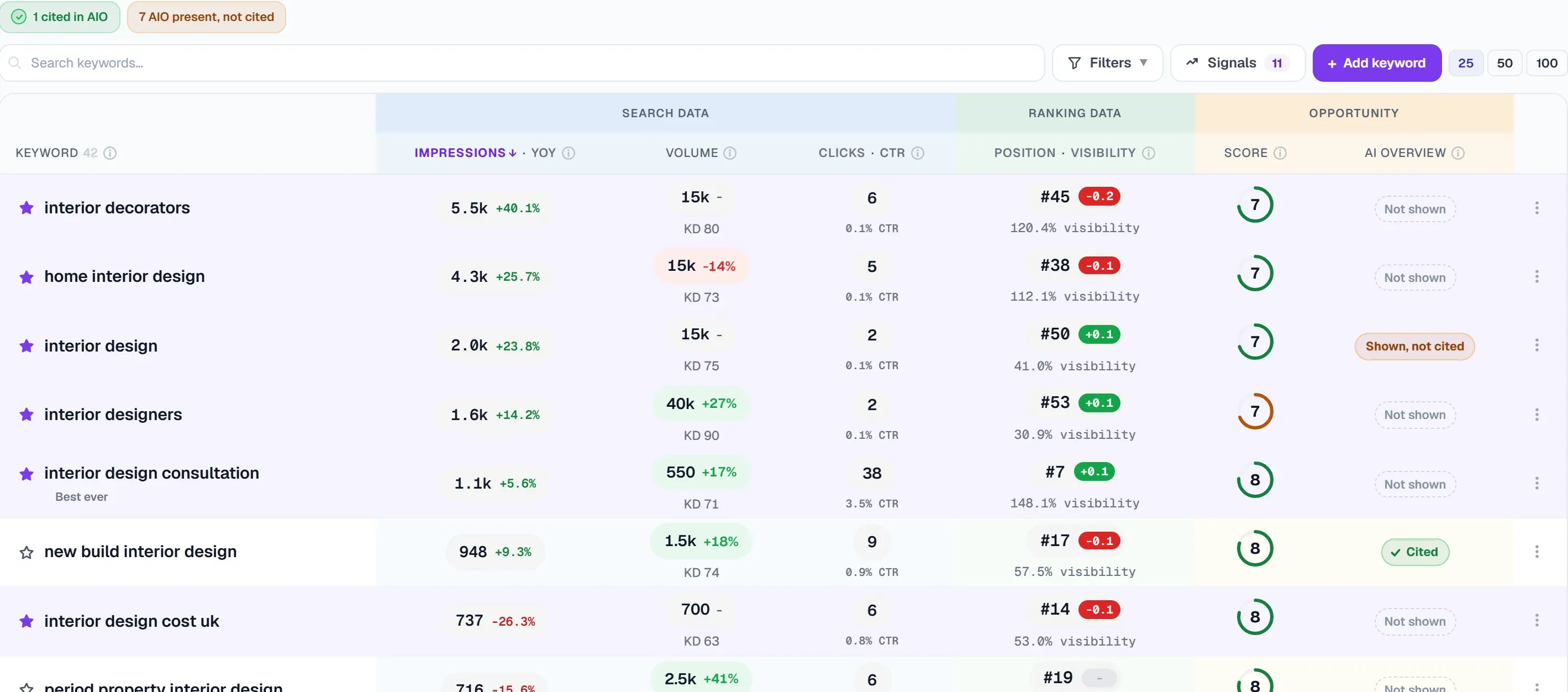
UtilitySEO's keyword tracking uses GSC powered rankings with impressions and clicks data. The Trends tab shows search performance over time from three days up to two years. This historical view reveals whether your visibility is improving or declining for specific queries.
The device and country breakdown per keyword is particularly useful. AI overviews may appear differently on mobile versus desktop, and regional differences exist. Tracking these splits helps you understand where optimisation efforts should focus.
For more detailed guidance on tracking, see our guide to monitoring rankings effectively.
How UtilitySEO Helps You Track AI Visibility
Traditional ranking tools tell you where you appear in organic results. But as AI overviews become more prominent, you need visibility into how AI systems perceive your brand.
Brand Tracking Across AI Platforms
UtilitySEO includes brand tracking that monitors your visibility across ChatGPT, Gemini, and Perplexity. This feature uses neutral category prompts to check if your brand appears organically in AI responses. It also extracts your position from ranked list style responses.
You get a brand visibility score with trend direction, showing whether your presence in AI generated answers is growing or shrinking. The per platform breakdown with percentages reveals where you perform best and where improvement is needed.
Competitor Analysis for AI Share of Voice
Understanding your competitors' AI visibility is equally important. UtilitySEO's share of voice donut chart shows how your brand compares against competitors across AI platforms.
The multi line trend chart tracks brand visibility versus competitors over time. The keyword comparison table includes opportunity scores, confidence scores, and winner badges. Inline drilldowns show the actual AI response excerpts and recommended actions per term.
This level of detail goes beyond what a standard keyword rank tracker provides. You see not just rankings but how AI systems talk about your brand and competitors.
Automated Monitoring and Alerts
Consistent tracking requires automation. UtilitySEO offers regular automated scheduling with email notifications on completion. Position alerts notify you when keyword rankings change significantly, so you can respond quickly to drops.
The progress dashboard tracks milestones, streaks, and fix rates by priority. This helps you maintain momentum on SEO improvements rather than letting issues accumulate.
Real World Application: Combining Audits and Tracking
Consider a practical workflow for improving AI overview visibility.
Start with a full site scan using UtilitySEO's crawl of up to 10,000 pages (depending on plan) via sitemap and internal links. The SEO results dashboard shows your score, issues, fixes, and category filters. Lightbulb tips provide specific recommendations.
Address crawl errors in Google first. These fundamental issues prevent any visibility. Use the Pages tab to check index status and mobile usability for key pages.
Run a core web vitals audit on your most important landing pages. Use the best seo audit software features to identify performance issues and track fixes over time.
Set up keyword tracking for terms where AI overviews appear. Group related keywords and monitor impressions, clicks, and position changes. The device and country breakdown helps you understand whether mobile users in specific regions see different results.
Enable brand tracking to monitor AI visibility across ChatGPT, Gemini, and Perplexity. Compare your share of voice against competitors and identify opportunity keywords where you could gain ground.
For ongoing management, use the issue tracking feature to pin problems from scan results and mark them as fixed. The progress dashboard shows your improvement trajectory.
If you need a google search console alternative that combines these features, explore the UtilitySEO workflow to see how different tools connect.
Building a Long Term Strategy for AI Search
AI overviews are not a passing trend. As AI integration in search deepens, your strategy must evolve. Regular auditing, consistent tracking, and attention to both technical and content factors will determine success.
Using an seo monitoring tool that tracks traditional rankings alongside AI visibility gives you complete picture awareness. A comprehensive shopify seo audit or general site audit reveals problems before they cost you traffic.
The best seo audit software combines technical analysis with content insights. UtilitySEO's AI Content Quality Scoring evaluates pages against SEO best practices, while the Meta Generator creates optimised title tags and meta descriptions with SERP previews.
Start by understanding your current position. Run audits, set up tracking, and establish baselines. Then systematically address issues while monitoring progress. This disciplined approach builds sustainable visibility in both traditional and AI powered search.
Ready to see where you stand? You can start your SEO journey with a free audit and begin tracking your AI visibility today.
Ranking higher in AI Overviews: what actually moves
Choosing the best AI Overviews keyword rank tracker is the easy half. Changing what appears is the half people skip, so it is worth being specific about what works.
You have to already rank. AI Overviews are assembled from pages Google already trusts for the query, usually from the first page of results. If you are at position 30, the answer is not an AI Overview strategy, it is ordinary ranking work. Nothing about AI Overviews skips that step.
The extractable shape matters more than length. Look at what actually got quoted in an Overview you want to be in. It is almost always a direct answer of roughly 40 to 60 words, placed immediately under a heading phrased as the question. Not the best paragraph on the page, the most liftable one.
Being cited and being visible are different outcomes. An Overview can paraphrase your page without naming you. Tracking only whether you were named misses the cases where you supplied the answer and got nothing for it, which is the more common and more annoying result.
Check the query still has an Overview. Google adds and removes them constantly. A position that "dropped" is sometimes a query where the Overview disappeared and the whole result set shifted up. That is the single most common false alarm in this data.
What a tracker can and cannot tell you
A tracker reports whether an Overview appeared and whether you were in it. Worth knowing before you buy: Google does not expose AI Overview appearances through the Search Console API. It is available in the Performance report under the Generative AI filter, as an export.
So any product advertising a fully automated AI Overviews feed is scraping results instead, which measures a simulated search rather than yours. Neither is wrong, but they are different numbers and a tracker should say which one you are looking at.
Frequently asked questions
AI Overviews are Google-generated summaries at the top of search results, reshaping user interaction and significantly affecting traditional organic rankings.
- They pull concise answers from various sources.
- AI Overviews can dominate the viewport, reducing visibility.
- Being cited can drive traffic even without a top organic position.
- Traditional SEO metrics don't always capture AI overview appearance.
A keyword rank tracker is essential for monitoring content performance in search results, including its potential appearance within AI Overviews.
- It helps track shifts in rankings due to AI summaries.
- Monitors both standard organic positions and emerging SERP features.
- Provides data to understand what content gets featured.
- Essential for staying competitive in the evolving search landscape.
Strong technical SEO is crucial because AI Overviews rely on well-structured, crawlable content search engines can easily understand and process.
- AI systems need to access and interpret your pages correctly.
- Fundamental site problems prevent content from being considered.
- Sound technical foundations are necessary before content optimization.
- Crawl errors can entirely block your content from AI consideration.
Common technical issues like crawl errors and indexing problems can prevent your content from being effectively considered for AI Overviews.
- Broken internal links hinder page discovery.
- Server errors block access to content.
- Blocked resources prevent proper rendering and understanding.
- Canonical mismatches confuse search engines about preferred versions.
Yes, your content can absolutely drive significant traffic from AI Overviews even if it doesn't hold a top three organic search position.
- Google pulls information from various sources.
- Being cited within an AI summary increases visibility.
- Users might click through from the overview citation.
- This creates new opportunities beyond traditional ranking goals.
Know what to fix next.
Scan your site for a clearer place to start.
About 30 seconds. No card needed.