

SEO
Site audit tool
The landscape of site audit tools reflects divergent architectural philosophies spanning enterprise-grade comprehensive platforms, specialised desktop...
A site audit tool is an essential resource for anyone serious about improving their website's performance and search engine visibility. These powerful solutions systematically examine your site's technical health, identifying issues that may hinder user experience or prevent search engines from properly crawling and indexing your content. From broken links and slow loading speeds to duplicate content and missing meta descriptions, comprehensive audits reveal critical areas requiring attention. By regularly conducting thorough site evaluations, you can maintain optimal website functionality and strengthen your online presence.
UtilitySEO
UtilitySEO delivers comprehensive site auditing capabilities that go far beyond surface-level checks, combining deep technical SEO analysis with powerful integrations and AI-driven insights. Whether you're scanning a single page or crawling your entire site, you'll receive actionable recommendations that help you identify and fix critical issues before they impact your rankings. With seamless Google Search Console and GA4 integration, you can monitor your site's health alongside real performance data, all from a single intuitive dashboard.
- Full site scan: Crawls up to 10,000 pages (depending on plan) via sitemap and internal links with server-side processing, delivering a complete technical audit of your entire website without manual page-by-page analysis.
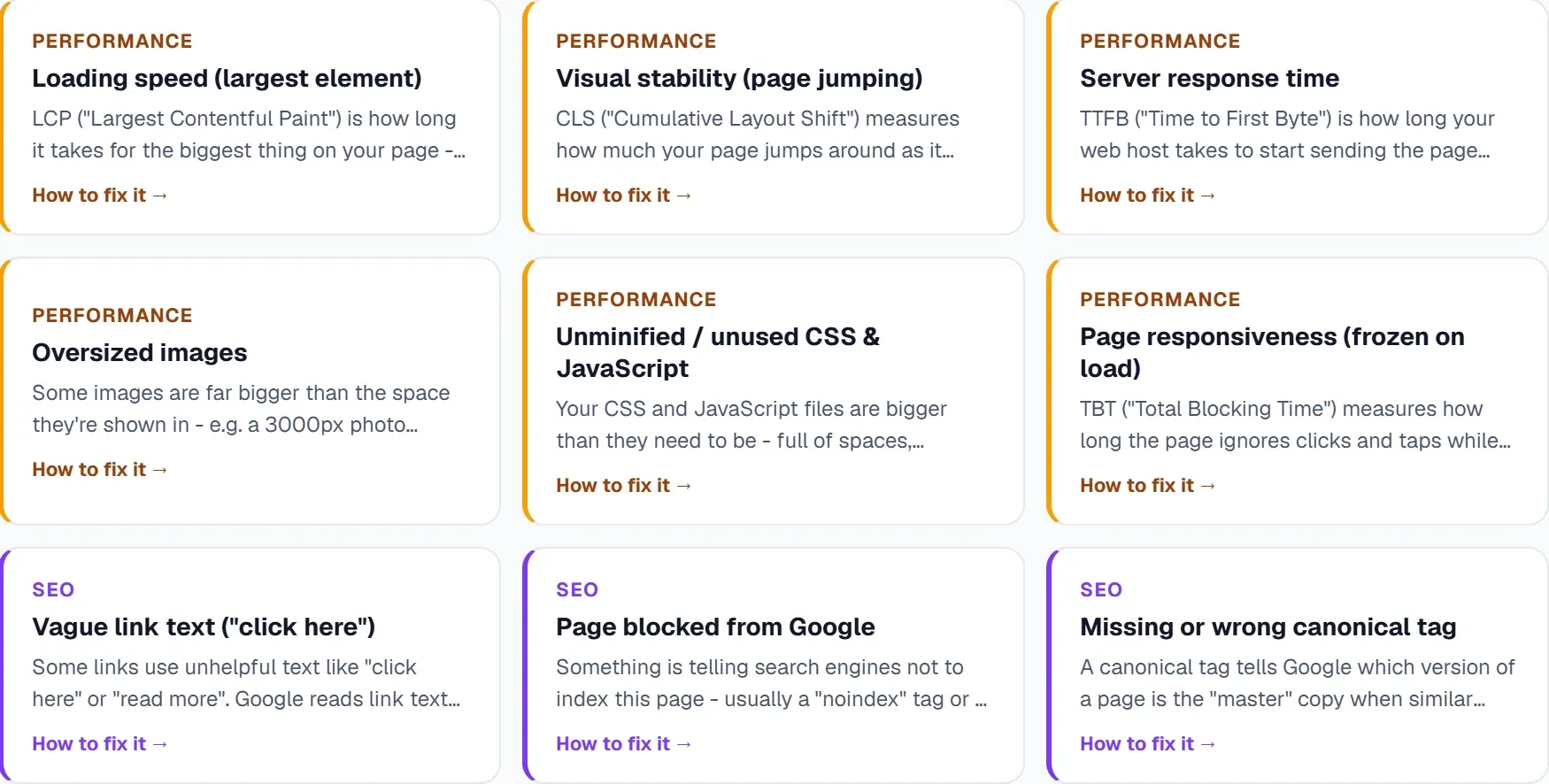
- SEO results dashboard: Presents your overall score, detected issues, recommended fixes, and category filters with lightbulb tips that guide you towards quick wins and long-term improvements.
- AI Insights: Provides automated SEO recommendations based on your scan results, highlighting priority issues and suggesting specific actions to improve your site's technical performance.
- Issue tracking: Allows you to pin issues directly from scan results and mark them as fixed, creating a streamlined workflow that keeps your team focused on what matters most.
- Progress dashboard: Tracks your SEO improvement journey with milestones, streaks, and fix rates organised by priority level, showing you exactly how your efforts translate into measurable progress.
- Scan history: Saves all previous scans so you can reload and compare results over time, making it easy to validate fixes and demonstrate the impact of your optimisation work.
SEMrush
The platform's Site Audit module employs thematic issue categorisation spanning crawlability diagnostics, HTTPS implementation verification, hreflang attribute validation, and canonical tag assessment, whilst integrating with complementary modules for backlink profile analysis and SERP position monitoring. The tool generates comprehensive audit reports featuring severity-weighted issue prioritisation, although the complexity of its multifaceted interface necessitates substantial onboarding investment.
Ahrefs
The platform's audit engine scrutinises fundamental technical elements spanning XML sitemap accuracy, robots.txt directive compliance, meta robots tag implementation, and HTTP status code distribution whilst providing granular insights into page-level optimisation opportunities concerning title tag uniqueness and meta description completeness. The tool's crawl budget allocation and scheduling parameters accommodate varying site architectures, yet pricing tiers reflect its positioning as a comprehensive SEO intelligence suite rather than dedicated audit tooling.
Screaming Frog
The application's crawling parameters accommodate JavaScript rendering configurations, custom extraction patterns through XPath and regex implementations, and API integrations with Google Analytics, Search Console, and PageSpeed Insights for augmented diagnostic capabilities. The tool's one-time licensing model contrasts with subscription-based alternatives, appealing to practitioners requiring ownership of audit infrastructure, yet the interface paradigm assumes technical proficiency that may present barriers for less experienced operators.
Sitebulb
Sitebulb Pro can crawl up to 500,000 URLs per audit by default on a desktop computer, whereas UtilitySEO crawls up to 10,000 pages per crawl (depending on plan). Sitebulb Pro is desktop software whose default limit is 500,000 URLs per audit, which can be raised to 2 million URLs depending on the computer's specification.
Google Search Console
Google Search Console operates as a diagnostic interface provided directly by the search engine, offering authoritative insights into indexation status, crawl error patterns, mobile usability deficiencies, and Core Web Vitals performance metrics as observed from Googlebot's perspective. The platform's Coverage report identifies pages encountering indexation barriers spanning robots.txt blockages, noindex directives, canonical exclusions, and server error responses, whilst the URL Inspection tool provides granular crawl diagnostics for individual pages including rendered HTML comparison and indexability determinations. Search Console's structured data validation, security issue alerting, and manual action notifications deliver essential technical intelligence unavailable through third-party crawlers, though the interface lacks comprehensive site-wide technical audit capabilities concerning internal linking analysis, content quality assessment, and holistic SEO health scoring. The platform's limitation to verified property data and retrospective reporting constraints diminish its utility as a proactive audit solution, positioning it as complementary intelligence rather than standalone site audit infrastructure.
Moz
Moz describes its Moz Pro Medium plan as intended for growing businesses that need both SEO and AI search or GEO tools. Moz Pro's Standard plan allows 100,000 pages crawled per week, whereas UtilitySEO's full-site crawl covers up to 10,000 pages per crawl (depending on plan).
SE Ranking
The platform's audit engine evaluates fundamental technical parameters including HTTP status code distributions, canonical tag implementations, hreflang attribute accuracy, and robots directive compliance whilst generating automated issue severity classifications and remediation recommendations. The tool's pricing model scales according to daily keyword tracking allocations rather than crawl frequency or site size parameters, creating potential misalignment for users prioritising intensive technical auditing over rank monitoring, with the interface balancing accessibility against granular technical control.
Seobility
The tool's crawler examines fundamental technical elements including meta tag implementation, heading structure adherence, image optimisation status, and mobile responsiveness parameters whilst generating aggregate SEO score metrics synthesising multiple diagnostic dimensions. The platform's keyword monitoring integration and backlink analysis modules position it as an entry-level comprehensive SEO suite, with the audit functionality providing sufficient diagnostic coverage for small to medium websites whilst lacking the granular technical controls and advanced crawling parameters offered by specialist audit applications.
Conclusion
The landscape of site audit tools reflects divergent architectural philosophies spanning enterprise-grade comprehensive platforms, specialised desktop applications, and accessibility-focused entry-level solutions, each embodying distinct compromises between diagnostic depth, interface complexity, and pricing accessibility. Optimal tool selection necessitates alignment between specific technical audit requirements, existing SEO infrastructure, and operational resource constraints rather than adherence to universal best-practice recommendations. For those beginning their optimisation journey, understanding your site's current state through a comprehensive audit remains foundational to implementing effective improvements.
Further reading
Frequently asked questions
A site audit tool is a crucial resource that systematically examines your website's technical health to improve performance and search engine visibility.
- Identifies issues hindering user experience or search engine crawling.
- Reveals problems like broken links, slow speeds, and duplicate content.
- Helps maintain optimal website functionality and strengthen your online presence.
A comprehensive site audit tool pinpoints critical issues like broken links, slow loading speeds, and duplicate content that negatively impact your site.
- Detects missing meta descriptions and crawl errors.
- Uncovers problems with internal linking and image optimization.
- Highlights areas for technical SEO improvement and better user experience.
UtilitySEO's site audit tool provides comprehensive technical SEO analysis and actionable recommendations to fix critical issues before they impact rankings.
- Offers full site scans for up to 10,000 pages (depending on plan), delivering complete technical audits.
- Features AI Insights for automated recommendations and priority issue highlighting.
- Tracks your SEO improvement journey with progress dashboards and scan history.
Yes, a quality site audit tool, such as UtilitySEO, allows you to track your SEO improvement journey and compare scan results over time.
- Progress dashboards show milestones, streaks, and fix rates by priority.
- Scan history saves previous audits for easy comparison and validation.
- Demonstrates the measurable impact of your optimization work effectively.
UtilitySEO's site audit tool stands out by combining deep technical SEO analysis with powerful integrations, AI-driven insights, and streamlined issue tracking.
- Integrates seamlessly with Google Search Console and GA4 for performance data.
- Provides AI Insights for automated, prioritized SEO recommendations.
- Offers issue tracking to pin problems and mark them as fixed efficiently.
Know what to fix next.
Scan your site for a clearer place to start.
About 30 seconds. No card needed.