

Comparisons
UtilitySEO vs Raven Tools: SEO Keyword Monitoring Comparison
Compare UtilitySEO and Raven Tools for SEO keyword monitoring. This guide examines monitoring frequency optimisation, alert threshold strategies, and...
UtilitySEO
UtilitySEO transforms keyword monitoring from a passive reporting exercise into an active decision-making system that connects Search Console data directly to the technical issues holding your rankings back. Rather than simply watching position changes, you'll understand exactly which crawl errors, indexing problems or content gaps are suppressing visibility for your most valuable terms-then track fix velocity as you resolve them. It's monitoring designed for SEO professionals who need to prove causation, not just document correlation.
- Keyword tracking with GSC integration: Monitor rankings, impressions and clicks powered directly by Google Search Console data, with inline grouping to segment your keyword portfolio by intent, seasonality or competitive threat level-so you can apply different monitoring frequencies and alert thresholds to brand terms versus high-volatility money keywords without drowning in noise.
- Device and country breakdown per keyword: View per-keyword performance split by device and country to identify false positives caused by location fluctuations or personalisation artefacts, whilst spotting genuine mobile-desktop ranking divergence that indicates mobile usability issues requiring immediate attention.
- Pages tab with URL inspection: Cross-reference keyword performance with GSC page-level data including index status, mobile usability diagnostics and canonical mismatch detection-turning keyword drops into actionable technical fixes rather than vague "content quality" speculation, and catching keyword cannibalisation when multiple URLs compete for the same term.
- Trends tab with flexible date ranges: Analyse search performance over periods from three days to two years to distinguish algorithm update impacts from seasonal patterns, establish keyword stability baselines that inform monitoring frequency decisions, and identify the optimal data retention window for your specific keyword portfolio without paying for historical data you'll never action.
- Issue tracking with priority-based fix rate: Pin technical SEO issues discovered during site scans directly to affected keywords, mark as fixed, then correlate resolution with ranking recovery in the Progress dashboard-creating an audit trail that proves ROI of monitoring efforts by connecting crawl budget waste, indexing barriers or content gaps to measurable ranking improvements over time.
- Brand tracking across AI platforms: Monitor whether your brand appears organically in ChatGPT, Gemini and Perplexity responses through neutral category prompts and ranked list extraction, with visibility scoring, share of voice comparison against competitors, and per-platform breakdown-addressing the emerging gap between traditional SERP monitoring and AI-mediated discovery that standard rank trackers completely ignore.
- Monitoring alerts with project-level configuration: Set per-project keyword position alerts with custom thresholds that reflect business impact rather than arbitrary position changes-so a three-position drop for a high-intent purchase term triggers immediate investigation, whilst informational keyword fluctuations only alert on statistically significant movement patterns.
Competitor Sections
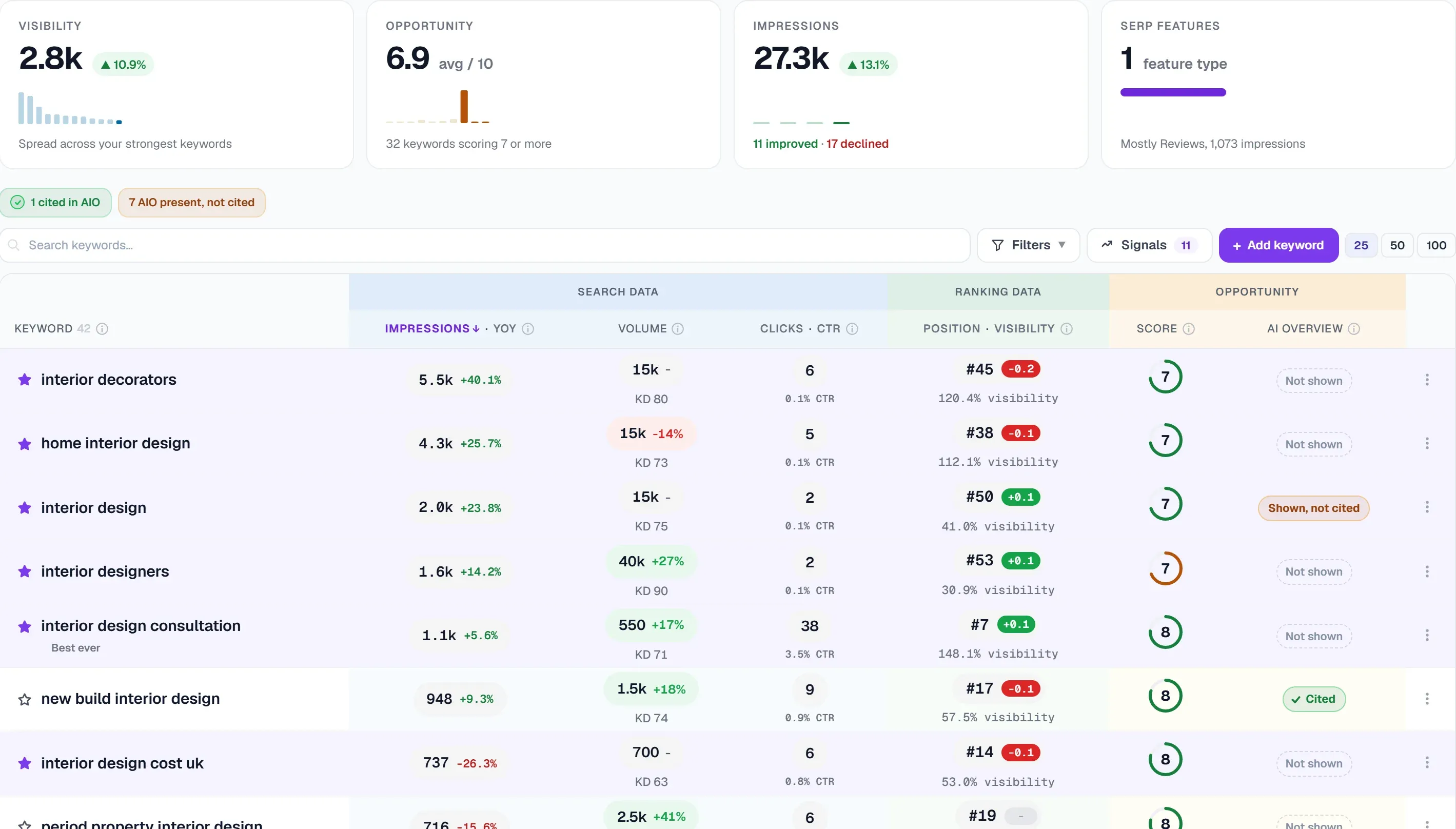 The keyword tracking panel shows visibility, an opportunity score and impressions above the full list of tracked keywords.
Raven Tools
The platform aggregates SERP data across geographical modifiers and device types whilst maintaining historical position archives for longitudinal trend analysis. Its monitoring architecture emphasises integration with peripheral marketing intelligence sources rather than standalone rank surveillance, requiring users to navigate through consolidated dashboard environments where keyword position data competes for attention alongside backlink profiles, site auditor outputs, and social media metrics. The workflow necessitates configuration of campaign hierarchies and client portals before rank monitoring functionality becomes operationally viable, creating implementation overhead that may obscure the fundamental keyword position tracking mechanics for practitioners seeking streamlined monitoring protocols without auxiliary marketing operations infrastructure.
Conclusion
Selecting appropriate keyword monitoring infrastructure ultimately depends on your operational requirements for data granularity, reporting cadence, and integration complexity rather than feature completeness alone. The distinction between platforms becomes meaningful when aligning monitoring frequency with keyword volatility patterns and competitive intensity thresholds. For guidance on establishing effective monitoring protocols that filter signal from noise, explore How To Track Google Rankings: A Practical Guide for SEO Monitoring or review Google Keyword Tracking How to Monitor Rankings Effectively.
Further reading
Frequently asked questions
Effective SEO keyword monitoring tracks keyword performance to align with business goals and competitive landscapes, forming the foundation of successful digital marketing strategies.
- Prioritize keywords based on commercial impact.
- Assess genuine competitive threats effectively.
- Establish appropriate review frequencies for efficiency.
- Focus resources on the most valuable terms.
UtilitySEO transforms SEO keyword monitoring from a passive reporting exercise into an active decision-making system, connecting Search Console data to technical issues.
- Understand exact crawl errors and indexing problems.
- Pinpoint content gaps suppressing keyword visibility.
- Track fix velocity as technical issues are resolved.
- Prove causation for ranking changes, not just correlation.
UtilitySEO helps identify technical issues impacting SEO keyword monitoring by cross-referencing keyword performance with GSC page-level data and diagnostics.
- Detects index status, mobile usability diagnostics, and canonical mismatches.
- Turns keyword ranking drops into actionable technical fixes.
- Prevents vague "content quality" speculation.
- Catches keyword cannibalization when multiple URLs compete.
UtilitySEO integrates directly with Google Search Console for robust SEO keyword monitoring, allowing users to track rankings, impressions, and clicks.
- Segments keyword portfolios by intent, seasonality, or competitive threat.
- Applies different monitoring frequencies to diverse keyword groups.
- Sets specific alert thresholds for brand versus money keywords.
- Helps avoid getting overwhelmed by unnecessary noise.
UtilitySEO's Trends tab allows you to analyze SEO keyword monitoring performance over flexible date ranges, from three days to two years.
- Distinguish algorithm update impacts from seasonal search patterns.
- Establish keyword stability baselines for better insights.
- Inform precise monitoring frequency decisions effectively.
- Identify optimal data retention windows for your portfolio.
Know what to fix next.
Scan your site for a clearer place to start.
About 30 seconds. No card needed.