

SEO
Answer Engine Optimization: What It Actually Is and How to Do It
Master answer engine optimization (AEO) for AI search with practical strategies and learn how UtilitySEO helps boost your brand's AI visibility.
The digital landscape is rapidly evolving, driven by the proliferation of artificial intelligence in search. Traditional search engine optimisation is being reshaped by the rise of answer engines, where AI models directly provide answers, summaries, and recommendations. Understanding answer engine optimization is no longer optional; it is crucial for maintaining visibility and relevance. This guide will demystify what answer engine optimization truly entails, explore practical strategies for implementation, and demonstrate how UtilitySEO empowers businesses to adapt and thrive in this new era of AI driven search.
What is Answer Engine Optimization?
Answer engine optimization (AEO) is the practice of optimising digital content to be directly cited, summarised, or recommended by artificial intelligence powered search experiences. Unlike traditional SEO which focuses on ranking highly in a list of search results, AEO aims for your content to be the definitive answer or source presented by platforms like Google's AI Overviews, ChatGPT, Gemini, and Perplexity. It is about becoming the authoritative voice that an AI model trusts to answer a user's query directly. This shift requires a focus on clarity, accuracy, and directness, ensuring your content is easily digestible and verifiable by AI systems. The goal is to achieve strong brand visibility not just in traditional search results, but within the AI generated responses themselves, which is increasingly vital for any robust ai search optimization strategy.
Beyond the Basics: Tailoring AEO for Your Business
Successfully implementing answer engine optimization requires more than generic advice; it demands a tailored approach that considers your specific industry, resources, and business model. For resource constrained teams, prioritisation is key.
Industry Specific Strategies:
- B2B SaaS: Focus on creating highly detailed, problem solution content that directly addresses specific pain points your software solves. Think about how an AI might summarise a complex workflow or compare features. Position your product as the definitive answer to common industry challenges.
- Ecommerce: Emphasise clear, concise product descriptions, comprehensive FAQs, and detailed comparison guides. AI models often summarise product benefits or provide buying advice. Ensure your unique selling propositions are easily extractable.
- Local Services: Prioritise local SEO fundamentals combined with AEO. Ensure your Google Business Profile is impeccable. Create content answering common local queries, such as "best plumbers near me" or "cost of roof repair in [city]". AI models are increasingly providing localised recommendations.
- Healthcare: Accuracy and authority are paramount. Ensure all content is medically reviewed, factually correct, and cites reputable sources. Focus on answering common health questions clearly and concisely, always adhering to disclaimers. AI must trust your content implicitly.
Workflow Integration for Resource Constrained Teams: Integrating AEO into existing content operations does not necessarily require new headcount or enterprise tools.
- Content Audits: Begin by auditing existing content using tools like UtilitySEO's content audit to identify high potential pages that can be optimised for direct answers. Look for content that already answers common questions.
- Question Based Formatting: Restructure articles with clear, question based H2 and H3 headings. Each question should be followed by a concise, direct answer, ideally 40 to 60 words, before expanding into further detail. This makes it easier for AI to extract specific information.
- Schema Markup: Implement relevant schema markup, particularly
QuestionandAnswerschema, to explicitly signal the question and answer pairs to search engines and AI models. - Editorial Calendar Adjustments: When planning new content, incorporate "AI answer potential" as a key consideration. Ask: "Could an AI directly answer a user's query using this content?" Prioritise topics that lend themselves to direct, factual answers.
- Small Business Focus: For smaller teams, focus on your niche. Become the absolute authority for a narrow set of queries. Rather than trying to cover everything, aim for perfect answers on your core topics. Use tools like UtilitySEO's Keyword explorer to identify these high value, niche questions.
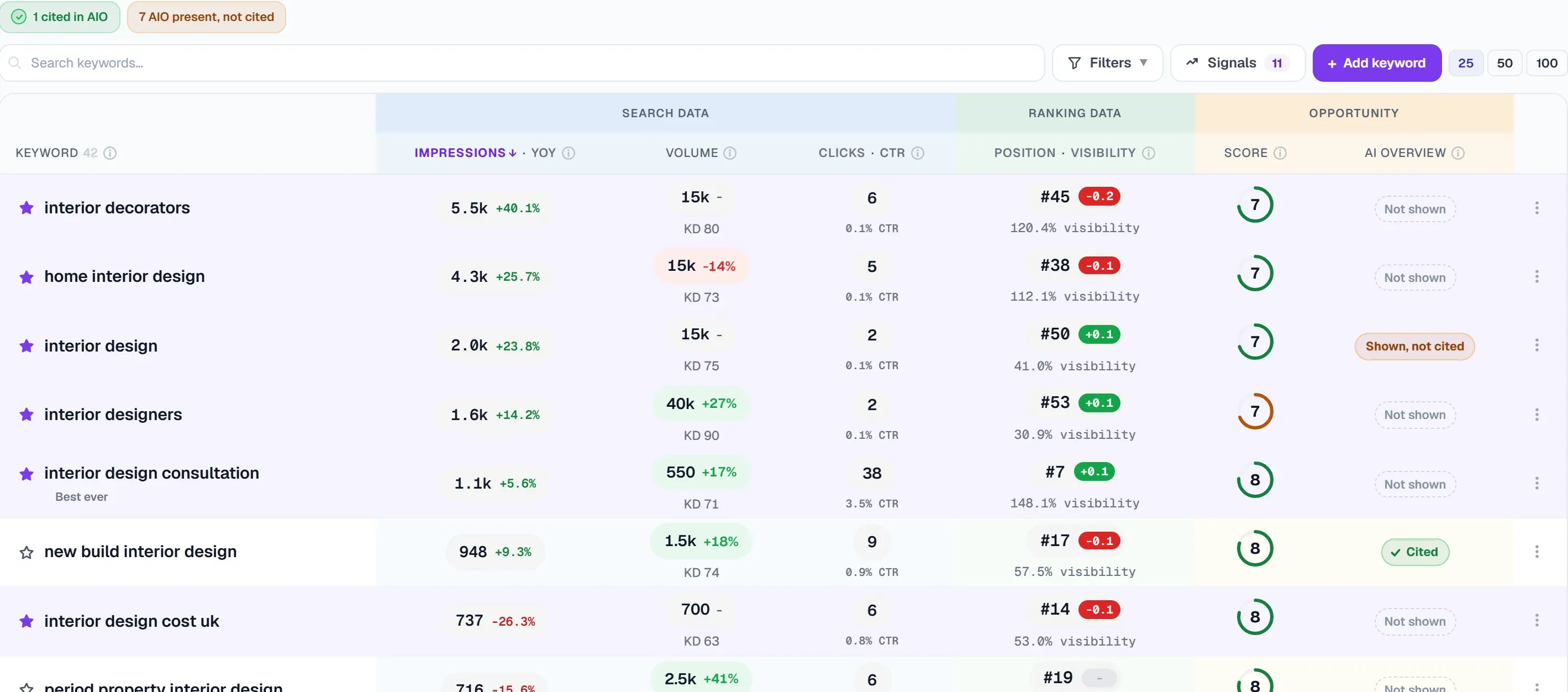 The keyword table flags which tracked keywords show an AI Overview, and whether the site is cited in it.
Measuring Success and Future Proofing Your AEO Strategy
The metrics for answer engine optimization differ significantly from traditional SEO. Success is less about click through rates and more about mentions, citations, and direct answers.
Attribution Modelling for AEO: Connecting AI citations to downstream conversions and revenue can be challenging.
- Brand Tracking: UtilitySEO's Brand tracking feature is invaluable here. It monitors your brand's visibility across various AI platforms like ChatGPT, Gemini, and Perplexity. You can see if your brand appears organically in neutral category prompts or if it is extracted in ranked list prompts. This provides a clear brand visibility score and trend direction, showing you which platforms mention your brand and how often.
- Indirect Impact: While direct attribution may be difficult, increased brand visibility in AI answers builds authority and trust, which can lead to direct searches for your brand later. Track increases in branded search queries and direct traffic to your site using UtilitySEO's GA4 analytics integration.
- Conversion Rate Analysis: Monitor conversion rates for visitors who arrive via branded searches or direct traffic after a period of increased AI visibility. While not a direct attribution, it can indicate the overall positive impact of AEO.
Competitive Intelligence and Historical Data: Understanding why competitors are being cited more frequently can inform your strategy.
- Competitor Comparison: UtilitySEO's Brand tracking allows you to compare your brand's share of voice against competitors across AI platforms. The keyword comparison table with opportunity score and winner badge helps identify specific terms where competitors are performing better. You can then use the inline drilldown to see AI response excerpts and recommended actions.
- Content Format Analysis: Review historical data on which content formats tend to be cited by AI. Often, structured data, lists, tables, and concise Q&A sections perform well. Use UtilitySEO's content audit to identify existing content that can be reformatted.
- Predictive SEO: As AI models evolve, understanding future trends is key. Keep an eye on new AI capabilities and how they might consume information. Tools that offer AI Insights, like UtilitySEO's automated SEO recommendations, can help you adapt proactively.
Future Proofing Considerations: AI models are constantly learning. Future proofing involves focusing on fundamental principles:
- Accuracy and Authority: Always provide factual, well researched information from credible sources.
- Clarity and Conciseness: AI values content that is easy to understand and summarise.
- User Intent: Understand the underlying intent behind queries and provide comprehensive answers.
- Adaptability: Be prepared to adjust your strategy as AI technologies and search behaviours change. Stay informed by reading resources like Generative Engine Optimization: What It Actually Is and How to Do It.
UtilitySEO: Your Partner in Answer Engine Optimization
UtilitySEO offers a comprehensive suite of tools designed to help businesses navigate the complexities of answer engine optimization without requiring vast resources. Our platform provides the insights and capabilities needed to enhance your visibility in AI powered search.
Our Brand tracking feature is at the forefront of AEO, allowing you to monitor your brand's presence across major AI platforms such as ChatGPT, Gemini, and Perplexity. You can track neutral category prompts to see if your brand appears organically and extract positions from ranked list prompts. This provides a clear brand visibility score, per platform breakdown, and a share of voice donut chart against competitors. The competitor comparison view and multi line trend chart allow you to systematically analyse why competitors might be cited more frequently, offering actionable insights through inline drilldown with AI response excerpts and recommended actions per term. This is critical for understanding and improving your ai-ranked recommendations.
Beyond brand tracking, UtilitySEO supports your broader AEO efforts:
- AI Insights provide automated SEO recommendations, helping you identify opportunities to optimise content for direct answers.
- AI Content Quality Scoring (available on Pro Plus plans) scores pages against SEO best practices, ensuring your content is well structured and relevant for both users and AI models.
- Content audit helps you pinpoint gaps in your existing content that could be filled with direct, AI friendly answers.
- Our Keyword tracking monitors your GSC powered rankings, impressions, and clicks, which while traditional, still provides valuable context for how your content performs before and after AEO efforts.
- GA4 analytics integration allows you to track organic traffic, sessions, and conversions, helping you to connect the dots between increased AI visibility and business outcomes.
- For predictive SEO and understanding user intent, the Keyword explorer tool assists in discovering new seed keywords and related queries that AI models are likely to answer.
By leveraging UtilitySEO, even resource constrained teams can develop a robust AEO strategy, integrate it into their workflow, and measure its impact effectively.
Conclusion
Answer engine optimization represents a significant evolution in how content achieves visibility. It moves beyond traditional rankings to focus on direct citations and recommendations from AI models. By understanding the nuances of AEO, tailoring strategies to your business model, and leveraging powerful tools like UtilitySEO's Brand tracking and AI Insights, you can ensure your brand remains prominent in this new search paradigm. Begin your journey towards enhanced AI visibility today and discover how UtilitySEO can streamline your AEO efforts. Explore our Pricing plans or learn more about our Workflow to see how we can support your digital strategy.
Frequently asked questions
Answer engine optimization (AEO) is the process of tailoring digital content to be directly cited, summarized, or recommended by AI-powered search experiences.
- Aims for content to be the definitive answer an AI provides.
- Focuses on clarity, accuracy, and directness for AI systems.
- Boosts visibility within AI-generated responses, not just search rankings.
Answer engine optimization differs from traditional SEO by aiming for your content to be directly cited or summarized by AI, not just listed in search results.
- SEO targets organic rankings in a list of links.
- AEO targets direct citations and summaries by AI models.
- Prioritizes clarity and direct answers for AI comprehension.
Answer engine optimization is vital for website visibility as AI models increasingly provide direct answers, making your content a primary source for users.
- Ensures brand visibility in AI Overviews and chatbots.
- Establishes your content as an authoritative voice for AI.
- Adapts to the evolving landscape of AI-driven search.
To implement answer engine optimization, focus on creating clear, accurate, and direct content that specifically answers user questions, making it easily digestible for AI systems.
- Conduct content audits to identify high-potential pages.
- Restructure articles using question-based headings (H2, H3).
- Ensure content is factual and verifiable by AI models.
Content that directly addresses specific user queries with clarity, accuracy, and conciseness is best for answer engine optimization.
- Detailed problem-solution guides work well for B2B SaaS.
- Clear product descriptions and comprehensive FAQs suit e-commerce.
- Medically reviewed, factual content is essential for healthcare.
- Local queries and Google Business Profile optimization aid local services.
Know what to fix next.
Scan your site for a clearer place to start.
About 30 seconds. No card needed.