

SEO
How To Track Google Rankings: Complete Guide
A complete guide to tracking Google rankings, covering methods, tools, and best practices for monitoring search positions effectively.
Understanding where your website appears in search results is essential for any successful SEO strategy. Learning how to track Google rankings gives you the insight needed to measure progress, identify opportunities, and make informed decisions about your content and optimisation efforts. Without accurate tracking, you are essentially operating blind, unable to determine whether your SEO work is producing results. This guide covers the methods, tools, and best practices for monitoring your search positions effectively, helping you build a data driven approach to improving your online visibility.
Why Tracking Your Google Rankings Matters
Monitoring your search positions provides tangible evidence of your SEO performance over time. When you track Google rankings consistently, you can identify which strategies are working and which need adjustment. This data becomes invaluable for reporting to stakeholders, justifying SEO investments, and planning future campaigns.
Ranking fluctuations often signal broader issues with your website. A sudden drop might indicate technical problems, algorithm updates, or increased competition. Conversely, steady improvements confirm that your optimisation efforts are on the right track. Without tracking, these signals go unnoticed until traffic has already suffered.
For ecommerce businesses, particularly those running platforms like Shopify, a thorough shopify seo audit combined with ranking tracking creates a complete picture of search performance. You can correlate technical fixes with position changes, proving the value of specific improvements.
Key Benefits of Consistent Tracking
Regular monitoring helps you identify seasonal trends in your keyword performance. Some terms naturally fluctuate based on consumer behaviour, and understanding these patterns allows for better content planning.
Tracking also reveals which pages drive the most valuable traffic. Not all rankings are equal. A position three ranking for a high intent commercial keyword often delivers more value than a position one ranking for a low volume informational term.
How To Track Google Rankings Effectively
The most reliable method for tracking search positions involves connecting directly to Google Search Console data. This approach provides accurate, first party information about how your site appears in search results, including clicks, impressions, and average positions.
Manual checking through incognito browsers gives a rough idea of rankings, but this method is inconsistent. Results vary based on location, search history, and device type. Automated tools that pull directly from GSC eliminate these variables.
Using the best seo audit software that integrates keyword tracking streamlines your workflow. Rather than switching between multiple platforms, you get ranking data alongside technical SEO information, allowing for better analysis of how site health affects positions.
Setting Up Your Tracking System
Start by identifying your target keywords. Focus on terms that align with your business goals and have realistic potential based on your site's current authority. Group keywords by topic, intent, or priority level to make analysis more manageable.
Connect your Google Search Console account to your tracking tool of choice. This integration provides the most accurate data available, directly from Google's own records. You can monitor position changes, click through rates, and impression volumes all in one place.
For detailed guidance on monitoring approaches, see How To Track Google Rankings: A Practical Guide for SEO Monitoring.
Common Technical Issues That Affect Rankings
Technical problems on your website can directly impact your search positions. Sitemap errors, for example, prevent search engines from discovering and indexing your content properly. If pages are not in Google's index, they simply cannot rank.
An automated seo audit tool identifies these technical barriers before they cause significant damage. Regular scanning catches problems like broken links, missing meta tags, crawl errors, and mobile usability issues that drag down your overall site quality in Google's eyes.
Canonical mismatches and duplicate content also harm rankings. When Google cannot determine which version of a page to rank, it often chooses neither. A comprehensive website seo audit uncovers these problems systematically.
Technical Factors That Influence Position Changes
Page speed significantly affects rankings, particularly on mobile devices. Core Web Vitals have become a confirmed ranking factor, making performance optimisation essential for competitive keywords.
Index status issues deserve immediate attention. Pages marked as noindex, blocked by robots.txt, or affected by sitemap errors will never appear in search results regardless of content quality. Regular audits catch these problems early.
How UtilitySEO Helps You Track Rankings
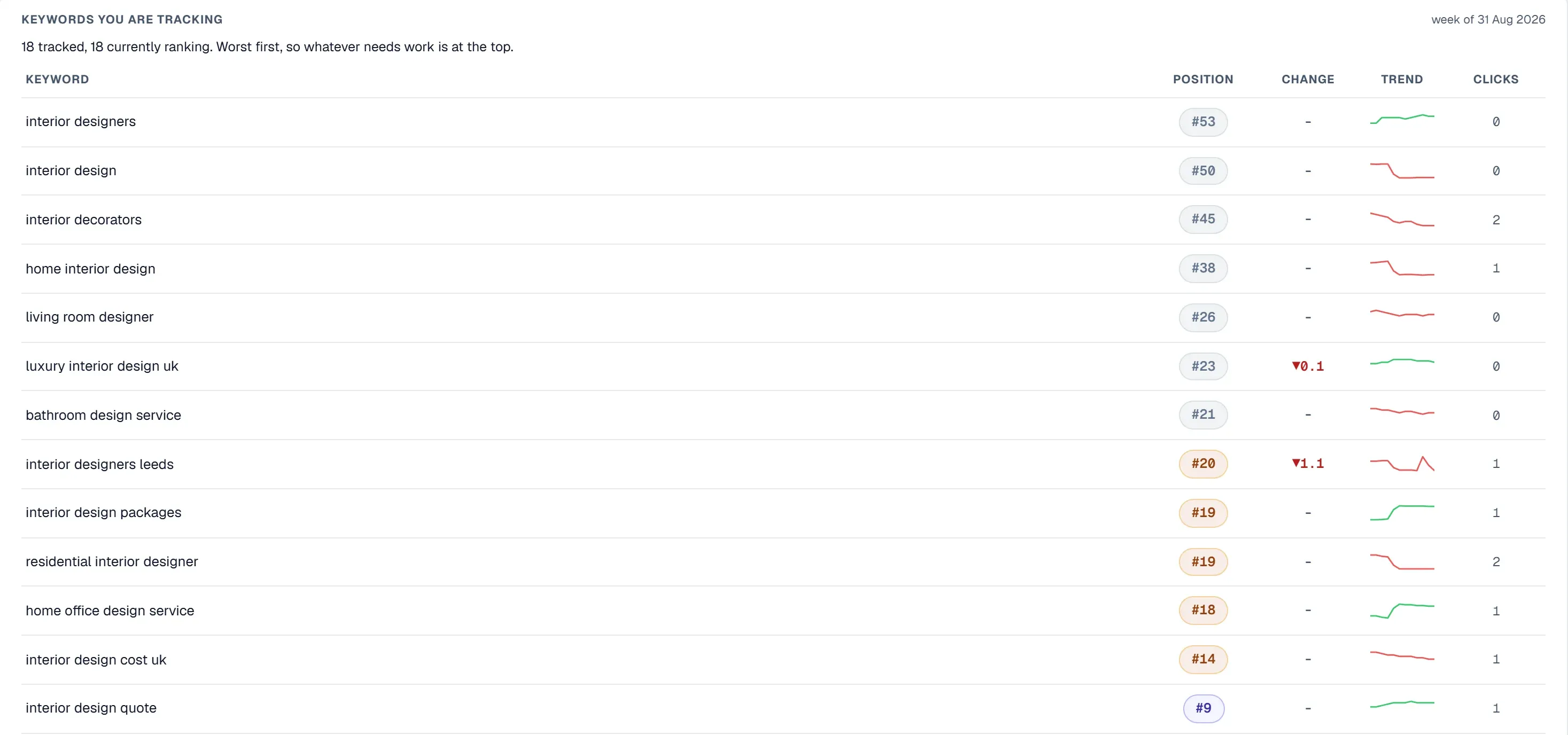
UtilitySEO provides GSC powered keyword tracking that displays rankings, impressions, and clicks with flexible grouping options. The keyword groups feature allows inline renaming and moving keywords between categories, making organisation straightforward for sites tracking hundreds of terms.
The device and country breakdown offers per keyword splits, showing how rankings differ across mobile, desktop, and tablet users in various regions. This granularity helps identify opportunities you might otherwise miss.
The Pages tab combines GSC page performance with URL inspection, index status checking, mobile usability testing, and canonical mismatch detection. This integration means you can identify exactly why certain pages underperform without switching tools.
The Trends tab visualises search performance over customisable time ranges, from three days to two years. Monitoring and alerts functionality delivers per project keyword position alerts, notifying you when important keywords move significantly.
For technical issues, the sitemap scanner and visualiser catches sitemap errors that might affect indexing. The full site scan crawls up to 10,000 pages (depending on plan) via sitemap and internal links, running server side for thorough analysis. Check the Workflow page to see how these features fit together.
Best Practices for Ongoing Rank Monitoring
Establish a regular cadence for reviewing your ranking data. Weekly checks catch sudden drops quickly, while monthly analysis reveals longer term trends. Avoid obsessing over daily fluctuations, as minor movements are normal and expected.
Compare ranking changes against your optimisation timeline. If you updated a page's content or improved its technical performance, track whether rankings improved in the following weeks. This correlation proves what works for your specific site.
Document your SEO changes systematically. When rankings shift, you need to understand what might have caused the movement. Was it an algorithm update, a competitor's improvement, or your own optimisation efforts?
Tracking Alongside Broader SEO Health
Rankings exist within the context of overall site quality. Regularly running scans with an automated seo audit tool ensures technical issues do not undermine your content efforts. A shopify seo audit or similar platform specific review catches problems unique to your CMS setup.
The UtilitySEO score provides a per project composite health score that contextualises ranking performance against technical SEO factors. This composite view prevents tunnel vision on positions alone.
For more on combining audits with tracking, read Start Your SEO Journey Today with a Free SEO Audit.
Take Control of Your Search Visibility
Learning how to track Google rankings transforms your approach to SEO from guesswork to data driven strategy. Consistent monitoring reveals what works, identifies problems early, and provides the evidence needed to demonstrate progress. Combined with regular technical audits using the best seo audit software, ranking tracking becomes the foundation of sustainable search performance.
UtilitySEO brings keyword tracking, technical auditing, and performance monitoring together in one platform. Start monitoring your positions today and build the visibility your website deserves. Explore the full feature set on the Pricing page to find the right plan for your needs.
Frequently asked questions
Understanding where your website appears in search results is essential, and learning how to track Google rankings gives you the insight needed to measure progress. This data helps in identifying opportunities and making informed content decisions.
- Provides tangible evidence of SEO performance.
- Identifies which strategies are working effectively.
- Signals potential technical problems or algorithm updates.
- Justifies SEO investments and future campaigns.
The most reliable method to track Google rankings effectively involves connecting directly to Google Search Console data for accurate first-party information. This approach provides precise insights into your site's search performance.
- Use Google Search Console for direct data.
- Utilize automated tools integrated with GSC.
- Avoid inconsistent manual checking via incognito browsers.
- Streamline tracking with SEO audit software.
Consistent monitoring provides tangible evidence of SEO performance, helping you track Google rankings and make data-driven decisions for improved online visibility. It offers crucial insights into your market and content.
- Identifies seasonal trends in keyword performance.
- Reveals which specific pages drive valuable traffic.
- Allows correlation of technical fixes with position changes.
- Supports better content planning and optimization.
While manual checking through incognito browsers gives a rough idea, this method is inconsistent for accurately helping you track Google rankings. Results can vary significantly due to personalization factors.
- Manual checks provide only a rough estimate.
- Results are influenced by location, history, and device.
- Automated tools offer more reliable and unbiased data.
- Not recommended for comprehensive, data-driven analysis.
Know what to fix next.
Scan your site for a clearer place to start.
About 30 seconds. No card needed.