

SEO
Monthly SEO Health Check Template for SaaS Companies
A focused monthly SEO health check designed for SaaS marketing teams, what to track, what to skip.
High-value page rankings
Start with the pages that directly drive trial signups: pricing, integrations, key comparison pages, the main "alternatives" pages. Track their position for the top three queries each. A movement of more than two positions on any of these pages is worth investigating that week. Stability here is more important than any blog post performance.
Branded search trend
Pull Search Console for queries containing your brand name. Are impressions and clicks trending up month over month? Branded search is the leading indicator of product-market traction and the lagging indicator of brand marketing effectiveness. A flat or declining branded curve while paid spend continues is a signal worth surfacing to leadership.
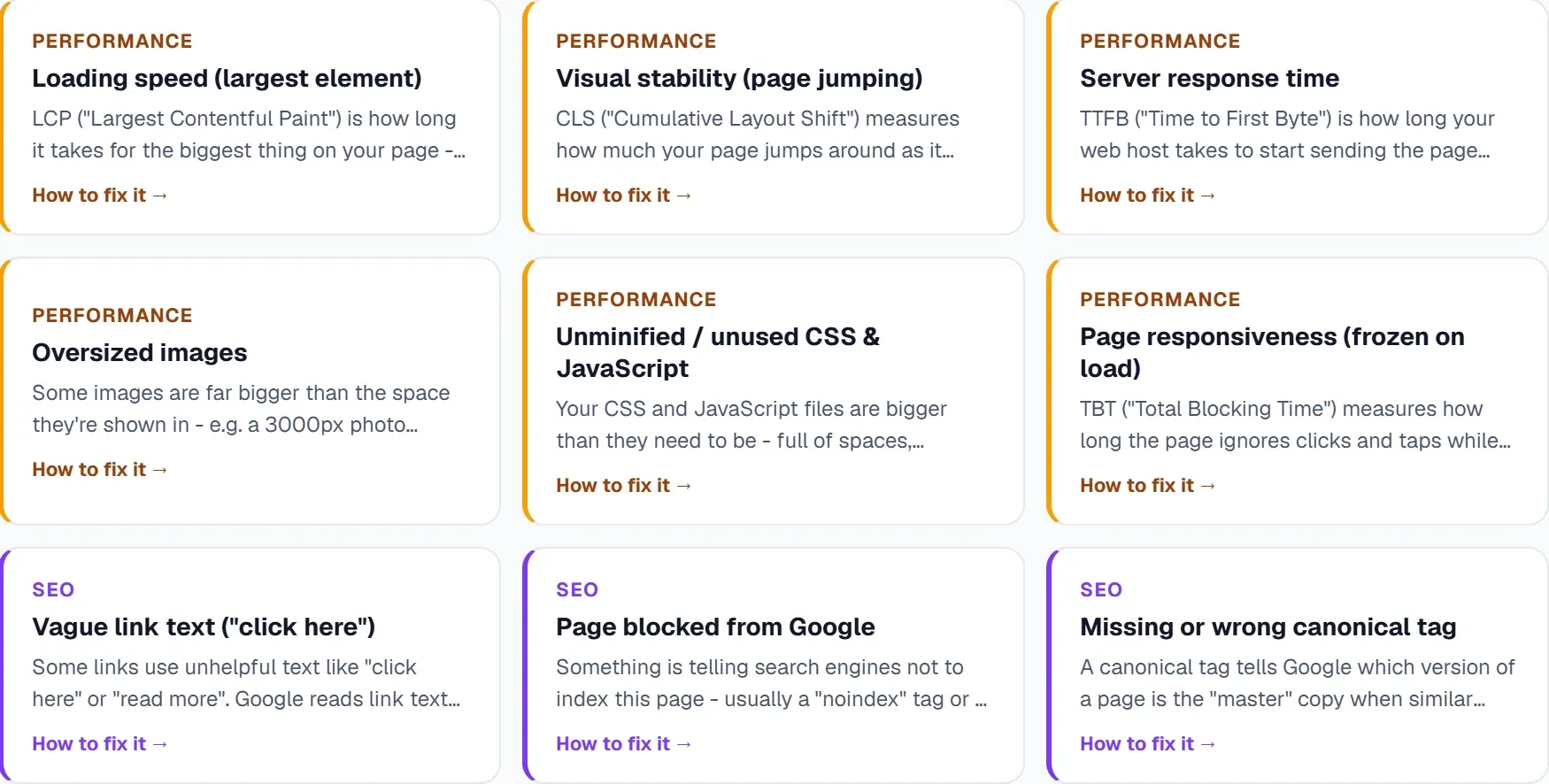 Each audit finding links to a plain-English guide on how to fix it, from loading speed to oversized images and blocked pages.
Comparison page audits
The "X vs Competitor" pages are SaaS gold dust and they need monthly attention because competitors update their positioning constantly. Read your top three comparison pages as a prospect would. Are the claims still accurate? Has the competitor launched a feature that invalidates one of your differentiators? Update the pages and resubmit to Search Console.
Pricing page indexability
This sounds trivial but pricing pages get accidentally noindexed surprisingly often, usually after a design refresh that copy-pastes a template from a marketing landing page that had noindex. Check the pricing page's indexability tag every month. Two seconds of work that occasionally saves a five-figure traffic disaster.
Blog content velocity vs decay
Most SaaS blogs publish weekly and assume the back catalogue keeps performing. It mostly does not. Look at the top 20 blog posts by traffic and check whether traffic per post is trending down. The bottom of that list usually needs either an update or a content consolidation. The top usually needs a content refresh every six months to stay current.
Integration pages
If your SaaS connects with other tools, each integration page is a small SEO asset capturing the search "your tool plus their tool." These pages decay if not maintained. A monthly check that they still exist, still index, and still show the right product information catches stale pages before they damage rankings.
Documentation crawlability
SaaS docs are often hosted on a subdomain with their own indexing rules. Make sure the docs are either fully indexed (helpful for long-tail search) or fully noindexed (to prevent thin-page issues). The worst state is half-indexed where some doc pages help and others hurt.
Site search query analysis
Most SaaS marketing sites have an on-site search box. The queries users actually type are a goldmine for content ideas. Pull the top 50 monthly site-search queries and identify any that suggest unmet content needs, usually these become next month's blog backlog.
Competitor monitoring
Track three direct competitors' new content publication and major site changes. Twenty minutes a month of competitor browsing usually reveals one or two strategic moves worth responding to. This is a creative exercise more than a checklist exercise.
Tooling that supports the cadence
For SaaS at this scale, a continuous SEO monitor with weekly rank updates and template-specific audits is the right shape of tool. UtilitySEO handles the multi-template SaaS site well, pricing pages, comparison pages, blog, integrations all get tracked separately without manual configuration. The monthly health check then becomes interpreting the data the tool already collected rather than running it from scratch.
A SaaS team that runs this monthly health check consistently for six months has a real-time understanding of their SEO position. Skipping it sets up the eventual scramble when a quarterly review reveals a problem nobody noticed three months ago.
Frequently asked questions
A specialized monthly SEO health check is crucial for SaaS companies because their websites have unique structures and priorities compared to general businesses.
- It focuses on a smaller site with high-value conversion pages.
- Avoids unnecessary tasks from generic, extensive SEO audits.
- Ensures critical pages like pricing and integrations remain optimized.
- Saves marketing teams time by targeting relevant metrics.
To monitor high-value SaaS pages, track their search ranking positions for top queries monthly as part of your monthly SEO health check.
- Identify your top three queries for each high-value page.
- Check for ranking movements exceeding two positions.
- Prioritize stability over rapid gains for these critical pages.
- Investigate any significant drops immediately.
Tracking branded search trends is important for your monthly SEO health check as it indicates product-market traction and brand marketing effectiveness.
- Use Google Search Console to monitor branded impressions and clicks.
- Upward trends suggest growing brand recognition and demand.
- Flat or declining trends signal potential issues to leadership.
- It provides early insight into overall business health.
You should audit your SaaS comparison pages monthly as part of your monthly SEO health check to ensure their accuracy and competitive edge.
- Competitors frequently update features and positioning.
- Verify claims made about your product and competitors.
- Update content promptly if differentiators change.
- Resubmit updated pages to Google Search Console.
A SaaS pricing page not being indexed risks significant loss of trial sign-ups and revenue, which a monthly SEO health check helps prevent.
- Accidental noindexing often occurs after design updates.
- Unindexed pricing pages disappear from search results.
- This issue can lead to five-figure traffic and revenue disasters.
- A quick monthly check ensures it remains visible to prospects.
An seo health check is a systematic evaluation of your website's technical infrastructure, content quality, and overall search engine optimisation. It helps identify issues.
- It's like a medical exam for your digital presence.
- Reveals technical problems, content gaps, and optimisation opportunities.
- Helps catch problems before they seriously impact rankings.
- Prevents declining organic traffic over time.
Fixing technical issues identified during an seo health check involves addressing problems like crawlability, indexation, and site speed for better performance.
- Ensure search engines can properly access and understand content.
- Review robots.txt for any accidental page blocks.
- Check for XML sitemap errors and correct them.
- Resolve slow loading speeds and broken links promptly.
An seo health check commonly uncovers critical issues such as technical errors, slow loading speeds, broken links, and poor mobile optimisation affecting rankings.
- Identifies robots.txt misconfigurations blocking content.
- Reveals XML sitemap errors preventing content discovery.
- Highlights crawlability and indexation problems for search engines.
- Pinpoints content gaps or quality issues.
Yes, a thorough seo health check can significantly improve your website's Google rankings by resolving underlying technical and on-page issues effectively.
- Boosts visibility by ensuring proper crawling and indexing.
- Optimises site performance, user experience, and mobile-friendliness.
- Helps your site adapt to evolving Google algorithms.
- Prevents technical debt from negatively impacting performance.
Your website might not be ranking due to overlooked technical and on-page factors that an seo health check can effectively identify and resolve.
- Hidden issues could be silently destroying search rankings.
- Unaddressed technical problems lead to declining organic traffic.
- Google's algorithms continuously evolve, requiring maintenance.
- Competitors prioritizing site health may be outperforming you.
Know what to fix next.
Scan your site for a clearer place to start.
About 30 seconds. No card needed.