

SEO
What Is an AI Visibility Score, and How Is It Measured?
Discover how AI visibility scores work, how they differ from SEO rankings, and how to measure your brand's presence in AI-generated answers.
An AI visibility score quantifies how often a brand appears in answers generated by large language models. It measures the frequency and prominence of your name within AI-generated text rather than traditional search engine result pages (SERP). This metric tracks your presence in the new era of answer-based search.
Many marketers confuse this with standard SEO rankings. Traditional SEO tracks where a page sits in a list of blue links. AI visibility tracks whether a model cites the brand at all. This distinction matters because users increasingly trust AI summaries over browsing multiple websites.
What does an AI visibility score actually measure?
There is no single standard definition for an AI visibility score. Different tools calculate it using different methods. Some focus on the number of times a brand is named. Others look at the position of the citation within the answer. A few measure sentiment or the specific prompts that trigger a mention.
The core concept remains consistent: it is a proxy for how visible your brand is to AI assistants. If a user asks, "What is the best project management tool for remote teams?" and the AI answers, "Jira is a popular choice," Jira has high visibility for that query. If the AI never mentions your brand, your score for that query is zero.
This metric differs from an AI visibility index, which might try to normalize data across different models. An AI visibility report typically breaks down these scores by specific prompts, models, and time periods. The goal is to understand where you stand in the AI conversation compared to competitors.
How is the score calculated in practice?
Calculations vary by provider, but most rely on three common measures. The first is share of answers naming a brand. This counts how many times the brand appears in a set of generated responses. The second is position in the answer. Being mentioned first carries more weight than being mentioned last. The third is citations. Some tools check if the AI provides a link or source attribution to your domain.
In our own methodology, share of voice is defined as the percentage of 40 answers from one AI model that named a brand at least once. You can see this approach in detail in our study on which SEO tools AI assistants recommend. This specific metric allows for direct comparison between brands within the same model and prompt set.
Other tools may use weighted averages or sentiment analysis. However, the fundamental input data is the same: prompts sent to AI models and the text returned. The difference lies in how that text is parsed and aggregated into a single number.
Why do definitions vary so much across tools?
The variation exists because there is no central authority regulating AI visibility metrics. Each tool defines its own success criteria. Some focus on brand awareness, while others focus on commercial intent. A tool might measure "brand recall" or "recommendation rate."
This lack of standardization can lead to confusion. A high score on one platform does not guarantee a high score on another. For example, a brand might be frequently mentioned by ChatGPT but rarely by Claude. An AI visibility index that averages these would hide that disparity.
Understanding the specific methodology behind a score is critical. Always check what prompts are used, which models are tested, and how "visibility" is defined. Without this context, the number is just a data point without direction.
How can you measure your own AI visibility?
You can measure your AI visibility by creating a standardized set of prompts relevant to your industry. Send these prompts to major AI models like ChatGPT, Gemini, Perplexity, and Claude. Record whether your brand is mentioned, where it appears, and if a link is provided.
Here is a step-by-step procedure to calculate a basic share of voice:
- Define a list of 40 specific prompts. These should mirror real user questions. For example, "Best CRM for small business" or "How to optimize email deliverability."
- Send each prompt to one specific AI model. Ensure the model settings are consistent across all tests.
- Review the 40 responses. Mark each one as "Mentioned" or "Not Mentioned."
- Calculate the percentage. If 12 out of 40 responses mention your brand, your share of voice is 30%.
- Repeat this process for your top three competitors using the same prompts and model.
This manual approach provides a baseline. It shows exactly where you stand. It also highlights which specific queries trigger mentions and which do not.
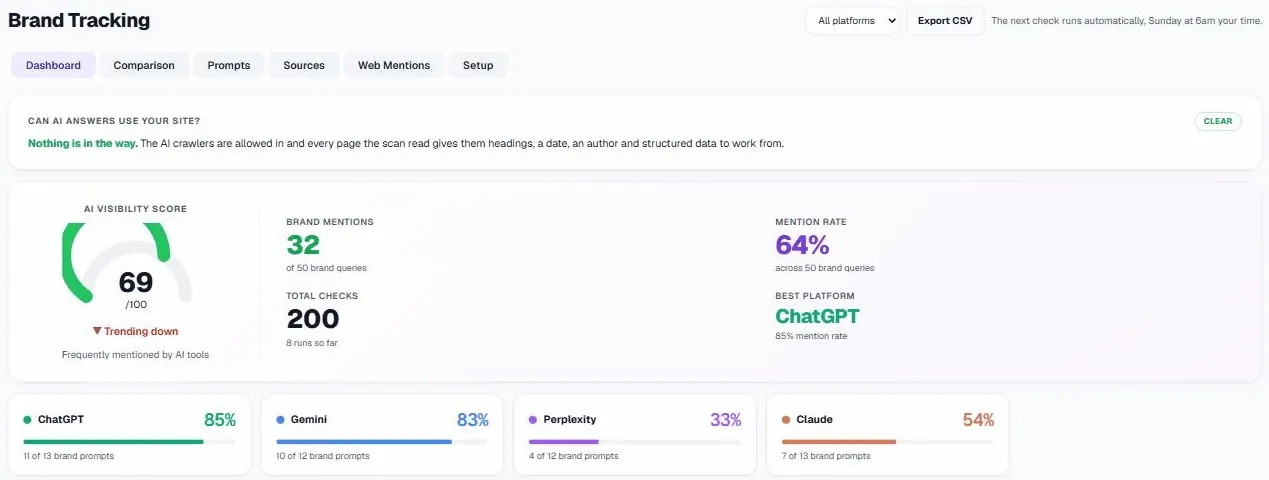 Brand Tracking first checks whether AI crawlers can use the site, then measures how often ChatGPT, Gemini, Perplexity and Claude mention the brand.
How does this apply to SaaS and local businesses?
The impact of AI visibility varies by vertical. For SaaS companies, visibility often correlates with lead generation. If an AI recommends your tool for a specific use case, users are more likely to click through. For local service businesses, visibility might drive phone calls or map directions.
Multilingual optimization plays a significant role here. AI models handle language nuances differently. A brand might be highly visible in English prompts but invisible in Spanish or French queries. Non-technical marketers can address this by ensuring their content is available in multiple languages. This includes creating localized landing pages and FAQs.
Voice search optimization also influences AI visibility. AI assistants often process voice queries. Phrasing your content to match natural speech patterns can improve how AI models interpret your brand. This is distinct from traditional keyword stuffing. It requires understanding conversational intent.
Is an AI visibility score the same as SEO ranking?
No, they are distinct metrics. SEO ranking measures where a page appears in a list of results on a search engine. AI visibility measures whether a brand is mentioned in a synthesized answer. A page can rank number one on Google but not be mentioned by an AI. Conversely, a brand can have high AI visibility without ranking highly for specific long-tail keywords.
Traditional SEO focuses on crawlability and link authority. AI visibility focuses on content quality, structure, and how well the information is presented to large language models. Google has advised creators to create helpful, reliable, people-first content. This principle applies to AI visibility as well. AI models are trained on high-quality, trustworthy sources.
You can check your site's readiness for AI citation using a Free AEO Scan. This tool checks whether AI crawlers can access your site and how your content is structured for answer engines.
How to tell if your AI visibility strategy is working?
Monitor changes in your share of voice over time. Run the same set of prompts monthly. Track if your mention rate increases or decreases. Look for trends in specific models. If your visibility drops in one model, investigate what changed.
Also track AI referral traffic. Tools like Google Analytics can show visitors arriving from AI platforms. If your AI visibility score rises and your traffic from these sources increases, the strategy is working.
Compare your score against competitors. If your share of voice grows while competitors decline, you are gaining ground. If everyone rises, the overall market is shifting toward AI answers.
Utilize AI Insights to prioritize fixes based on real crawl data. This helps identify technical barriers that might prevent AI models from citing your content.
Summary
An AI visibility score measures how often a brand is mentioned in AI-generated answers. It is not a standard metric, and definitions vary by tool. Common measures include mention frequency, position in the answer, and citations. You can calculate a basic score by testing a set of prompts across multiple AI models. For SaaS and local businesses, this metric influences lead generation and brand awareness. It is distinct from traditional SEO ranking. Tracking changes over time and comparing against competitors reveals whether your strategy is effective.
Frequently asked questions
Your ai visibility score is calculated by measuring how often your brand is named in AI‑generated answers and weighting the position of each mention.
- Count brand mentions across a sample of model responses.
- Assign higher weight to first‑sentence citations.
- Include any source links or citations as additional points.
Your ai visibility score is lower than your SEO ranking because AI models prioritize relevance and recent data over traditional keyword rankings.
- AI models use different training data sets.
- They favor brands frequently cited in recent queries.
- SEO rankings reflect link authority, not AI citation frequency.
The most influential factors in an ai visibility score are mention frequency, citation position, and the presence of source links within AI responses.
- Higher mention count boosts the score.
- First‑place mentions receive greater weight.
- Linked citations add extra credibility points.
You can improve your ai visibility score without paid advertising by increasing brand mentions in high‑quality content and optimizing prompts for AI models.
- Publish authoritative articles on relevant topics.
- Encourage backlinks from reputable sites.
- Use clear, AI‑friendly language in FAQs.
Know what to fix next.
Scan your site for a clearer place to start.
About 30 seconds. No card needed.