

SEO
Internal Link Recommendations: The Anchor and Target Workflow
Learn advanced internal link recommendations focusing on anchor text and target workflow for better SEO and user experience.
Effective internal link recommendations are crucial for guiding users and search engines through your site. This workflow involves carefully selecting anchor text and identifying optimal target pages. Understanding how to build a robust internal link graph improves content discoverability and distributes authority across your domain. This post explores advanced strategies for identifying internal link opportunities and measuring their impact.
The Strategic Importance of Internal Linking
Internal links are more than just navigation. They define relationships between your content, signal importance to search engines, and reduce crawl depth for key pages. A well planned internal link graph enhances user experience by providing relevant pathways through your site. It also helps search engines understand your site's structure and the thematic connections between pages. Poor internal linking can lead to orphan pages and diluted authority.
Identifying Internal Link Opportunities
Finding the right internal link opportunities, especially on large sites, requires a data driven approach. Basic audits identify broken links or redirect chains, but a deeper analysis uncovers strategic placements. Consider pages with strong authority that could pass equity to newer or less prominent content. Look for pages that rank for similar keywords, indicating a thematic connection. For example, a high authority blog post about "sustainable gardening tips" could link to a product page for "organic compost," using descriptive anchor text distribution.
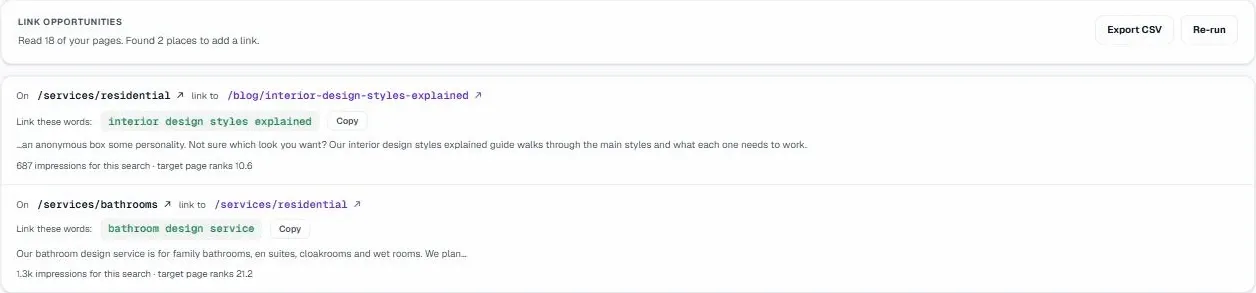
UtilitySEO provides specific tools to pinpoint these opportunities. The Internal link recommender feature suggests the exact phrase, source page, and target. This moves beyond manual guesswork, offering concrete recommendations. The Orphan page detection feature identifies pages with no internal links pointing to them, highlighting content that needs integration into your site's structure. Understanding your site's crawl depth analysis also helps identify pages that are too many clicks from the homepage, indicating they might need more direct internal links.
Crafting Effective Anchor Text Distribution
Anchor text is the clickable text in an internal link. It provides context to both users and search engines about the linked page's content. Generic anchor text like "click here" offers little value. Instead, use descriptive, keyword rich phrases that accurately reflect the target page's topic. For instance, linking to a page about "eco friendly cleaning products" should use anchor text such as "eco friendly cleaning products" or "sustainable household cleaners."
Over optimisation of anchor text can be detrimental. Aim for natural language and a diverse range of relevant phrases. Analysing your existing anchor text distribution helps identify areas for improvement. If many links use the exact same phrase, consider varying them with synonyms or related long tail keywords. This ensures a healthy and natural internal link graph.
Measuring Internal Link Effectiveness
Measuring the impact of internal linking goes beyond simply checking for broken links. Focus on metrics that reflect user engagement and conversion rates. Track how internal links influence user journeys. Do users click through to related content? Does a new internal linking strategy reduce bounce rates on specific pages?
While direct conversion tracking for internal links can be complex, you can infer effectiveness by monitoring changes in page rankings, traffic to target pages, and engagement metrics within analytics. For example, if you implement internal link recommendations to a product page, monitor its organic search traffic and conversion rate in the weeks following. UtilitySEO's GA4 integration can show sessions and conversions, while the GSC integration tracks keywords, pages, positions, clicks, and impressions, allowing you to correlate internal linking efforts with SEO performance. The Crawl comparison feature can diff two site snapshots to isolate changes after implementing internal linking updates.
Integrating Internal Linking with Content Strategy
Internal linking should be an integral part of your overall content strategy. When planning new content, consider how it will connect to existing pages. Identify content clusters where related articles and guides can link to a central "pillar page." This contextual internal linking strategy strengthens the authority of your pillar page and improves the discoverability of supporting content.
For example, an e-commerce site selling outdoor gear might have a pillar page on "hiking boot guides." Supporting articles on "choosing waterproof boots," "boot care tips," and "best hiking trails" would all link back to the main guide, and to each other where relevant. This creates a strong internal link graph around a core topic. UtilitySEO's Content Opportunities feature can help identify pages that are striking distance or low CTR, which could benefit from stronger internal linking to improve their performance. The Blog Plan feature can also help structure new content with internal linking in mind from the outset.
UtilitySEO and Your Internal Link Workflow
UtilitySEO provides a powerful suite of features to streamline your internal link workflow. Our Internal link recommender identifies specific links to create, including the exact anchor text and target URL. This removes the guesswork from internal linking. The Orphan page detection feature ensures no valuable content remains isolated.
Beyond recommendations, UtilitySEO's Full site crawl identifies issues like broken links detection and redirect chain detection, crucial for maintaining a healthy internal link graph. Our Content audit provides quality signals per page, helping you prioritise which pages need internal linking attention. The Multi-model audit can provide consensus on page quality, further informing your linking strategy. By regularly using these tools, you can continuously optimise your internal linking for improved SEO and user experience. Visit our Pricing page to learn more about how our platform can support your SEO efforts.
Frequently asked questions
Internal link recommendations are suggestions for creating links between pages on the same website, which are important for guiding users and search engines through your site and distributing authority.
- They define relationships between content.
- They signal importance to search engines.
- They enhance user experience by providing relevant pathways.
- They help reduce crawl depth for key pages.
You can find opportunities for internal link recommendations by using a data-driven approach to identify pages that can pass equity or have thematic connections.
- Look for high-authority pages to link from.
- Identify pages ranking for similar keywords.
- Utilize tools like internal link recommenders.
- Check for orphan pages that need integration.
Effective anchor text is the clickable text in an internal link that provides context to users and search engines about the linked page's content.
- Use descriptive, keyword-rich phrases.
- Ensure it accurately reflects the target page's topic.
- Aim for natural language and diverse phrasing.
- Avoid over-optimization with generic terms like "click here."
Anchor text distribution is important for internal link recommendations because it ensures a natural and healthy internal link graph, providing diverse context to search engines and users.
- It prevents over-optimization penalties.
- It varies the context for linked pages.
- It uses synonyms and long-tail keywords.
- It helps search engines understand content themes.
You can measure the effectiveness of your internal link recommendations by focusing on metrics that reflect user engagement and conversion rates, and by monitoring user journeys.
- Track user click-through rates on internal links.
- Monitor bounce rates on specific pages.
- Observe if users navigate to related content.
- Infer effectiveness through changes in site performance.
Know what to fix next.
Scan your site for a clearer place to start.
About 30 seconds. No card needed.