
Contextual Internal Linking for Sites Over 1000 Pages

Optimise your internal link graph to boost rankings for large websites with over 1000 pages.
Large websites often suffer from diluted authority because their internal linking structure lacks strategic intent. When a site exceeds one thousand pages, random linking patterns fail to guide search engine crawlers to your most valuable content. This results in wasted crawl budget and missed ranking opportunities for high-potential pages. Effective contextual internal linking solves this by placing relevant links within body text to signal topical relevance and pass authority. This approach ensures that Google understands your site architecture and prioritises the pages that drive conversions.
Understanding the Internal Link Graph
The internal link graph represents the network of connections between every page on your domain. Search engines traverse this graph to determine which pages are important. A flat structure where every page links to every other page creates noise. A hierarchical structure with deep silos creates isolation. The goal is a balanced web where authority flows logically from high-traffic hubs to niche support pages.
You must monitor this structure regularly. As you add new content, the graph expands. Without maintenance, older pages become disconnected. This leads to orphan page detection becoming a critical task. Orphan pages are those with no internal links pointing to them. Google may still index them if they appear in your sitemap, but they will rarely rank well because they lack the trust signals passed through anchor text.
The Mechanics of Pagerank Sculpting
Pagerank sculpting involves directing link equity from high-authority pages to lower-authority pages that need a boost. You achieve this by strategically placing links in high-traffic blog posts or landing pages. The link acts as a vote of confidence. The more relevant the surrounding content, the stronger the signal.
This process requires careful anchor text distribution. Using the exact match keyword too frequently triggers spam filters. Using generic terms like "click here" wastes the opportunity to provide context. You should vary your anchor text with partial matches, synonyms, and branded terms. For a site with thousands of pages, manual management is impossible. You need data to identify which pages have high PageRank but no outgoing links to your money pages.
Practical Implementation Strategies
Start by identifying your cornerstone content. These are your best-performing pages that attract the most organic traffic. Audit these pages to see where they link internally. If they only link to the homepage or footer elements, you are missing an opportunity. Add contextual links to related service pages or detailed guides.
Next, review your new content strategy. Every new blog post should link to at least three existing relevant pages. This immediately integrates the new page into the internal link graph. It helps the new page get indexed faster and distributes authority to the older content.
Consider the user journey. Links should guide the reader to the next logical step. If a user reads a comparison article, link to the product page. If they read a troubleshooting guide, link to the support documentation. This improves dwell time and reduces bounce rates.
Managing Scale with UtilitySEO
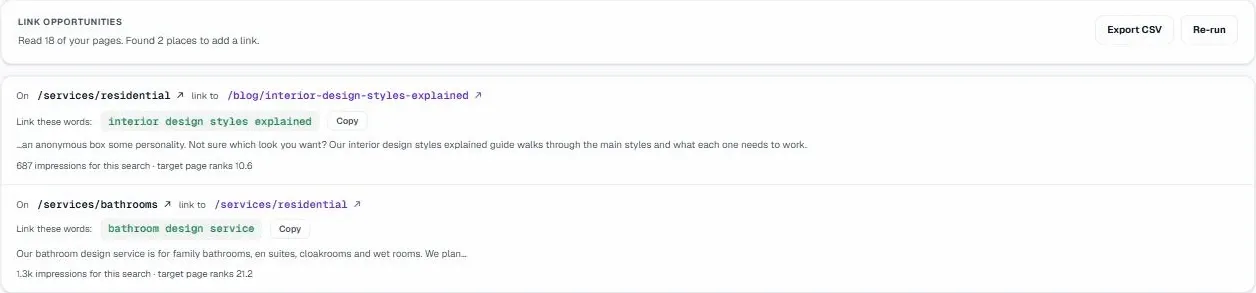
Manual auditing of a thousand-page site is inefficient. UtilitySEO automates the discovery of linking opportunities. The platform uses a full site crawl to map your entire internal structure. This crawl supports up to 1,000 pages per project and renders JavaScript correctly. This ensures that React and Vue applications are scanned accurately.
The orphan page detection feature highlights pages with zero internal inbound links. You can then decide whether to add links to these pages or remove them from the sitemap if they are obsolete. The Internal link recommender feature suggests specific anchor text, source pages, and target pages. It calculates the potential upside based on keyword difficulty and current rankings.
You can also use the Crawl depth analysis to see how many clicks it takes to reach specific pages. Pages buried deeper than four clicks often struggle to rank. The tool identifies these shallow vs deep pages so you can adjust your navigation or add contextual links in high-traffic areas.
For ongoing maintenance, the Scheduled weekly re-crawls feature tracks changes over time. You can compare two site snapshots to isolate whether a recent ranking drop correlates with a change in your internal linking structure. This data-driven approach removes guesswork from your SEO strategy.
Conclusion
Contextual internal linking is a foundational SEO tactic that scales poorly without automation. As your site grows, the complexity of your link graph increases. You need to balance authority flow with user experience. Use tools to detect orphans, optimise anchor text, and recommend new links. This ensures that every page on your site contributes to your overall ranking potential.
Start by auditing your current structure. Identify your top ten pages by traffic and check their internal links. Use the data to inform your next content update. For a deeper dive into tracking these changes over time, read our guide on Year On Year SEO for SaaS Marketing Teams.
Frequently asked questions
why is contextual internal linking important for large websites
Contextual internal linking boosts rankings by signaling topical relevance and passing authority to high-potential pages on large sites.
- Guides crawlers to valuable content efficiently.
- Prevents wasted crawl budget on low-value pages.
- Strengthens site architecture for better ranking.
how do you fix orphan pages on a site with over 1000 pages
Fix orphan pages by adding relevant **contextual internal linking** from high-traffic hub pages to boost their visibility.
- Audit site to find disconnected pages.
- Identify high-authority pages for backlinks.
- Insert links naturally within body text.
what is the best anchor text strategy for internal links
The best strategy varies anchor text with partial matches and synonyms to avoid spam filters while maintaining **contextual internal linking**.
- Avoid exact match keyword overuse.
- Use branded terms and generic phrases.
- Ensure text matches surrounding content context.
how does pagerank sculpting work with internal links
Pagerank sculpting directs link equity from high-authority pages to lower-authority pages through strategic **contextual internal linking** placement.
- Link from high-traffic blog posts.
- Signal importance to search engines.
- Boost rankings for niche support pages.
can I automate internal link audits for large sites
You can automate audits using tools that map your **contextual internal linking** structure to identify opportunities across thousands of pages.
- Use full site crawl tools.
- Discover missing links automatically.
- Scale maintenance without manual effort.
Keep reading
See how your site actually scores
Free 30-second scan, real Google scores and a ranked fix list. No signup needed.
No credit card · Cancel anytime