

SEO
Rank Tracking on a Small Budget: Three Workflows
Three practical rank-tracking workflows for small budgets, from fully manual to almost-automated, with the trade-offs of each.
Workflow one: weekly manual tracking, free
For sites tracking under 20 keywords in one location, manual tracking is genuinely viable. Open an incognito window, search each query, note the position. Keep the list in a spreadsheet with one column per week. The data quality is fine, incognito plus a private browser profile gives you a close approximation of the unpersonalised SERP. The cost is your time, roughly 30 minutes a week. This workflow scales to about 50 keywords before it becomes unbearable.
The downside is location accuracy. Manual searches happen from your IP, which means you cannot easily check rankings in cities you do not live in. For most small businesses serving one local area, this does not matter. For businesses operating in multiple cities, this is the workflow's hard ceiling.
Workflow two: free-tier rank tracking, automated
Several SEO tools offer a free tier that includes rank tracking for a handful of keywords. The catch is keyword count, most free tiers cap at numbers below what you actually want to track.
The workflow that works here is to use the free tier for your top 10 most-important queries and accept that the rest of your keyword list is tracked manually or not at all. This works for businesses where there are clearly 10 queries that drive most of the value and the long tail is interesting but not critical.
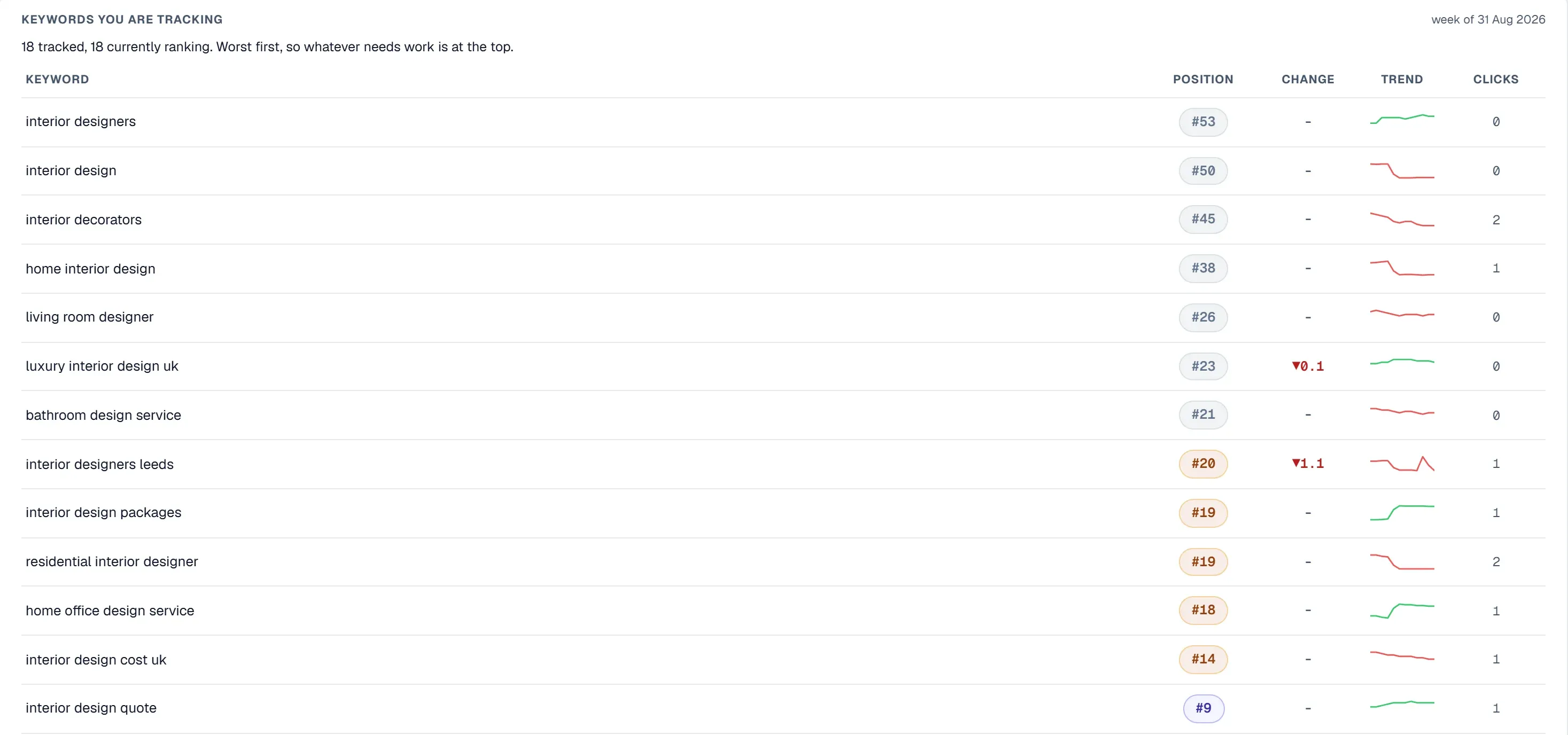 Tracked keywords with their position, change, a trend sparkline and clicks, worst first.
Workflow three: cheap paid tier, hundreds of keywords
Below £40 a month, you can get automated rank tracking for around 500 keywords across multiple locations. This is the right tier for most small businesses past their initial launch phase. The differences between tools at this price point are mostly UX and integration, the underlying rank data is similar quality. Pick based on which tool's dashboard you actually want to look at every week.
Demo a few and pick the one whose workflow matches your actual review cadence.
Choosing between the workflows
The decision is mostly about volume and review cadence. If you have fewer than 20 keywords that matter and you check rankings weekly, workflow one is fine and saves money. If you have 50-100 keywords and want automated tracking, workflow two on a free tier gets you the most important subset. If you have hundreds of keywords across multiple locations and need this data for decisions, workflow three is the right investment.
What rank tracking actually tells you
The temptation with any rank-tracking workflow is to over-react to small movements. A keyword that drops from position 4 to position 6 is usually noise, Google's SERP varies day to day even when nothing on your site has changed. The signal in rank tracking is multi-week trends, not single-day movements. Build your review cadence around comparing this month to last month, not today to yesterday. For a deeper dive, check out our guide on Mastering Rank Tracking.
When to step up to enterprise tracking
The transition from cheap paid tier to enterprise rank tracking usually happens around the point where you are tracking 2000+ keywords, multiple country-level locations, and feeding the data into a wider business intelligence stack. Below that scale, the additional features of enterprise plans are real but not worth the price increase. Most businesses that think they need enterprise rank tracking actually need to be more disciplined about which keywords matter. You can also explore Best Rank Tracking Software for more options.
The fundamental truth about rank tracking
Rank data is interesting, but rankings do not directly cause revenue, clicks do. Pair any rank tracking workflow with Search Console click data and you get a much clearer picture of which ranking changes actually matter financially. A position-3 page getting 100 weekly clicks is more valuable than a position-1 page getting 10 weekly clicks, and only the click data tells you that.
The right rank-tracking workflow is the cheapest one that produces useful data at the cadence you actually use. Most small businesses can stay on workflow one or two indefinitely without compromising their SEO programme. For more insights on this, read our article on Mastering Keyword Tracking: Tips and Tools for SEO Success.
Further reading
Frequently asked questions
There are three primary workflows for effective rank tracking on a small budget, ranging from fully manual to almost automated solutions. - Manual tracking is free for under 50 keywords. - Free-tier SEO tools offer automated tracking for a few critical keywords. - Affordable paid tiers provide automated tracking for hundreds of keywords.
You can manually perform rank tracking by searching your keywords in an incognito browser and recording positions in a spreadsheet, a free method viable for under 50 keywords. - Use incognito mode for unpersonalized search results. - Record weekly positions in a simple spreadsheet. - This workflow takes about 30 minutes per week. - Location accuracy is limited to your physical IP address.
Yes, several SEO tools offer free tiers or trials that include automated rank tracking for a limited number of keywords, typically 10-30. - Use these free tiers for your top 10 most important queries. - Examples include free tiers of Mangools or UtilitySEO trials. - This approach works well when a few keywords drive most value. - Automated tracking saves time compared to manual checks.
A reasonable budget for automated rank tracking of hundreds of keywords across multiple locations is typically under £40 per month for most growing small businesses. - Expect around 500 keywords tracked automatically. - Tools like UtilitySEO, Semrush, and Ahrefs offer entry-level plans. - Compare user experience and integration features when choosing a tool. - Automated tracking provides consistent, multi-location data.
Choosing the best rank tracking method depends primarily on your keyword volume and how frequently you need to review your rankings. - Manual tracking is ideal for fewer than 20 critical keywords checked weekly. - Free-tier automation suits 10-30 highly important keywords. - Paid tiers are best for hundreds of keywords across various locations. - Consider the trade-offs between cost, time, and data accuracy.
Know what to fix next.
Scan your site for a clearer place to start.
About 30 seconds. No card needed.