

SEO
Web Mentions vs AI Mentions: Tracking Both Modes of Discovery
Understand the difference between web mentions and AI mentions to effectively track brand visibility in the evolving digital landscape.
Understanding how your brand is discovered online has become more complex. Traditionally, web mentions vs AI mentions referred to how often your brand appeared across websites. Now, with the rise of conversational AI, a new dimension exists. This shift requires a nuanced approach to brand mentions tracking, distinguishing between traditional web appearances and mentions within AI models like ChatGPT or Gemini. Ignoring one over the other means missing crucial insights into your brand's visibility and reputation. This article explores both types of mentions, their distinct impacts, and how to track them effectively.
The Divergence of Web Mentions and AI Mentions
Web mentions are the classic form of brand visibility. These are instances where your brand name, products, or services appear on websites, blogs, news articles, and social media platforms. They contribute to traditional SEO through backlinks and brand authority. An effective web mentions tool focuses on crawling the open web to identify these occurrences, often providing context and sentiment analysis. These mentions are typically driven by human content creators linking to or discussing your brand.
In contrast, AI mentions occur when large language models (LLMs) reference your brand in their responses to user queries. This includes direct recommendations, factual statements, or even implicit references based on their training data. A critical distinction arises between AI citations and AI mentions. AI citations are when an LLM explicitly links to or references a specific source for information, indicating trust in the data's origin. AI mentions, however, are when the LLM names a brand directly, often as a recommendation or part of a factual answer, indicating trust in the brand itself. An LLM might cite your content as a source but then mention a competitor as a recommended solution, creating a "Mention-Source Divide." This highlights the importance of comprehensive brand visibility tracking across both paradigms.
Bridging the Mention-Source Divide: Ethical Considerations
The "Mention-Source Divide" presents ethical implications. When an AI system cites content from one source but then recommends a competitor, questions arise about fair credit and intellectual property. Content creators invest significant resources into generating original research and valuable information. If their content is used to inform an AI's response, but the direct traffic or brand recognition benefits go to a competitor through an AI mention, it undermines the value exchange. This scenario can lead to content creators seeing their work consumed without adequate attribution or the associated traffic.
User perception also plays a role. Users might implicitly trust an AI's direct recommendation more than a cited source they may or may not click through to. The direct mention carries an authoritative weight. Addressing this requires transparency from AI platforms about how recommendations are generated and how sourced information contributes to those recommendations. Brands must focus on building such strong semantic associations within AI training data that their content is not only cited but also mentioned as a primary solution.
Strategies for Earning Both Citations and Mentions
To effectively bridge the gap between AI citations and AI mentions, brands need a dual strategy. For citations, focus on creating high quality, authoritative content that AI models can easily retrieve and understand. This means clear, well structured articles, data driven reports, and comprehensive guides. Ensuring your site architecture is logical and your content is semantically rich helps AI parse information accurately.
For AI mentions, the strategy shifts towards pervasive brand association. This involves standardising business information across all online properties, ensuring consistent brand messaging, and building a strong digital footprint. The more frequently and consistently your brand appears in positive contexts within the AI's training data, the higher the likelihood of direct mentions. This includes consistent social media activity, PR mentions, and user generated content.
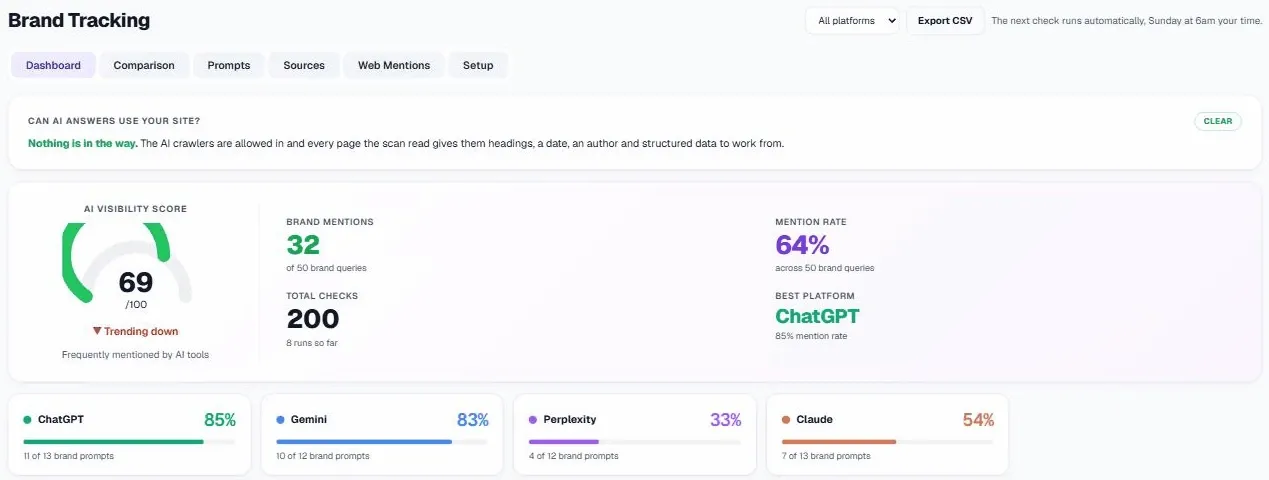
UtilitySEO's AI Visibility features can assist in this area. Our Brand Tracking monitors your mention rate across leading LLMs such as ChatGPT, Gemini, Perplexity, and Claude. This provides insight into your share of voice vs competitors in the AI space. We also offer Sentiment analysis on brand mentions, helping you understand the tone of these AI references. The AI prompt suggester assists in designing prompts that are more likely to elicit relevant brand mentions, guiding your content strategy. Tracking AI referral traffic from platforms like ChatGPT and Perplexity helps quantify the direct impact of these mentions on your website visits.
The Evolving Landscape of AI Recommendations
The potential for AI-generated mentions to be manipulated is a concern. Brands might attempt to "game" the system by artificially inflating their online presence or creating repetitive content. AI platforms are continually evolving their algorithms to detect and penalise such tactics, similar to how search engines combat spam. They prioritise genuine authority, relevance, and helpfulness. This means that authentic brand building remains paramount.
The legal landscape around AI-generated content and brand recommendations is also in its nascent stages. As AI becomes more integrated into daily life, regulations regarding intellectual property, fair use, and advertising standards will likely expand to cover AI outputs. Brands need to stay informed about these developments to ensure their strategies remain compliant and ethical.
UtilitySEO provides tools like Robots.txt and llms.txt tester which allows you to manage how different AI crawlers interact with your site, grouped by search, AI answers, and AI training. This control is crucial for managing your digital footprint in the AI era. For deeper understanding of how AI mentions fluctuate, our Citation churn alerts notify you when your mention rate drops, allowing for quick adjustments to your strategy. You can also explore insights into these fluctuations through our blog post on Citation Churn in AI Answers: Why Your Mention Rate Drops Weekly.
Conclusion
The distinction between web mentions and AI mentions is no longer a theoretical concept but a practical challenge for brand visibility. Effective brand mentions tracking now demands monitoring both traditional web appearances and AI-generated references. By understanding the nuances of the "Mention-Source Divide" and implementing strategies to earn both citations and direct mentions, brands can ethically enhance their authority and drive engagement. UtilitySEO offers the tools and insights necessary to navigate this complex landscape, ensuring your brand achieves comprehensive visibility in both human and AI driven discovery channels. Explore our workflow to see how our platform integrates these tracking capabilities into your SEO strategy.
Questions fréquentes
The key difference between web mentions vs AI mentions lies in their origin: web mentions are traditional brand appearances on websites, while AI mentions occur when large language models (LLMs) reference your brand in their responses.
- Web mentions are driven by human content creators.
- AI mentions are generated by AI models like ChatGPT.
- Web mentions boost traditional SEO and brand authority.
- AI mentions influence user perception through AI recommendations.
AI mentions impact brand visibility by directly influencing user perception through AI recommendations, which can carry an authoritative weight, often bypassing the need for users to click through to a cited source, unlike web mentions.
- Web mentions drive traffic and backlinks.
- AI mentions build direct brand trust via AI.
- Users might trust AI recommendations implicitly.
- Missing AI mentions means missing a crucial visibility channel.
It is important to track both web mentions vs AI mentions to gain a comprehensive understanding of your brand's visibility and reputation across the entire digital landscape, ensuring no crucial insights are missed.
- Web mentions show traditional online presence.
- AI mentions reveal brand presence in conversational AI.
- Ignoring one leads to an incomplete view of discovery.
- Both contribute to brand authority in different ways.
The 'Mention-Source Divide' refers to the ethical dilemma where an AI system cites content from one source for information but then mentions or recommends a competitor as a solution, potentially undermining the original content creator's value.
- AI cites content but recommends a different brand.
- This can reduce traffic to the cited source.
- It raises questions about fair credit and IP.
- Brands need strategies to be both cited and mentioned.
Sachez quoi corriger ensuite.
Analysez votre site pour savoir clairement par où commencer.
Environ 30 secondes. Sans carte bancaire.