

SEO
Boosting Online Visibility with Proven Generative Engine Optimization Strategies
Discover the key competitors in the generative engine optimisation space, including SEMrush, Ahrefs, Moz, and Google Search Console.
UtilitySEO
UtilitySEO empowers you to master your generative engine optimisation strategy, providing the definitive insights needed to thrive in an AI driven search landscape.
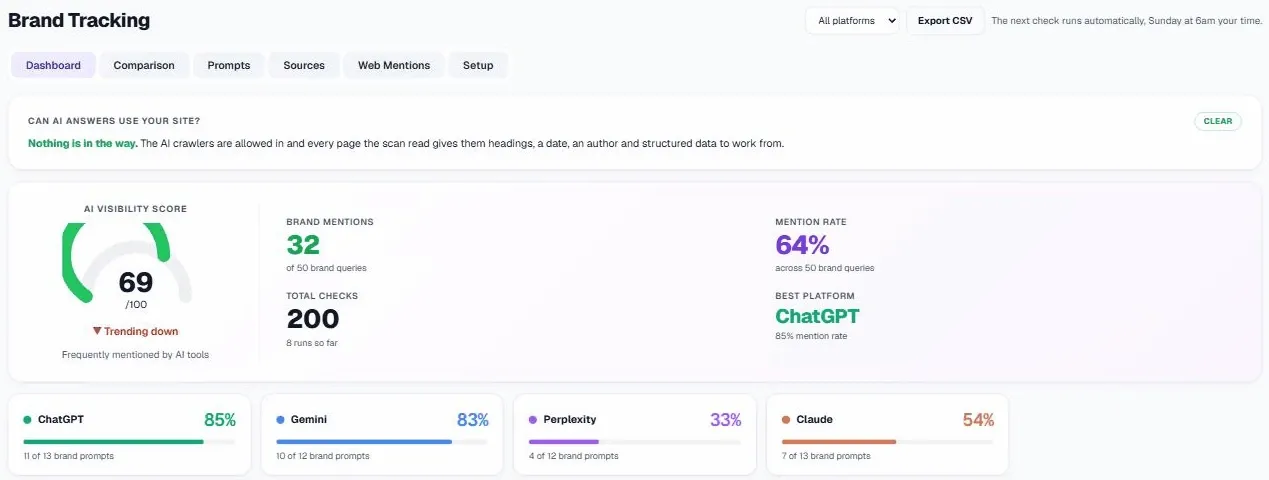 Brand Tracking first checks whether AI crawlers can use the site, then measures how often ChatGPT, Gemini, Perplexity and Claude mention the brand.
SEMrush
This platform provides a comprehensive ecosystem of digital marketing functionalities, encompassing keyword research, competitive analysis, technical SEO auditing, and content marketing analytics. Its sophisticated algorithms facilitate deep dives into organic search performance, backlink profiles, and PPC campaign efficacy, offering granular data for strategic generative engine optimisation. The integrated content marketing suite leverages machine learning heuristics to inform topic clusters, semantic relevance, and content brief generation, thereby enabling the production of content highly attuned to large language model processing and AI overview synthesis. Such multifactorial data aggregation supports the development of robust content strategies for enhanced algorithmic visibility and SERP dominance in evolving generative search landscapes.
Ahrefs
Predominantly recognised for its extensive backlink index and organic keyword research capabilities, this platform offers critical insights into link graph topology and query intent analysis. Its site audit functionality systematically identifies technical SEO impediments, ensuring optimal crawlability and indexation status essential for generative AI systems to process web content. The content explorer module facilitates the identification of high performing topical entities and content formats, informing data driven content creation strategies. Leveraging its robust data infrastructure, practitioners can reverse engineer competitor strategies and ascertain authoritative content vectors, crucial for optimising for semantic relevance and entity recognition within AI driven search paradigms.
Moz
With a foundational emphasis on domain authority and page authority metrics, this platform provides a framework for assessing website credibility and link equity, factors intrinsically linked to algorithmic trust signals. Its suite includes keyword explorer for granular query analysis, link explorer for backlink profile evaluation, and a robust site audit tool for technical diagnostics. The on page SEO grader assists in optimising content elements for semantic coherence and structural markup, which are paramount for effective content ingestion by large language models. These functionalities collectively support the development of content architectures and link acquisition strategies that enhance a site's overall topical authority and influence within generative search environments.
Google Search Console
This indispensable utility provides direct communication with Google's indexing and ranking systems, offering unparalleled first party data on website performance within organic search. It delivers critical insights into crawl errors, index status, core web vitals, and search query performance, directly informing technical and content optimisations for generative engine landscapes. Monitoring click through rates, impressions, and average position for specific queries allows practitioners to refine content for explicit query intent and identify opportunities for schema markup implementation. Understanding how Google perceives and processes a site's content via this console is fundamental for enhancing visibility and relevance in an era dominated by AI Overviews and sophisticated ranking algorithms.
SE Ranking
This all in one SEO platform integrates a diverse set of tools for keyword research, competitor analysis, technical site auditing, and rank tracking, all contributing to a holistic generative engine optimisation strategy. Its content marketing features, often incorporating AI assisted text generation and optimisation suggestions, support the creation of semantically rich and contextually relevant content. The platform's comprehensive approach to data aggregation across various SEO facets allows for a granular understanding of market dynamics and algorithmic shifts. This enables practitioners to strategically position digital assets for maximum impact within evolving search engine results pages and AI driven content synthesis.
Serpstat
This analytical platform provides a comprehensive toolkit for keyword research, competitive intelligence, backlink analysis, and site auditing, facilitating multifaceted generative engine optimisation efforts. Its robust data sets allow for the identification of high value keywords, analysis of competitor content strategies, and discovery of link building opportunities. The platform’s capacity to unearth semantically related terms and content gaps supports the creation of topically authoritative content designed for optimal processing by large language models. By providing a detailed overview of organic performance and technical health, it empowers practitioners to refine content strategies and site architecture for enhanced visibility in AI dominated search environments.
Ubersuggest
This tool offers functionalities for keyword discovery, content idea generation, competitive analysis, and backlink data exploration, aiding in the formulation of generative engine optimisation strategies. Its intuitive interface provides insights into search volume, keyword difficulty, and content performance metrics, informing content creation aligned with user intent and algorithmic preferences. The platform assists in identifying trending topics and analysing competitor content strategies, thereby facilitating the development of semantically rich and contextually relevant content. Leveraging its data, practitioners can identify opportunities to optimise existing content and create new assets designed for enhanced visibility within AI enhanced search environments and AI Overviews.
These platforms offer distinct functionalities that collectively empower practitioners to navigate the complexities of generative engine optimisation. Understanding their individual strengths and data provision capabilities is crucial for developing a comprehensive strategy for enhanced digital visibility. For deeper insights into leveraging Google's own tools, consider reading Unlock Google Search Console. To explore further strategies for AI driven search, refer to Maximizing Online Visibility with Effective Ai Overviews Seo Strategies for Business Success.
Questions fréquentes
Generative engine optimization is a strategic approach to enhance online visibility by aligning content and technical SEO with the processing capabilities of AI models and generative search systems.
- Optimizes content for large language model processing.
- Focuses on semantic relevance and entity recognition.
- Aims for dominance in evolving AI-driven SERPs.
- Leverages multifactorial data for robust strategies.
SEO tools like SEMrush and Ahrefs significantly bolster generative engine optimization efforts by providing critical data for keyword research, competitive analysis, and content strategy.
- Offer deep dives into organic search performance.
- Identify technical SEO impediments for optimal crawlability.
- Inform topic clusters and content brief generation.
- Help reverse engineer competitor strategies effectively.
Content strategy is crucial for generative engine optimization, ensuring material is highly attuned to large language models and AI overview synthesis.
- Informs topic clusters and semantic relevance.
- Ensures content elements are optimized for ingestion by AI.
- Identifies high-performing topical entities and formats.
- Enhances algorithmic visibility and SERP dominance.
Google Search Console is indispensable for generative engine optimization, offering direct insights into website performance within Google's indexing and ranking systems.
- Delivers critical data on crawl errors and index status.
- Monitors Core Web Vitals and search query performance.
- Informs technical and content optimizations directly.
- Identifies opportunities for schema markup implementation.
Backlink analysis is very important for generative engine optimization, offering critical insights into link graph topology and assessing website credibility and link equity.
- Helps understand algorithmic trust signals.
- Informs data-driven content creation strategies.
- Crucial for optimizing semantic relevance.
- Supports overall topical authority within generative search.
Sachez quoi corriger ensuite.
Analysez votre site pour savoir clairement par où commencer.
Environ 30 secondes. Sans carte bancaire.