

SEO
How to Track Your Brand Visibility in ChatGPT, Gemini and Perplexity
Search is no longer just about rankings. When people turn to ChatGPT, Gemini, or Perplexity, they don’t browse, they read a single answer. This guide explores how to track your AI brand visibility, understand where you appear, and why being cited in AI responses is becoming the new form of search presence.
There is a moment that happens more often than most brands realise. Someone has a question. Not a vague one. Something specific. Something that matters to them. They open ChatGPT, Gemini, or Perplexity AI. They type it in. And then they read. That is it.
No scrolling through pages. No comparing blog posts. No jumping between tabs. Just a single answer that feels complete enough to act on. Inside that answer, whether quietly or clearly, certain brands are mentioned. Others are not. And that difference is becoming one of the most important shifts in search.
A different kind of visibility
For years, visibility was something you could point to. You could open a ranking report and see exactly where you stood. Position three. Position eight. Moving up or down depending on the week.
There was a structure to it. Now, things feel less defined. AI does not present a list. It forms a response. It chooses what to include based on what it understands and what it trusts. That changes the nature of visibility.
You might still rank well on Google. Your pages might be technically sound, well optimised, and bringing in traffic. But when someone asks an AI tool a question that sits right in your space, your brand might not appear at all.
That is the gap that AI brand visibility tracking is trying to uncover. It is not about replacing SEO. It is about understanding how your presence translates into a new kind of search environment.
What you are really looking for
At first glance, tracking this might sound technical. Something that needs a platform or a complicated setup. In reality, it begins with something much simpler. Curiosity. You are trying to understand how your brand exists inside AI-generated answers.
Not in theory, but in practice. When someone asks a question you should have authority on, a few things matter: Are you mentioned at all? If you are, what role do you play in the answer? If you are not, who is being referenced instead?
That last point often reveals more than the others. Because AI does not leave a gap. If you are not included, another brand is filling that space and shaping the narrative.
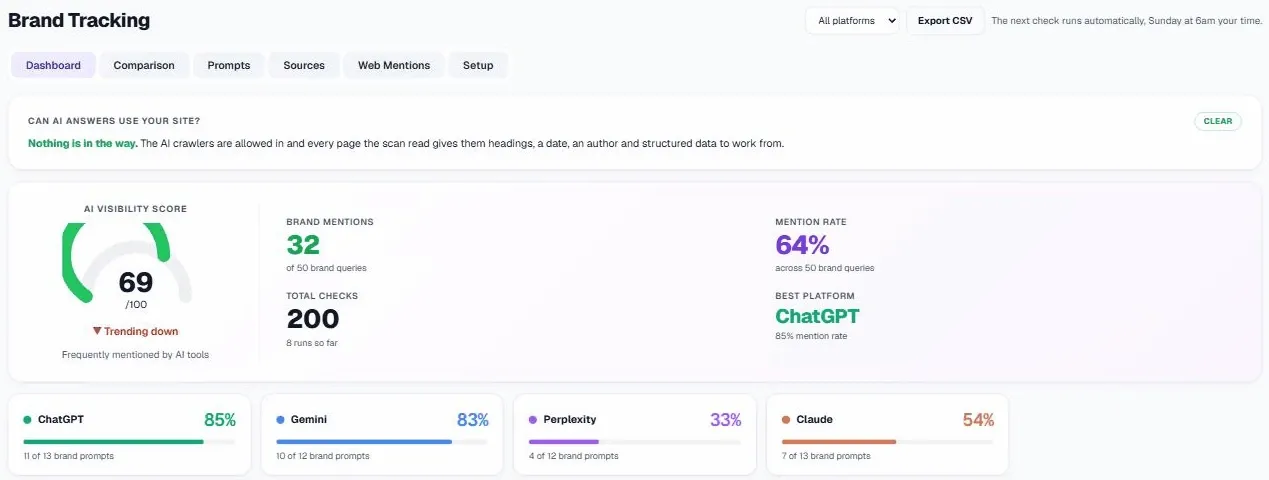
Starting without overthinking it
There is a temptation to over-engineer this. To jump straight into tools and tracking systems. It is better to begin in a more grounded way. Think about the kinds of questions your audience asks when they are trying to understand something, compare options, or make a decision.
Not keyword variations. Real questions. The kind that come up in sales calls, customer conversations, or even your own thinking when you were first learning.
Write a few of them down. Then go and ask those questions inside ChatGPT, Gemini, and Perplexity. Take your time with it. Read the answers properly. Notice what stands out. Are certain brands appearing consistently? Are some answers more confident than others? Do any feel vague or surface-level? You are not just checking for your name. You are starting to see how the space is being shaped.
What patterns start to show
After doing this a handful of times, something shifts. You begin to recognise which brands are being surfaced and why. It is rarely random. The content that tends to get pulled into AI responses often shares a few characteristics. It is clear. It explains things in a way that feels easy to follow. It carries a sense of understanding rather than just information.
There is also a certain confidence in how it is written. Not loud or exaggerated, just assured. This connects closely with how effective writing has always worked. Readers are drawn to what feels relevant and meaningful to them. If a piece of content cannot answer the quiet question of “why should I care?”, it tends to be ignored.
AI systems are not human, but they are trained on human preferences. The same signals of clarity and usefulness still matter.
The role of your content
This is where things become more interesting. It is easy to think about AI visibility as something external. Something is happening outside of your control. In reality, it reflects the quality and shape of what you are already putting into the world.
Content that is written purely to rank often struggles here. It may be structured around keywords, but it lacks the depth or clarity needed to be used as a source.
On the other hand, content that is written with a genuine intention to explain, to guide, or to make something clearer tends to travel further. There is a different energy behind it. Writing like that often feels better to produce as well. When you are engaged in what you are saying, when you are shaping ideas rather than assembling them, the result carries more weight. Writing for pleasure is not about being casual or unfocused. It is about being immersed enough in the process that your voice comes through naturally. That kind of writing is easier for both people and AI systems to understand.
Tracking over time
One search tells you very little. The real value comes from returning to this regularly. Ask the same questions again a week later. Try new variations. Look at different stages of the customer journey. Over time, you start to see movement. Maybe your brand begins to appear in more answers. Maybe competitors become more prominent. Maybe certain topics feel more competitive than others. This is where tracking becomes useful, not as a rigid system, but as a way of noticing change. You are building a picture of your presence in a space that is still evolving.
Where brands tend to go wrong
A common mistake is to treat this like a direct extension of traditional SEO. More content. More optimisation. More output. That approach can work to a point, but it often misses the underlying shift.
AI is not just indexing pages. It is interpreting them. If your content is difficult to follow, overly generic, or trying too hard to appeal to an algorithm, it becomes harder for AI to use it as a source. There is also a tendency to focus only on being mentioned, rather than how you are mentioned. Being included as a passing reference is very different from being positioned as a trusted source. The nuance matters.
A quieter but deeper shift
If you step back from the mechanics of tracking, something more fundamental is happening. Search is moving towards answers that feel complete. Towards responses that reduce effort for the person asking the question.
That changes how trust is built. Instead of competing for clicks, brands are competing to be part of the answer itself. It is a different kind of visibility. Less about being found, more about being chosen.
A simple place to begin
You do not need a perfect framework to get started. Just ask.
Ask the questions your audience cares about. Read the answers carefully. Notice where you stand. There is something valuable in that simplicity. Because once you see it clearly, it becomes much easier to decide what to do next. And more often than not, the answer is not to produce more content.
It is to produce better content. Clearer thinking. More honest explanations. A stronger point of view.The kind of work that earns its place in the answer. In this new environment, visibility is not something you assume based on rankings. It is something you observe, understand, and gradually build. And once you start looking for it, you begin to see just how much is changing.
Frequently asked questions
AI brand visibility refers to how often and prominently your brand is mentioned in AI-generated responses from tools like ChatGPT, Gemini, or Perplexity. This matters because AI is becoming a primary source for specific answers.
- AI responses provide a single, complete answer.
- Brands mentioned in AI gain significant trust and authority.
- It's a new, crucial form of search presence.
- Not appearing means another brand fills that space.
You can effectively begin tracking your AI brand visibility by asking specific, audience-relevant questions in AI tools like ChatGPT, Gemini, and Perplexity. This initial manual exploration provides critical insights.
- Formulate questions your target audience would ask.
- Query these questions in various AI platforms.
- Observe which brands are consistently mentioned or omitted.
- Analyze the role your brand plays in the AI responses.
Yes, AI brand visibility fundamentally differs from traditional SEO rankings because AI tools provide a single, curated answer rather than a list of search results. It's about being cited, not just ranked.
- Traditional SEO focuses on page positions in search results.
- AI visibility means your brand is actively chosen and mentioned within an answer.
- AI doesn't show a list; it forms a comprehensive response.
- Your brand might rank well in Google but be absent in AI.
A lack of mentions in AI responses signals a gap in your AI brand visibility, as AI models may not deem your content authoritative or relevant for citation. Another brand likely fills that void.
- AI algorithms choose trusted and understood sources.
- Your online presence might not be optimized for AI comprehension.
- Competitors might have stronger AI-relevant content or mentions.
- AI doesn't leave gaps; if you're out, someone else is in.
Yes, you can influence your AI brand visibility by ensuring your content is clear, authoritative, and frequently cited across the web, making it more likely for AI models to reference. Consistent, quality content is key.
- Develop highly authoritative and trustworthy content.
- Increase your brand's overall online mentions and citations.
- Focus on answering specific user questions thoroughly.
- Monitor AI responses to identify content gaps and opportunities.
Know what to fix next.
Scan your site for a clearer place to start.
About 30 seconds. No card needed.