

SEO
What Is Keyword Research? A Plain Guide for Small Businesses
Learn what keyword research is, why it matters and how to do keyword research for small businesses in the UK.
Keyword research is the process of identifying and analysing the search terms people use to find information, products or services online. It tells you what phrases to target so that your content matches what users are actually looking for.
Many people think keyword research is only about finding high‑volume terms, but it is far more nuanced. Understanding intent, avoiding common pitfalls and linking the data to other marketing channels can turn a simple list into a powerful growth engine.
What Is Keyword Research and Why It Matters
Keyword research is the foundation of any SEO effort. It reveals the language your audience uses, the questions they ask and the problems they need solved. Without this knowledge, content can miss its target audience and fail to attract traffic.
A mistake beginners make is treating keyword research as a one‑time task. Search behaviour changes, new topics emerge and competitors shift. Continual research keeps your strategy relevant and lets you discover hidden opportunities that others overlook.
How Does Keyword Research Work?
Short‑Tail vs Long‑Tail
Short‑tail keywords are broad, high‑volume terms such as shoes or gardening. They attract many searches but are highly competitive and often lack specific intent. Long‑tail keywords are longer, more precise phrases like water‑proof running shoes for women or how to prune a tomato plant. They have lower search volumes but higher conversion potential because they match a user’s intent more closely.
Google Keyword Planner gives you a range of search volumes for each term, while Google Autocomplete shows real‑time suggestions that reflect current queries. For UK‑based audiences, focus on the UK data set to match local language and spelling variations.
Choosing the Right Keywords
- Start with a core idea – think of the main product, service or topic you want to promote.
- Expand with autocomplete – type the core idea into Google and note the suggestions that appear.
- Filter by relevance – keep only those terms that truly relate to your offering.
- Check search volume – use Keyword Planner to see how many people search for each term in the UK.
- Assess competition – look at the difficulty estimate and the quality of the top pages ranking for the term.
- Prioritise intent – choose terms that match the stage of the buyer journey you want to target (informational, navigational or transactional).
What to Do With the Keyword List
Once you have a list, organise it into themes or topics. Each theme becomes a pillar page that can support several supporting articles. Use a tool that pulls data directly from Google Search Console to see which queries already bring traffic to your site and which are untapped opportunities.
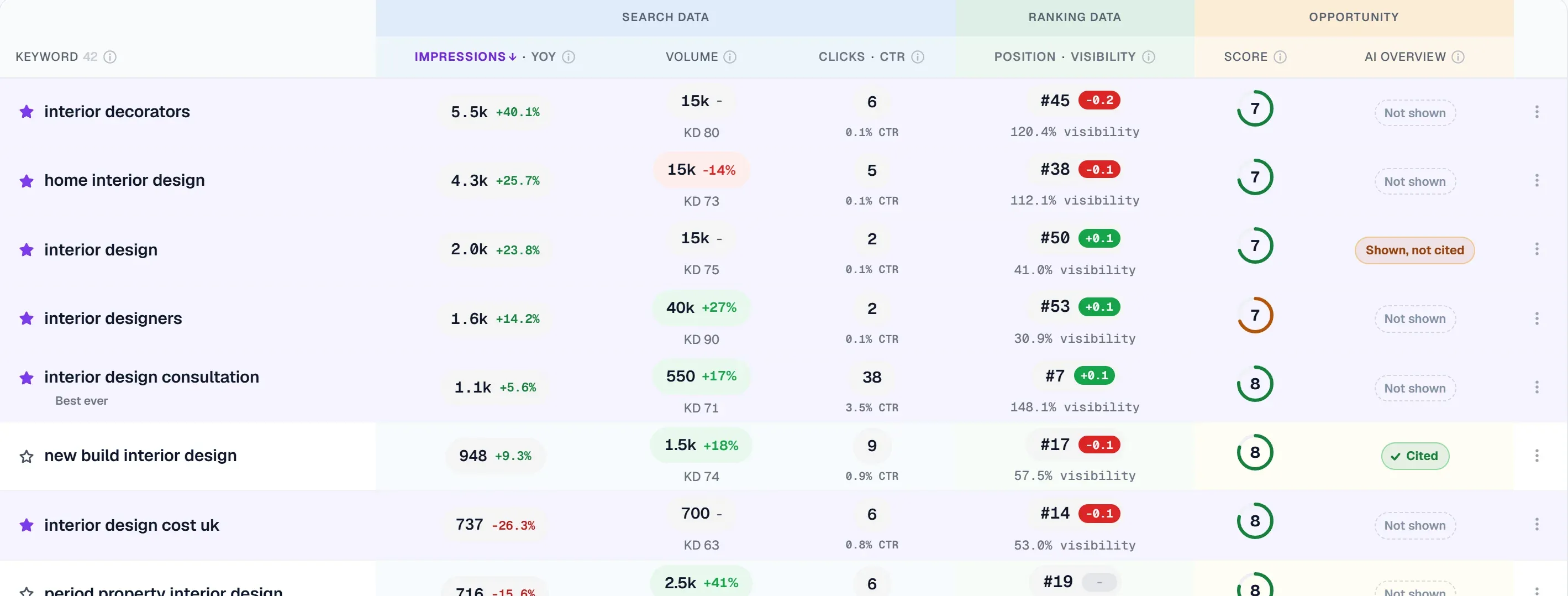 Each tracked keyword with its impressions, search volume, clicks, UK position, opportunity score and AI Overview status, read live from Google Search Console.
These insights let you decide where to focus your content creation and optimisation efforts.
 The diagram demonstrates that effective keyword research groups related terms into clusters and maps each cluster to the most relevant page.
Why Is Keyword Research Important for Small Businesses?
Keyword research shows you what customers are actually searching for, not what you think they should search. It prevents wasted effort on irrelevant topics and helps you write content that answers real questions. By targeting the right terms, you improve your chances of ranking higher in the SERP, attracting clicks and converting visitors into customers.
For small businesses with limited budgets, this focused approach means you can achieve measurable results without spending on broad‑based campaigns that may not convert.
How to Do Keyword Research Step‑by‑Step
- Define your goal – decide whether you want to attract more traffic, increase sales or build brand awareness.
- Collect seed keywords – list 5–10 core terms that describe your main products or services.
- Use Google Autocomplete – type each seed term into Google and copy the suggestions that appear.
- Pull data from Keyword Planner – for each suggestion, note the UK search volume and difficulty estimate.
- Export to a spreadsheet – organise terms by volume, difficulty and relevance.
- Cross‑check with Google Search Console – identify queries that already bring traffic to your site and note their positions and click‑through rates.
- Group by topic – cluster related terms so you can plan pillar pages and supporting posts.
- Prioritise – focus first on medium‑volume, low‑difficulty terms that match your buyer intent.
- Create content – write posts that answer the specific questions behind each keyword, using natural language and incorporating synonyms.
- Track performance – use the free keyword‑tracking feature that pulls daily rank data from Search Console to see how your pages perform over time.
This process can be repeated monthly to keep your keyword strategy fresh.
Which Mistakes Should You Avoid?
- Keyword stuffing – inserting the same term repeatedly in a post can trigger penalties and hurt readability.
- Ignoring user intent – targeting a term without understanding whether the user is looking for information, a product or a service will lower conversion rates.
- Relying solely on volume – high‑volume terms are often too competitive; low‑volume terms can deliver higher ROI.
- Neglecting localisation – UK audiences use different spelling and phrasing; use UK‑specific data to stay relevant.
- Overlooking long‑tail opportunities – long‑tail queries capture users who are closer to purchase and are more likely to convert.
When Will You Know Keyword Research Is Working?
- Improved rankings – your target keywords climb the SERP over weeks or months.
- Higher click‑through rates – the CTR for the pages rises as the meta tags better match the query.
- Increased organic traffic – the volume of visitors coming from search grows.
- Better conversion metrics – more visitors complete the desired action, such as filling a form or making a purchase.
- Lower bounce rates – users find the content relevant to their search and stay longer.
Use the free keyword‑tracking tool that pulls data from Search Console to monitor these indicators daily.
How to Integrate Keyword Research with Other Marketing Channels
The keyword list can feed PPC campaigns by providing high‑intent terms that are likely to convert. Social media posts can be optimised around the same phrases to improve discoverability on platforms that use search. Email subject lines can incorporate popular keywords to increase open rates. By sharing the same vocabulary across channels, you create a consistent brand voice and reinforce relevance to search engines.
What Is the Role of Semantic Search and Intent?
Search engines now favour content that matches user intent rather than just keyword density. Semantic search looks at the context of a query, recognising related concepts and synonyms. When you write content that answers the broader topic, you are more likely to rank for a range of related terms. Incorporating natural language and answering common follow‑up questions helps the page signal relevance to search engines.
Sources
Summary
Keyword research is the act of finding and analysing the words people type into search engines to discover what they need. It moves beyond simple volume figures to include intent, competition and localisation. By following a systematic approach – starting with seed terms, using autocomplete, checking volumes, clustering topics and monitoring performance – small businesses can create content that ranks, attracts the right visitors and drives conversions.
Keyword Tracking: daily rank tracking joined to Google Search Console data.
Perguntas frequentes
What is keyword research is the process of finding the search terms your customers use, helping you attract relevant traffic.
- Reveals language your audience speaks
- Identifies topics with real demand
- Guides content that matches user intent
- Improves SEO rankings and conversions
What is keyword research begins with brainstorming core ideas and using Google Autocomplete to expand them.
- Write down main products or services
- Enter each idea into Google search bar
- Note suggested long‑tail phrases
- Prioritise terms with UK search volume
What is keyword research shows that long‑tail keywords attract more qualified visitors because they reflect specific intent.
- Lower competition than broad terms
- Higher conversion rates
- Easier to rank quickly
- Aligns with buyer’s journey stages
What is keyword research can be performed using free tools like Google Keyword Planner and Google Trends.
- Access basic search volume data
- Discover related queries and seasonality
- Analyse competitor keywords
- Export results for further analysis
What is keyword research is an ongoing activity that must adapt to changing search behaviour and market trends.
- Review keywords monthly
- Update content to match new queries
- Track performance in Search Console
- Adjust strategy based on competitor moves
Saiba o que corrigir a seguir.
Analise o seu site e saiba melhor por onde começar.
Cerca de 30 segundos. Sem cartão.