

SEO
Top 10 Backlink Analysis Tools and Platforms
Uncover the strengths of top backlink analysis tools, providing a detailed look at their features for optimising your off page SEO.
UtilitySEO
UtilitySEO empowers you to uncover critical insights, streamline your workflow, and elevate your website's performance with unparalleled accuracy and ease.
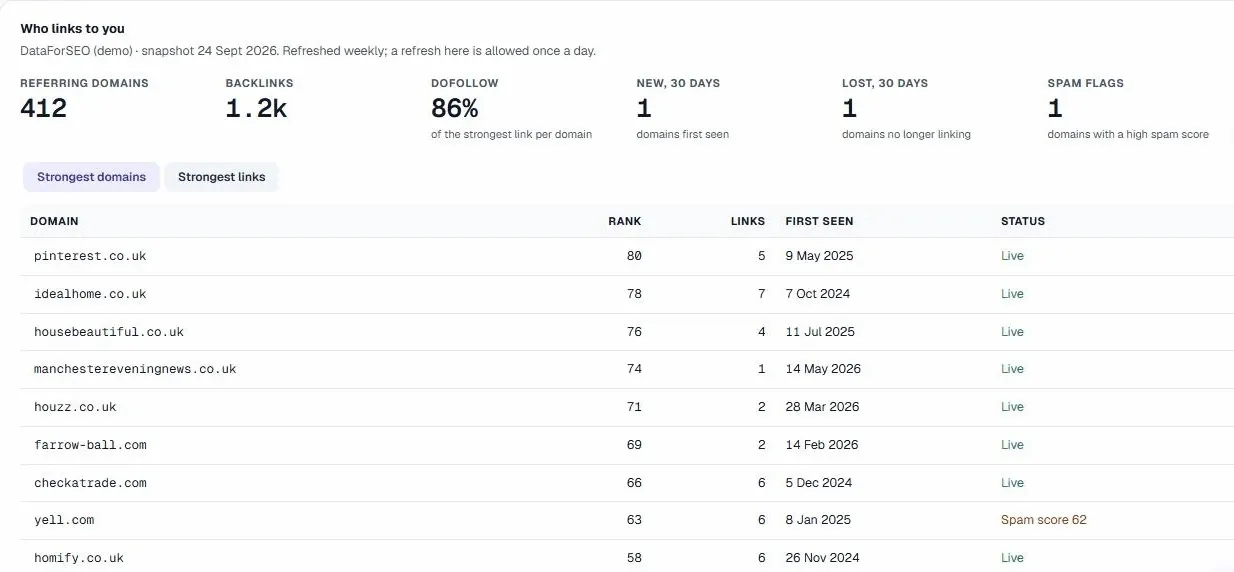 UtilitySEO lists who links to a site: referring domains, the dofollow share, new and lost linking domains, spam flags and the strongest linking domains.
SEMrush
Its functionalities include identifying toxic backlinks, assessing referring domains and IP addresses, and analysing anchor text distribution across various link types. The platform facilitates competitive backlink gap analysis, revealing missed opportunities, and offers a robust link building tool for outreach and monitoring. Users can track new and lost backlinks, evaluating the overall health and authority metrics of a domain's external linking structure, contributing to informed SEO strategy development.
Ahrefs
The platform’s Site Explorer module delivers granular data on referring domains, anchor text profiles, and the distribution of follow versus nofollow links. Users can scrutinise new and lost backlinks, identify broken external links, and perform link intersect analyses to discover common linking domains among competitors. Proprietary metrics such as Domain Rating and URL Rating provide a quantifiable assessment of a domain’s link equity, aiding in strategic link acquisition and disavow file construction.
Moz
The tool facilitates the identification of top linking domains, anchor text variations, and the classification of inbound link types. Users can conduct competitive link comparisons, track new and lost link acquisitions over time, and utilise the Spam Score metric to assess potential link quality issues. Its capabilities extend to analysing linking root domains and subdomains, providing a holistic view of a site’s external link ecosystem.
Majestic
Its core metrics, Citation Flow and Trust Flow, offer distinct perspectives on link volume and quality respectively, aiding in the assessment of a domain’s authority. The platform allows for deep dives into backlink history, identifying new and lost links, and provides detailed anchor text analysis. Topical Trust Flow categorises domains by industry relevance, enabling targeted link prospecting.
SE Ranking
Users can analyse a domain’s full backlink profile, including referring domains, anchor text distribution, and the identification of new or lost links. The tool supports competitive backlink analysis, enabling comparisons against competitor link portfolios to uncover strategic opportunities. It also facilitates the creation and management of disavow files for mitigating the impact of potentially harmful links, offering a pragmatic approach to link profile maintenance.
Serpstat
Its features include the identification of referring domains, analysis of anchor text distribution, and tracking of new and lost backlinks over time. The platform supports competitive backlink comparisons, enabling users to uncover common linking domains and identify outreach opportunities. Data on domain authority, page authority, and link types contributes to a detailed understanding of link equity and potential risks within a site’s external link landscape.
Mangools
LinkMiner allows users to evaluate the strength and relevance of backlinks, identifying referring domains, anchor text, and the presence of broken links. The tool provides insights into the overall link profile of a domain, facilitating competitor analysis and the discovery of high quality link prospects. Its interface is designed for efficient navigation through backlink data, supporting strategic link building and auditing processes.
Ubersuggest
Users can assess the total number of backlinks, referring domains, and the distribution of anchor text. The tool tracks new and lost links, aiding in the ongoing monitoring of link acquisition and attrition. Its functionalities support competitive analysis, allowing users to compare their link profile against those of competitors, identifying patterns and potential opportunities for strategic link building.
Seobility
Users can analyse the full backlink profile of any domain, identifying referring domains, anchor text variations, and the overall quality of inbound links. The platform assists in detecting potentially toxic links and supports the creation of disavow files. Competitive backlink analysis features enable direct comparisons, revealing common link sources and unique opportunities for link acquisition, contributing to a well rounded link building strategy.
Navigating the complexities of backlink analysis requires a robust toolset to gain actionable insights. Each platform offers distinct methodologies and data coverage, providing varied perspectives on link equity and domain authority. Understanding these nuances is crucial for developing an effective SEO strategy. For those seeking to refine their internal processes, exploring our Workflow could provide valuable insights.
Backlink analysis vs competitor backlink analysis
These get used interchangeably and they are different jobs with different outputs, which is worth settling before you choose a tool.
Backlink analysis is auditing your own profile. How many distinct domains link to you, which of those links still exist, which of your pages earn them, and what you lost this quarter. The output is a maintenance list.
Competitor backlink analysis points the same instrument at a rival and asks one question instead: which sites link to them and not to you? The output is a prospect list, and it is the more useful of the two if you are trying to grow rather than maintain.
Any competitor backlink analysis tool will show you far more than that. Their domain rating, their total links, a growth curve. None of it is actionable. The overlap between two rivals' referring domains is, because a site that has already written about two competitors has demonstrated it will write about this category.
How to run a backlink competitor analysis in ten minutes
- Pick two rivals who genuinely outrank you for a query you care about.
- Export referring domains for both. Domains, not links.
- Find the intersection of the two lists.
- Remove any already linking to you.
- Sort by relevance to your subject, then sanity-check each is a real site.
What is left is your outreach list in priority order. This works in any backlink analysis platform, free or paid, because it is set arithmetic rather than index size.
One rule: never compare across two tools. Every backlink index has crawled a different slice of the web. Your count from one tool against a competitor's count from another is meaningless. Inside a single tool the differences cancel.
Perguntas frequentes
Backlink analysis is the process of evaluating a website's incoming links to understand its external link profile and authority, crucial for SEO.
- It assesses link quality and quantity.
- Identifies referring domains and anchor text.
- Uncovers competitor link strategies.
- Essential for improving search engine rankings.
When choosing a backlink analysis tool, look for features like comprehensive link indexing, competitive analysis, and metrics for link quality assessment.
- Deep data on referring domains.
- Ability to track new and lost links.
- Anchor text distribution analysis.
- Spam score or toxicity identification.
Tools like SEMrush and Ahrefs provide extensive data and functionalities to streamline backlink analysis, offering deep insights into link profiles.
- SEMrush identifies toxic links and performs gap analysis.
- Ahrefs offers granular data on referring domains and anchor text.
- Both track new/lost links and assess domain authority.
- Facilitate competitive link comparisons and prospecting.
Yes, backlink analysis is highly effective in identifying harmful or toxic links that could negatively impact your website's search engine rankings and authority.
- Tools like Moz and SE Ranking offer spam scores.
- Helps pinpoint unnatural or low-quality links.
- Essential for creating a disavow file.
- Protects your site from Google penalties.
Key metrics used in backlink analysis to assess link quality include Domain Authority (Moz), Domain Rating (Ahrefs), Citation Flow, and Trust Flow (Majestic).
- Domain Authority/Rating indicates overall strength.
- Trust Flow measures link trustworthiness.
- Citation Flow shows link volume.
- Topical Trust Flow identifies industry relevance.
Saiba o que corrigir a seguir.
Analise o seu site e saiba melhor por onde começar.
Cerca de 30 segundos. Sem cartão.