

SEO
Citation Churn in AI Answers: Why Your Mention Rate Drops Weekly
Understand why AI citations quickly disappear and learn practical strategies to increase your content's longevity in AI answers.
The rise of AI answers has introduced a new challenge for content visibility: AI citation churn. This phenomenon describes the rapid decay of mentions and citations from large language models (LLMs) like ChatGPT, Gemini, Perplexity, and Claude. Businesses often observe their brand or content appearing in AI answers one week, only to find its mention rate drops significantly the next. Understanding this swift turnover is crucial for maintaining digital visibility and ensuring your content continues to be a source for AI models. This blog explores the mechanisms behind this churn and offers practical strategies to enhance citation longevity.
Understanding AI Citation Churn
AI citation churn is the observed rate at which links, facts, and content references disappear from AI generated answers over time. Research indicates a median "AI citation half-life" of approximately 4.5 weeks across various platforms, meaning half of all initial citations are gone within that timeframe. For instance, only about 33% of cited URLs persist for 28 days. This rapid llm mention decay presents a significant hurdle for brand tracking and content strategy. The underlying causes are multi-faceted, involving how AI models are trained, updated, and respond to evolving information.
The Technical Mechanisms Behind Citation Decay
Several technical factors contribute to the rapid disappearance of citations. AI models are continuously refined through processes like model retraining, prompt refinement, and the integration of fresher sources.
Model Retraining: LLMs undergo periodic retraining with updated datasets. When a model is retrained, older information, including specific citations, might be deprioritised or replaced by newer, more relevant content. This can lead to a sudden ai citation drop for previously cited sources.
Prompt Refinement: The algorithms that interpret user prompts and generate answers are constantly being improved. Changes to these algorithms can alter how source material is selected and cited, potentially favouring different types of content or more recent information. This impacts per-prompt trends, causing shifts in which sources are referenced.
Fresher Sources: AI models are designed to provide the most current and accurate information available. As new content is published and indexed, older sources naturally lose their prominence. This continuous prioritisation of fresher sources directly contributes to the ephemeral nature of AI citations. A Google freshness audit can reveal how your content's age compares to query expectations, offering insights into its potential for AI citation.
Strategies to Combat AI Citation Churn
Given the inherent volatility of AI citations, content creators need proactive strategies to maintain visibility. Moving beyond generic advice, specific tactical approaches can help improve the longevity and impact of your mentions.
1. Consistent Content Refresh and Update Cycles
Regularly updating and expanding your existing content is paramount. Instead of creating new content constantly, focus on refreshing high performing pages. Implement a content audit to identify pages that could benefit from updates. For example, a blog post about "SEO best practices" from 2022 will likely be superseded by one from 2024 if not updated. UtilitySEO's scheduled weekly re-crawls and crawl comparison features allow you to monitor changes and ensure your updates are being picked up. The Content decay report helps diagnose why pages are losing traffic, distinguishing between lost rankings, fewer searches, or losing the click, which can inform your refresh strategy.
2. Deepening Topical Authority and Interlinking
AI models often favour sources that demonstrate deep topical authority. This means creating comprehensive clusters of content around specific themes. Instead of isolated articles, build interconnected webs of information. Use internal link recommender tools to identify optimal internal linking opportunities, strengthening the perceived authority of your content. For example, if you have a core guide on "Sustainable Business Practices," link extensively to it from related articles on "Eco-Friendly Supply Chains" and "Renewable Energy Adoption." This internal linking structure helps AI models understand the breadth and depth of your expertise.
3. Emphasising Original Research and Unique Data
Content that presents original research, proprietary data, or unique insights tends to have a longer shelf life and higher citation potential. This type of content is harder to replicate or supersede, making it a more stable source for AI models. Consider conducting industry surveys, publishing unique case studies, or compiling novel data visualisations. Such content provides distinct value that is less susceptible to rapid obsolescence by newer, similar information.
4. Monitoring and Responding to Citation Trends
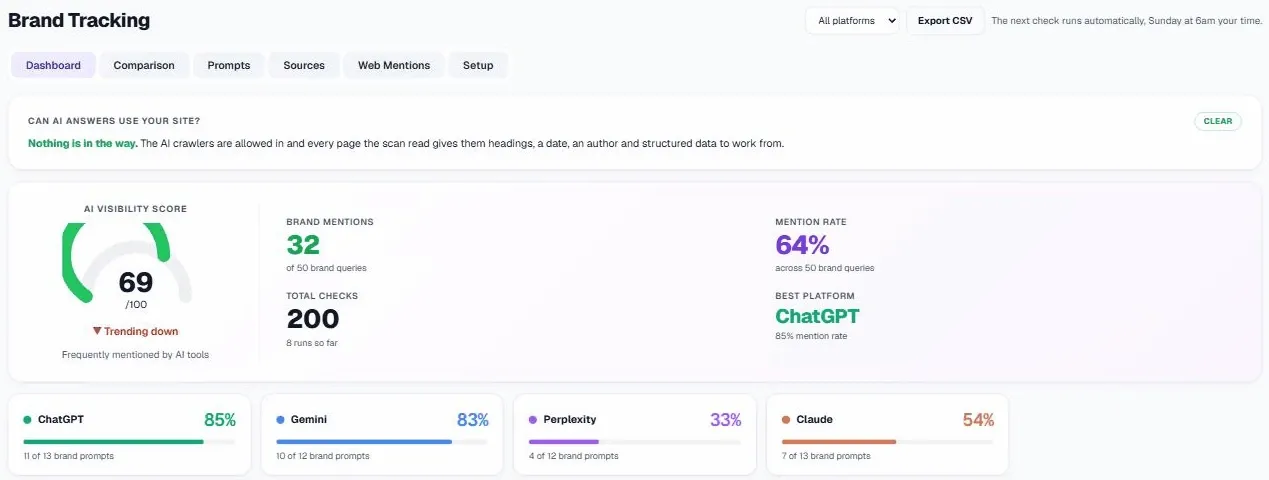
Active monitoring of your brand's presence in AI answers is critical. UtilitySEO offers Brand Tracking, which monitors your mention rate across ChatGPT, Gemini, Perplexity, and Claude. This feature provides a share of voice comparison against competitors and offers sentiment analysis on brand mentions. Importantly, it includes citation churn alerts, notifying you when your mention rate drops. This immediate feedback allows you to diagnose potential causes and adjust your content strategy promptly. Understanding per-prompt trends can also inform your content creation, helping you tailor information to specific AI query patterns.
5. Optimising for AI Training and Crawlability
Ensure your content is easily discoverable and consumable by AI crawlers. While the exact weighting of factors is proprietary, a well structured website with clean code and clear semantic markup is beneficial. Use robots.txt and llms.txt tester tools to verify that your content is accessible to relevant AI crawlers. UtilitySEO's full site crawl and JavaScript rendering ensure that even complex modern websites built with React or Vue are fully scanned, preventing content from being missed by AI training models. Addressing issues like thin content detection and canonical tag audit ensures that valuable content is properly attributed and indexed, increasing its chances of being cited.
UtilitySEO: Your Ally Against AI Visibility Drop
UtilitySEO provides the tools necessary to navigate the complexities of ai visibility drop. Our platform integrates several features designed to help you understand, monitor, and influence your brand's presence in AI answers.
Our Brand Tracking feature provides a clear overview of your mention rate across major LLMs, giving you essential data on your share of voice. When an ai citation drop occurs, our citation churn alerts notify you immediately, allowing for swift action. Furthermore, the ability to track AI referral traffic helps you quantify the real-world impact of your AI mentions.
Beyond monitoring, UtilitySEO helps you optimise. Our content audit identifies areas for improvement, while the internal link recommender strengthens your site's topical authority. For technical readiness, the robots.txt and llms.txt tester ensures your content is accessible to AI crawlers. By providing these insights and tools, UtilitySEO empowers you to develop a more resilient content strategy against the challenges of LLM mention decay.
Conclusion
The dynamic nature of AI answers means that content visibility is no longer a static achievement. AI citation churn is a reality that demands a proactive and adaptive approach. By focusing on consistent content refreshment, building topical authority, creating unique data, actively monitoring AI mentions, and ensuring technical crawlability, businesses can significantly improve the longevity and impact of their content in AI generated responses. UtilitySEO offers the comprehensive toolkit to manage this new frontier of digital visibility, helping you maintain a strong presence where it matters most. Explore our pricing and workflow to see how we can assist your efforts.
Domande frequenti
AI citation churn refers to the rapid disappearance of mentions and content references from AI-generated answers, primarily because AI models are constantly updated and prioritize fresh information.
- AI models undergo periodic retraining with new datasets.
- Prompt interpretation algorithms are continuously refined.
- Newer, more relevant sources are prioritized over older ones.
AI citations often have a short lifespan, with research indicating a median "AI citation half-life" of approximately 4.5 weeks, meaning half of original citations are gone within that period.
- Only about 33% of cited URLs persist for 28 days.
- This rapid decay is a major challenge for brand tracking.
- The rate of disappearance varies across different AI platforms.
Several technical mechanisms contribute to AI citation churn, including model retraining, prompt refinement, and the continuous integration of fresher sources into large language models.
- Model retraining can deprioritize or replace older information.
- Changes in prompt algorithms alter source selection.
- AI models constantly seek and prioritize the most current content available.
To combat AI citation churn, content creators should implement proactive strategies such as consistent content refresh and update cycles to ensure their information remains current and relevant.
- Regularly update and expand existing high-performing content.
- Conduct content audits to identify pages needing updates.
- Focus on providing fresh, accurate information consistently.
Yes, it is still worth tracking AI citations despite their rapid decay because understanding these patterns is crucial for maintaining digital visibility and adapting your content strategy effectively.
- Provides insight into how AI models value your content.
- Helps identify content that resonates with current AI trends.
- Informs strategies for improving content longevity and impact.
Scopri cosa sistemare dopo.
Scansiona il tuo sito per capire meglio da dove iniziare.
Circa 30 secondi. Nessuna carta richiesta.