

SEO
Crawl Depth: When 4 Clicks From Homepage Becomes a Ranking Problem
Learn how crawl depth affects SEO rankings, with advanced strategies for large websites and how UtilitySEO helps identify and fix deep pages.
Crawl depth, also known as click depth, measures the number of clicks required to reach a specific page from the homepage. A page with a crawl depth of zero is the homepage itself. For search engines, this metric significantly influences how easily and frequently pages are discovered and indexed. Pages located many clicks deep within a site often receive less attention from crawlers, impacting their visibility and potential to rank. Understanding and optimising crawl depth SEO is crucial for ensuring all valuable content is discoverable. This post explores the implications of deep pages and offers strategies for improving site architecture, especially for large and complex websites.
Understanding Crawl Depth and its SEO Impact
Crawl depth directly affects a search engine's ability to discover and index content. Googlebot and other crawlers allocate a specific crawl budget to each site. Pages that are many clicks away from the homepage consume more crawl budget to reach, potentially leading to important content being overlooked. A common guideline suggests that critical pages should be within three clicks of the homepage. This ensures they are frequently crawled and considered important by search engines. When pages are five or more clicks deep, their chances of ranking significantly diminish, often correlating with a noticeable ranking loss.
For example, an e-commerce site with millions of product pages faces unique challenges. While a small blog might easily keep all posts within three clicks, a large retailer cannot. Product pages buried under multiple category and subcategory layers can become deep pages, struggling for visibility despite containing valuable unique content. This situation highlights why a blanket "three clicks" rule is often impractical for very large sites. The issue is not just about indexing; it also signals to search engines the relative importance of a page. Deep pages often appear less important.
Advanced Strategies for Large Websites
Managing crawl depth on extremely large websites requires more sophisticated strategies than simply flattening the entire site. For sites with millions of products or extensive archives, a pragmatic approach is necessary. Prioritise internal linking to ensure high value pages, even if they are not product pages, are within three or four clicks. This could involve dynamically linking popular products or articles from category pages or even the homepage. A well organised information architecture becomes paramount.
Consider the role of internal search. While not a direct linking mechanism for crawlers, a robust internal search can guide users to deep pages. More importantly, it can reveal user intent and popular deep content. This data can then inform internal linking adjustments. For large content hubs, implementing a clear hub and spoke model can reduce click depth. Hub pages link to numerous related spoke pages, which then link back to the hub, establishing a strong internal link profile for the entire cluster.
JavaScript Rendering and Crawl Depth
Modern web technologies, particularly JavaScript rendering in single page applications (SPAs) like React or Vue, introduce additional complexities for crawl depth SEO. Search engines like Google are adept at rendering JavaScript, but the process is resource intensive. If internal links are primarily generated client side via JavaScript, crawlers must fully render the page to discover those links. This can slow down discovery and increase the effective crawl depth if the rendering process itself delays the identification of internal links.
UtilitySEO addresses this challenge with its JavaScript rendering feature, which uses real Chromium to scan sites. This ensures that React and Vue sites are not scanned as empty shells. Instead, UtilitySEO processes them as a browser would, accurately discovering all internal links and calculating the true crawl depth. This precise measurement is essential for identifying deep pages that might be overlooked due to client side rendering. Without accurate JavaScript rendering, a page that appears to be two clicks deep in the HTML could, in reality, be four or five clicks deep from a crawler's perspective if its parent links are JavaScript dependent.
UtilitySEO's Role in Identifying and Fixing Deep Pages
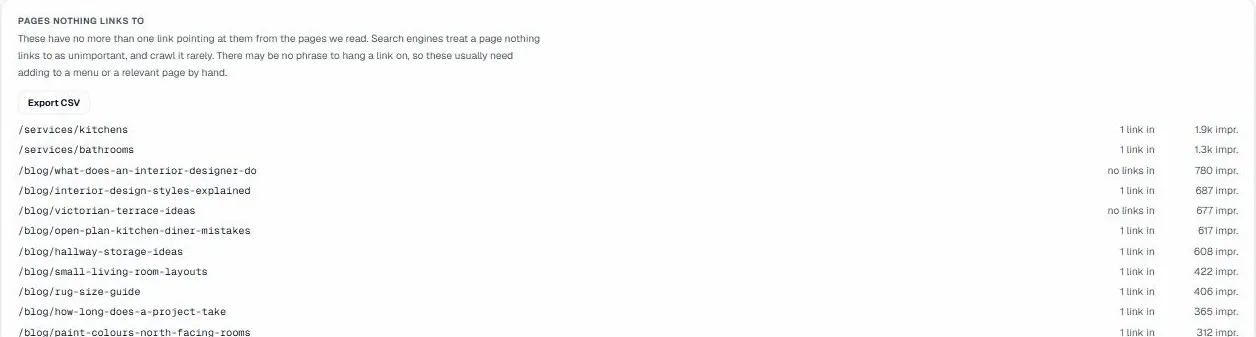
UtilitySEO provides specific tools to analyse and manage crawl depth effectively. The crawl depth analysis feature precisely measures the click distance from the homepage for every page on your site. This allows you to quickly identify deep pages that might be struggling for visibility. Combined with orphan page detection, which flags pages with no internal links, you gain a comprehensive view of your site's internal linking health. Orphan pages are effectively infinite clicks deep as they are unreachable.
Our platform also offers a deep page audit and quick page check, enabling you to focus specifically on pages that are far from the homepage. For any identified issues, the Fix Guides provide plain English how to guides. For more technical fixes, the Fix with AI feature generates code solutions. Understanding where your deep pages are and why they are deep is the first step towards improving information architecture. UtilitySEO helps you visualise this structure and pinpoint areas for improvement, directly correlating with potential ranking loss data. The scheduled weekly re-crawls and crawl comparison features allow you to monitor changes in crawl depth over time and assess the impact of your optimisations. You can also use the sitemap audit to ensure your sitemap accurately reflects your site structure and aids crawler discovery.
Conclusion
Effective management of crawl depth SEO is fundamental for ensuring search engine visibility, especially for large and complex websites. While the "three clicks from homepage" rule serves as a good guideline, advanced strategies are needed for sites with extensive content. Tools like UtilitySEO provide the necessary insights and capabilities to accurately measure crawl depth, identify deep pages, and implement targeted improvements to your site's information architecture. By understanding how crawl depth correlates with ranking loss and addressing these structural issues, you can enhance the discoverability and performance of your entire website. Explore UtilitySEO's features to gain control over your site's crawl depth and improve your organic search presence.
Questions fréquentes
Crawl depth directly impacts how easily and frequently search engines discover and index your pages, with deeper pages often receiving less attention, which can negatively affect their SEO rankings.
- Pages many clicks deep consume more crawl budget.
- Critical content should ideally be within three clicks of the homepage.
- Very deep pages (five+ clicks) often see diminished ranking chances.
- It signals less importance to search engines.
A good crawl depth for important pages is typically considered to be within three clicks of the homepage, ensuring search engines frequently crawl and prioritize them.
- Homepage has a crawl depth of zero.
- Key content benefits from being shallow.
- Deeper pages require more crawl budget.
- This helps signal page importance to crawlers.
Your crawl depth SEO can be a problem on large e-commerce sites because millions of product pages are often buried under multiple category layers, making them difficult for crawlers to discover and index efficiently.
- Large sites struggle to keep all pages shallow.
- Product pages can become very deep.
- Valuable content might be overlooked by crawlers.
- This reduces visibility despite unique content.
You can improve crawl depth for a very large website by strategically prioritising internal linking to ensure high-value pages are within three or four clicks from the homepage.
- Use dynamic linking for popular content.
- Implement a clear hub and spoke model.
- Focus on robust information architecture.
- Leverage internal search data to inform linking.
Yes, JavaScript links can affect crawl depth for SEO because search engines must fully render the page to discover client-side generated links, which is a resource-intensive process that can slow down discovery.
- SPAs use JavaScript for internal links.
- Rendering JavaScript consumes crawl budget.
- Slow rendering can delay link discovery.
- Ensure JavaScript links are crawlable.
Sachez quoi corriger ensuite.
Analysez votre site pour savoir clairement par où commencer.
Environ 30 secondes. Sans carte bancaire.