

SEO
Top 10 Google Rank Tracking Keywords Tools and Platforms
Explore how leading rank tracking platforms approach Google keyword monitoring, and determine which solution aligns with your organisational needs and...
UtilitySEO
UtilitySEO equips you with enterprise-grade rank tracking that goes far beyond basic keyword monitoring, integrating Google Search Console data with comprehensive SEO auditing and analytics in a single intuitive platform. By combining real-time keyword performance tracking with technical site audits and traffic forecasting, you gain complete visibility into how your rankings drive actual business results. This unified approach eliminates the need for juggling multiple tools, saving time whilst delivering the actionable insights needed to outrank competitors.
- Keyword tracking with GSC integration: Monitor your rankings powered directly by Google Search Console data, capturing impressions and clicks for each keyword alongside position changes. Group related keywords together and instantly see which queries drive the most valuable traffic to your site.
- Device and country performance breakdown: View how your rankings vary across different devices and geographic markets, allowing you to identify regional opportunities and optimise for mobile versus desktop search intent separately.
- SEO results dashboard: Receive a comprehensive score of your site's overall health along with categorised technical issues and clear fixes. The built-in lightbulb tips guide you towards the highest impact improvements you can make.
- Full site scanning with history: Crawl up to three hundred pages of your site via sitemaps and internal links, with server-side processing that captures the complete picture. Revisit previous scans anytime to track your progress and celebrate improvements over time.
- Traffic forecasting by keyword: Leverage your tracked keywords to forecast future organic traffic trends, helping you predict the business impact of your SEO efforts and prioritise optimisation efforts with confidence.
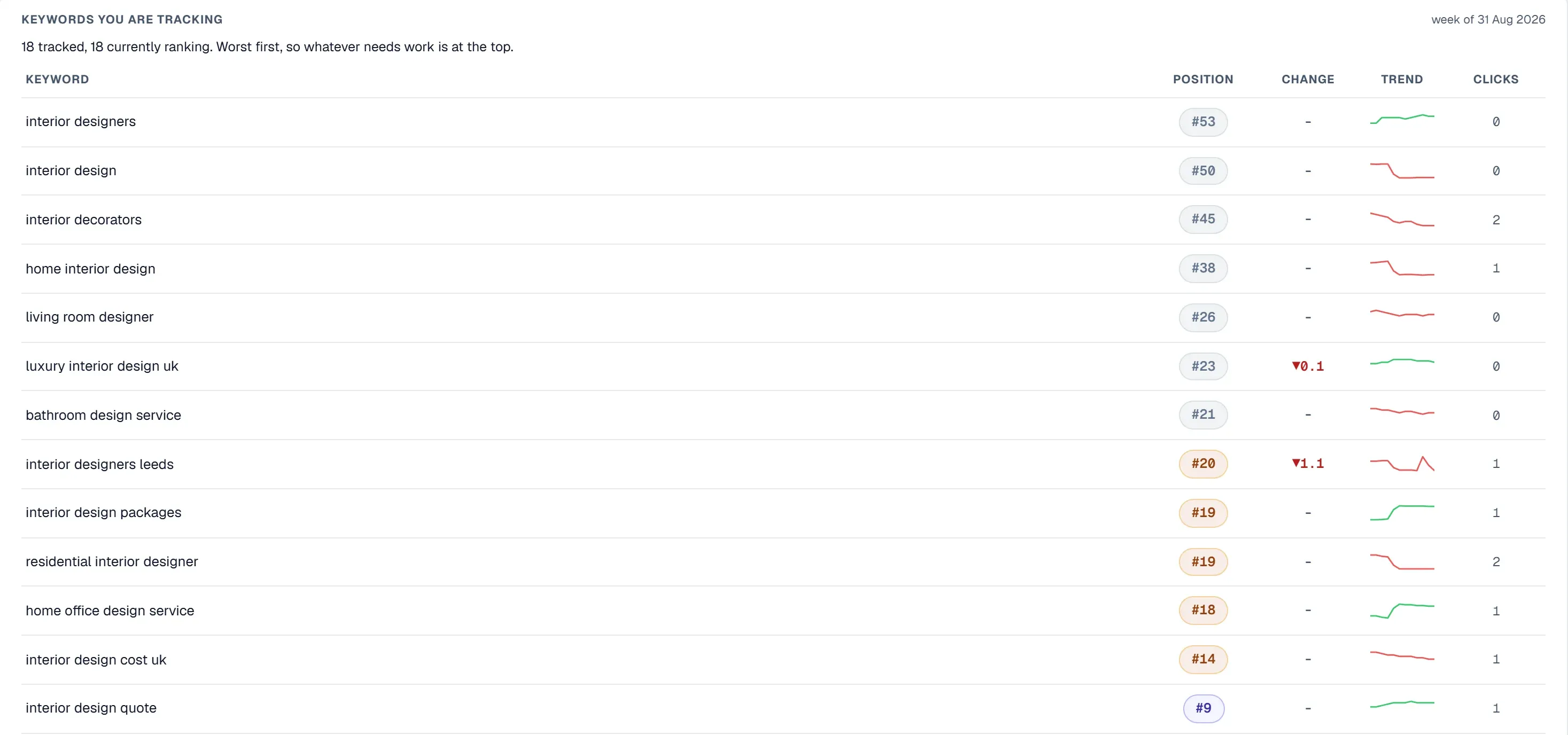 Tracked keywords with their position, change, a trend sparkline and clicks, worst first.
SEMrush
The tool aggregates keyword position data across multiple search engines and localised SERPs, leveraging historical data to forecast ranking volatility. However, the platform's complexity necessitates substantial onboarding investment, and pricing structures favour large agencies rather than SMEs. Whilst the reporting interface offers granular segmentation capabilities, the underlying infrastructure relies on proprietary tracking methodologies that may diverge from actual organic search behaviour in certain vertical markets.
Ahrefs
The platform's keyword ranking data derives from a proprietary bot that crawls SERPs at designated intervals, capturing position fluctuations and search volume estimates. Integration with their broader toolset creates data silos when isolated rank tracking analysis is required. The subscription model assumes consistent usage across multiple feature sets, potentially inflating costs for organisations focused exclusively on positional monitoring rather than comprehensive SEO auditing workflows.
Moz
The platform's tracking infrastructure exhibits occasional latency in capturing volatile ranking movements, particularly within competitive niches where fluctuations occur intraday. Their local search ranking capabilities remain limited compared to geolocation-intensive verticals, and the tool lacks sophisticated alert mechanisms for unexpected ranking deterioration without excessive manual configuration.
SE Ranking
The platform tracks keyword positions across multiple regions and devices, though its accuracy in detecting micro-fluctuations remains inferior to enterprise solutions. Integration capabilities with third-party tools are constrained, limiting workflow automation for teams requiring streamlined data pipelines. The reporting interface prioritises simplicity over customisation depth, potentially frustrating organisations with complex ranking analysis requirements.
Serpstat
The platform's tracking methodology incorporates mobile-specific ranking data and featured snippet attribution, addressing contemporary search dynamics. However, the user experience suffers from cluttered interface design, and the knowledge base lacks comprehensive documentation for advanced functionality. Pricing transparency remains obscured by tiered subscription models that don't clearly delineate tracking-specific feature allocation.
Google Search Console
Google Search Console provides fundamental impression and click data without direct ranking position visibility, requiring manual SERP inspection or supplementary tools to establish positional authority. The platform's historical data window extends only ninety days, constraining longitudinal analysis of ranking trends across seasonal fluctuations. Integration with Google Analytics creates dependencies on the Google ecosystem, limiting portability for organisations utilising alternative analytics platforms. Whilst cost-free access appeals to budget-constrained entities, the absence of predictive analytics and automated alerting mechanisms necessitates reactive rather than proactive ranking management.
Rank Math
Tracking capabilities remain localised to the installed WordPress instance, creating data fragmentation for multi-domain portfolios. The plugin's reliance on API-dependent data sources creates vulnerability to upstream service interruptions and rate-limiting constraints.
Screaming Frog
The tool's architecture prioritises on-site crawling and page-level analysis rather than SERP position tracking, creating contextual misalignment for teams prioritising ranking intelligence. Integration between on-site data and positional metrics remains manual and labour-intensive, potentially introducing analytical drift. The licensing model favours periodic technical audits rather than continuous ranking surveillance.
Sitebulb
The platform's positional data derives from external rank tracking APIs rather than proprietary SERP capture methodologies, introducing latency and potential data inconsistencies. Workflow integration emphasises prioritising crawl issues over ranking factors, potentially misdirecting remediation efforts for organisations facing purely algorithmic ranking challenges rather than technical impediments. The tool's strength lies in structural SEO rather than competitive positional intelligence.
Conclusion
Each platform approaches Google rank tracking with distinct methodologies, cost structures, and ancillary feature integration. Rather than identifying an universal optimal solution, successful rank tracking strategy depends upon organisational maturity, budget allocation, and whether positional monitoring represents the primary use case or a supplementary intelligence stream within broader SEO workflows. Determining your optimal approach requires mapping internal team capabilities against tracking frequency requirements and competitive intelligence depth.
If you are choosing software rather than comparing the field, monitor search engine rankings goes into the buying decision in more detail.
Further reading
Preguntas frecuentes
Google rank tracking keywords monitors your website's search engine positions for targeted keywords over time. This reveals whether your SEO efforts improve visibility and organic traffic performance.
- Identifies which keywords drive qualified traffic to your site
- Tracks ranking progress across devices and geographic locations
- Reveals competitor positioning and market opportunities
- Guides SEO prioritization based on business impact
Rank tracking frequency depends on your industry volatility, keyword competitiveness, and resource availability. Most businesses benefit from daily or weekly tracking for priority keywords.
- Daily tracking recommended for competitive, high-value keywords
- Weekly tracking sufficient for stable, established rankings
- Less frequent tracking saves costs for lower-priority keywords
- Adjust frequency based on algorithm update cycles and market changes
Google rank tracking keywords tools complement Search Console but serve different purposes. Search Console shows actual data; rank trackers estimate positions and provide historical trends.
- Search Console reveals true impressions, clicks, and CTR data
- Rank trackers offer historical tracking and competitive analysis
- Combined approach provides complete visibility and actionable insights
- Integrate both platforms for comprehensive SEO performance monitoring
Google rank tracking keywords ROI depends on measuring traffic impact and conversion attribution rather than position alone. Focus on keywords driving qualified business results.
- Track keywords connected to revenue-generating pages
- Monitor organic traffic volume and conversion rates together
- Prioritize keyword clusters that capture buyer intent
- Forecast traffic impact before investing optimization time
Google rank tracking keywords is essential for small businesses to measure SEO progress and justify marketing investment. Start with essential keywords before expanding tracking.
- Begin with top 20-50 keywords aligned to business goals
- Track monthly or weekly based on budget and resources
- Focus on long-tail, lower-competition keywords for quick wins
- Use free or affordable tools before upgrading to enterprise platforms
Selecting google rank tracking keywords tools requires evaluating integration capabilities, pricing, reporting depth, and whether your tracking needs justify enterprise-grade complexity.
- Assess whether you need standalone tracking or integrated SEO platform
- Compare pricing models: per-keyword, monthly subscriptions, or agency discounts
- Test free trials focusing on usability, data accuracy, and reporting
- Prioritize GSC integration and historical data availability for your use case
Sabe qué arreglar a continuación.
Analiza tu sitio y ten más claro por dónde empezar.
Unos 30 segundos. Sin tarjeta.