

SEO
Cannibalisation Cluster Analysis: Reading the GSC Data Pattern
GSC cluster analysis helps SEO professionals detect content cannibalisation and refine content strategy by grouping related search queries.
Understanding how Google interprets your content is crucial for SEO success. GSC cluster analysis offers a powerful method to achieve this. It involves grouping related search queries from Google Search Console (GSC) to reveal patterns in user intent and Google's routing of queries to specific pages. This approach is vital for identifying content cannibalisation, optimising underperforming pages, and refining your overall content strategy. By examining these clusters, SEO professionals can gain deeper insights into their site's performance and make data driven decisions.
What is Cluster Analysis in SEO?
Cluster analysis, in a general sense, is a statistical technique used to group a set of objects in such a way that objects in the same group, or cluster, are more similar to each other than to those in other groups. In SEO, specifically with GSC data, this means taking thousands of individual search queries and grouping them into thematic clusters. Each cluster represents a common user intent or topic. This process moves beyond simply looking at individual keywords to understanding the broader topics and subtopics your content addresses. Different clustering algorithms exist, such as K means or hierarchical clustering, each with suitability depending on the data's complexity and the desired outcome. For GSC keyword cluster data, algorithms that can handle high dimensionality and uncover semantic relationships are often preferred.
The Power of GSC Cluster Analysis for SEO
GSC cluster analysis provides significant benefits for various SEO roles. For content marketers, it identifies content gaps and informs future content creation by revealing underserved topics. SEO specialists use it to diagnose performance issues, such as pages competing for the same queries or pages ranking for irrelevant terms. Data analysts can leverage the insights to build more sophisticated models for predicting content performance.
A key benefit is the ability to detect cannibalisation detection. When multiple pages on your site rank for the same or very similar queries, Google struggles to determine the most authoritative page. This dilutes ranking power and can lead to lower overall visibility. GSC cluster analysis clearly shows which page Google routes each query to. When a single query cluster maps to several different URLs, it is a strong signal of cannibalisation.
Another insight is the identification of content opportunities. Queries that appear in clusters but are not adequately addressed by existing content represent clear areas for new articles or page updates. Conversely, pages attracting a wide range of disparate queries might indicate a need to split content or create more focused pages. This process helps refine your page query mapping, ensuring each page serves a distinct and valuable purpose.
Performing GSC Data Analysis with UtilitySEO
UtilitySEO streamlines the complex process of GSC data analysis and cluster detection GSC. Our platform integrates directly with Google Search Console, pulling in keywords, pages, positions, clicks, impressions, and CTR data. This foundational data then undergoes sophisticated processing to identify keyword clusters.
The platform's Keyword clusters feature automatically groups topics by which page Google routes each query to. This direct mapping is invaluable for pinpointing cannibalisation. For instance, if a cluster of queries related to "best running shoes" shows impressions for both your main product category page and a specific blog post review, UtilitySEO flags this potential overlap. The Cannibalisation detection feature specifically highlights pages competing for the same query, making it easy to see where your internal content is working against itself.
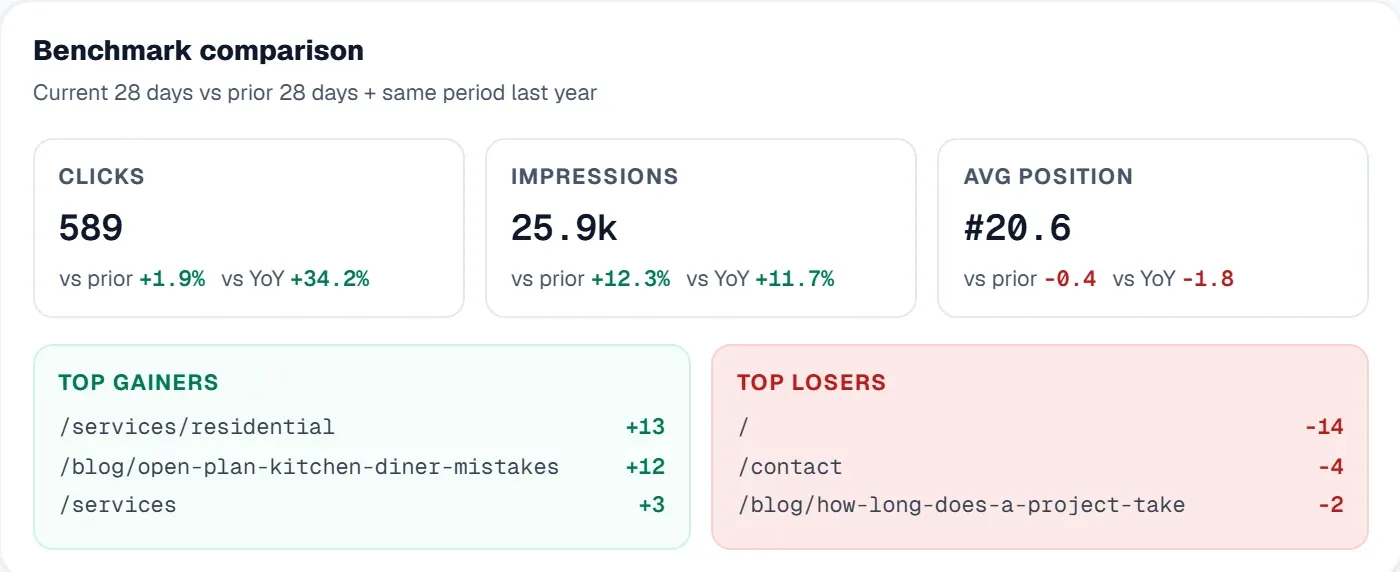
UtilitySEO also offers Untracked keyword discovery, identifying GSC queries not yet in your tracked set, which can then be added with one click for ongoing monitoring. This ensures your cluster analysis is always based on the most comprehensive data. For deeper dives, our Content Opportunities feature ranks striking distance and low CTR pages by real upside, helping you prioritise optimisation efforts based on cluster insights. The platform's ability to show year on year comparison for performance allows you to track the impact of your cluster based optimisations over time.
Real World Application: Resolving Content Cannibalisation
Consider an e commerce site selling outdoor equipment. Their GSC data shows a cluster of queries around "waterproof hiking boots". However, this cluster is sending traffic to three different pages: a product category page, a blog post reviewing specific models, and a general guide on choosing hiking boots. This is a classic case of cannibalisation.
Using GSC cluster analysis, the SEO team identifies this pattern. They then decide to consolidate the information. The product category page is optimised to be the primary target for transactional "buy waterproof hiking boots" queries. The blog post is updated to focus on comparative reviews, linking strongly to the category page and specific products. The general guide is refocused on educational content like "how to care for hiking boots", providing internal links to both the product category and the review post. By clarifying the intent of each page within the "waterproof hiking boots" cluster, they improve the page query mapping, leading to higher rankings and better conversion rates for the intended pages. This strategic adjustment is directly informed by the insights gained from detailed GSC data analysis.
Conclusion
GSC cluster analysis is an essential technique for any SEO professional seeking to understand their site's performance at a deeper level. It moves beyond individual keywords to reveal the thematic relationships between queries and content, providing clear pathways to improve content strategy and resolve issues like cannibalisation. By leveraging tools like UtilitySEO, you can automate much of this complex analysis, gain actionable insights into your GSC keyword cluster data, and make informed decisions that drive organic growth. Explore how UtilitySEO can transform your GSC data analysis and optimise your site's performance.
Domande frequenti
GSC cluster analysis is an SEO technique that groups related search queries from Google Search Console to identify patterns in user intent and how Google routes queries to specific pages.
- It helps understand broader topics your content addresses.
- Moves beyond individual keyword analysis.
- Essential for optimising content strategy and performance.
You can use GSC cluster analysis to find content cannibalisation by identifying instances where a single cluster of search queries maps to several different URLs on your website.
- Google struggles to determine the most authoritative page.
- Dilutes ranking power and overall visibility.
- Strong signal to consolidate or differentiate content.
For content marketers, GSC cluster analysis helps identify content gaps, informs future content creation, and reveals underserved topics that represent clear areas for new articles or page updates.
- Pinpoints content opportunities.
- Refines page-query mapping.
- Ensures each page serves a distinct purpose.
Yes, GSC cluster analysis can significantly improve your site's search visibility by helping you diagnose performance issues, identify content gaps, and refine your overall content strategy.
- Optimises underperforming pages.
- Ensures content aligns with user intent.
- Leads to better ranking and traffic.
Scopri cosa sistemare dopo.
Scansiona il tuo sito per capire meglio da dove iniziare.
Circa 30 secondi. Nessuna carta richiesta.